

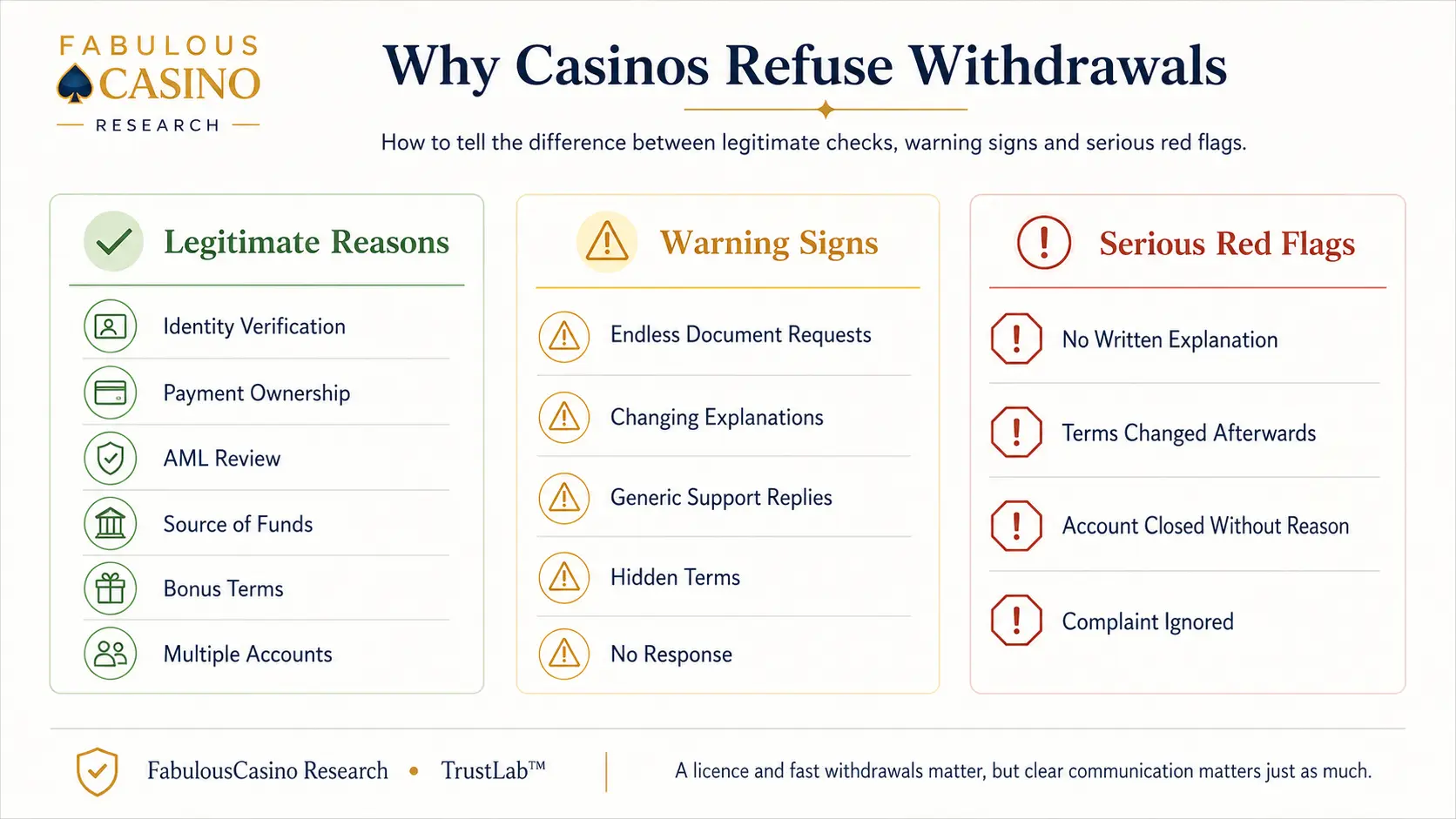
1. Identity Verification Has Not Been Completed
The vast majority of withdrawal issues begin with identity verification.
Licensed casinos are required to confirm that customers are who they claim to be. Depending on the jurisdiction and the player’s activity, operators may request:
- Government-issued photo identification
- Proof of residential address
- A selfie or live verification
- Confirmation of payment method ownership
Many players believe verification only becomes necessary after winning.
In reality, many operators are legally required to verify customers before allowing continued gambling or before releasing withdrawals.
2. Payment Method Ownership Cannot Be Confirmed
Casinos generally expect withdrawals to return to the same payment source whenever possible.
Problems often arise when:
- someone else’s card was used;
- an expired payment method must be replaced;
- multiple payment methods were used;
- digital wallets cannot be linked to the account holder.
These situations usually require additional documentation before payments can continue.
This is not necessarily an attempt to delay payment—it is often a regulatory obligation.
3. Bonus Terms Have Been Violated
Bonus disputes remain one of the most common causes of refused withdrawals.
Typical examples include:
- maximum bet violations;
- incomplete wagering;
- excluded games;
- multiple bonus accounts;
- using restricted payment methods;
- bonus abuse patterns.
Some casinos enforce these rules consistently.
Others rely on vague wording that leaves players uncertain about what constitutes a breach.
For that reason, FabulousCasino evaluates not only the existence of bonus restrictions, but also whether they are clearly written, easy to understand and applied consistently.
A complicated bonus policy is not automatically unfair.
A confusing one often is.
4. Multiple Accounts
Most casinos permit only one account per individual—and frequently only one account per household.
Duplicate accounts may result from:
- creating a second profile after forgetting login details;
- family members sharing devices;
- shared internet connections;
- shared payment methods;
- attempts to claim multiple welcome bonuses.
Operators are generally entitled to investigate duplicate accounts before releasing funds.
However, players should always receive a clear explanation of the findings rather than a generic statement that “multiple accounts were detected.”


5. Suspicious Financial Activity
Casinos licensed in regulated markets must monitor transactions for signs of money laundering and financial crime.
Reviews may be triggered by:
- unusually large deposits;
- rapid deposits followed by immediate withdrawals;
- inconsistent betting behaviour;
- sudden changes in spending patterns;
- transactions involving multiple payment sources.
These reviews are rarely visible to the player.
Instead, the withdrawal simply remains pending while additional checks take place.
Although frustrating, these reviews exist because operators have legal obligations beyond ordinary customer service.
6. Source of Funds Reviews
Higher-value customers increasingly encounter Source of Funds requests.
This process aims to establish where gambling funds originated.
Depending on the circumstances, casinos may ask for:
- employment income;
- business income;
- investment returns;
- inheritance documentation;
- property sale records;
- savings statements.
Many players consider these requests intrusive.
From a regulatory perspective, however, they have become an increasingly important component of anti-money laundering compliance.
The key question is proportionality.
Requesting extensive financial documentation for a relatively small withdrawal deserves closer scrutiny than requesting similar documentation for significantly larger transactions.
When Casinos Are Usually Acting Reasonably
One of the biggest mistakes players make is assuming that every withdrawal review is evidence of dishonest behaviour.
In reality, many investigations are entirely legitimate.
Examples include:
- verifying identity before releasing funds;
- confirming ownership of payment methods;
- checking compliance with published bonus terms;
- reviewing unusually large transactions;
- complying with anti-money laundering regulations;
- investigating duplicate accounts.
These actions protect both the casino and its customers.
Professional operators explain these procedures clearly and apply them consistently.
The review itself is rarely the problem.
Poor communication usually is.

Welcome Bonus
100% up to €1,000 + 300 Free Spins


Full T&Cs apply. 18+. New Casino players only. First Deposit: 100% up to 1000 EUR / CAD / AUD / NZD + up to 300 FS on Gates of Olympus 1000 by Pragmatic Play
When Players Should Become Concerned
Not every delay deserves suspicion.
Some absolutely do.
The following warning signs deserve closer attention.
🚩 Red Flag 1: Endless Document Requests
Perhaps the most common complaint among players involves what appears to be an endless verification process.
A player submits:
Passport.
The casino requests proof of address.
The player submits proof of address.
The casino requests a payment screenshot.
That is provided.
Several days later another request arrives.
Then another.
Then another.
Sometimes additional documentation is genuinely required.
But when requests continue indefinitely without explanation, players are justified in asking why every requirement was not communicated at the beginning.
Professional verification follows a structured process.
Poor verification often appears improvised.
🚩 Red Flag 2: The Explanation Keeps Changing
Consistency matters.
Consider the following example.
Monday
“We’re reviewing your withdrawal.”
Wednesday
“There may be a bonus issue.”
Friday
“We require another identity document.”
Next Tuesday
“The payment department is still investigating.”
When explanations continually change, confidence naturally decreases.
A professional operator should be able to identify the primary reason for a review and communicate it clearly.
🚩 Red Flag 3: Nobody Takes Ownership
Large support departments sometimes create a frustrating cycle.
Live chat refers the player to email.
Email refers the player to another department.
The payment department never responds.
Eventually, every conversation begins again from the beginning.
While delays happen, players deserve a single, consistent point of communication whenever significant withdrawals are under review.
🚩 Red Flag 4: Published Terms Suddenly Become Flexible
One of the strongest indicators of poor operational practice is inconsistent application of the Terms & Conditions.
Examples include:
- applying rules that cannot reasonably be found in published terms;
- interpreting vague language differently from previous communications;
- introducing explanations that appear nowhere in the documented rules.
Whenever possible, players should politely request the exact clause that supports the casino’s decision.
Clear operators have no difficulty providing it.
🚩 Red Flag 5: Support Stops Responding
Silence is rarely reassuring.
If multiple polite requests over a reasonable period receive no meaningful response, escalation becomes increasingly appropriate.
Professional casinos may require time to investigate.
They should not disappear.
What FabulousCasino Looks For
When reviewing online casinos, we deliberately look beyond withdrawal speed.
A casino earning a strong TrustLab™ rating demonstrates several characteristics:
✓ Clear verification procedures
✓ Consistent communication
✓ Transparent withdrawal policies
✓ Published complaint process
✓ Reasonable documentation requests
✓ Consistent application of Terms & Conditions
✓ Professional support during difficult cases
Players rarely remember the casino that paid them quickly.
They remember the casino that treated them fairly when something went wrong.
Read also:

Enrico Braunschweig
Founder
Enrico Braunschweig is the Founder of FabulousCasino and a long-time entrepreneur in the digital marketing and iGaming industry. With nearly two decades of experience in affiliate marketing, online casino acquisition, and SEO-driven publishing, he focuses on building trusted gaming brands with a strong emphasis on transparency, product quality, and long-term player value.