

Most Withdrawal Problems Are Not Scams
Few situations create more frustration than seeing a large withdrawal remain pending for days—or even weeks.
For many players, the immediate conclusion is simple:
“The casino is stealing my money.”
Sometimes that conclusion is justified.
Very often, it is not.
One of the biggest misconceptions in online gambling is that every delayed withdrawal represents dishonest behaviour. In reality, modern online casinos operate within a framework of identity verification, anti-money laundering obligations, fraud prevention, payment processing and internal risk management. These checks can delay a payment even when the casino has every intention of completing it.
At the same time, not every operator handles these processes professionally.
Some casinos communicate clearly, explain every step and resolve issues quickly.
Others respond with vague emails, repeatedly request new documents, apply bonus terms inconsistently or simply stop responding altogether.
Those differences matter.
At FabulousCasino, we believe the quality of a casino is measured less by how easily it accepts deposits than by how professionally it handles withdrawals when problems arise.
That philosophy forms the basis of our FabulousCasino TrustLab™ and Withdrawal Lab, where we evaluate not only payout speed but also transparency, complaint handling and communication quality.
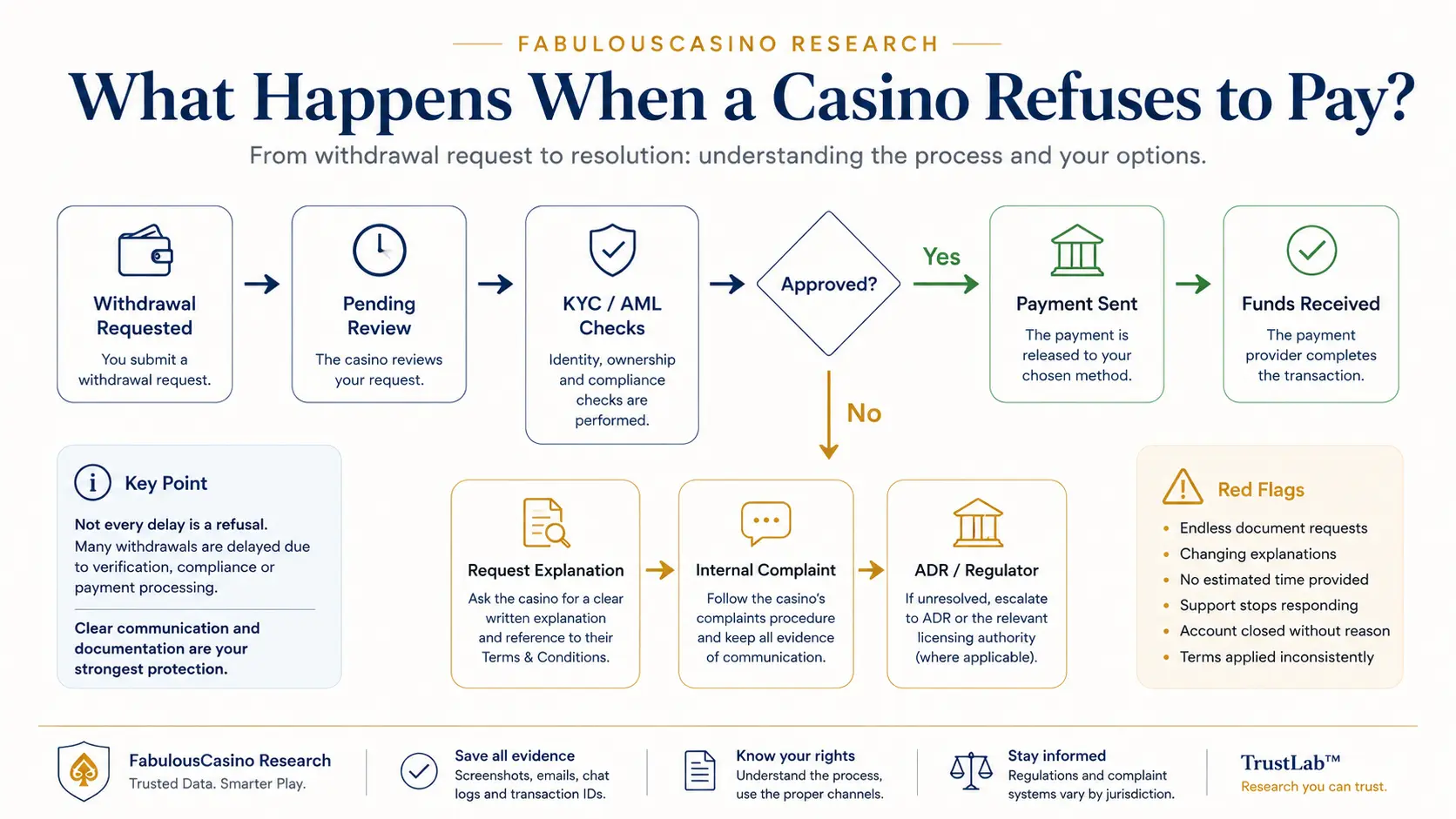
Understanding the Difference Between a Delay and a Refusal
Before discussing complaints, regulators or legal rights, one important distinction must be made.
A delayed withdrawal is not automatically the same as a refused withdrawal.
The two situations require completely different responses.
Normal Withdrawal Processing
Most withdrawals follow a predictable journey.
A player submits a withdrawal request.
The request enters the casino’s internal queue.
The casino performs automated or manual checks.
If necessary, additional verification is requested.
Once approved, the payment is released to the chosen payment provider.
Only then does the bank, e-wallet or payment network begin its own processing.
For the player, all of this may simply appear as:
Pending
Yet multiple separate processes are taking place behind the scenes.
Understanding those stages helps explain why two casinos using the same payment method can produce completely different payout times.
A Delayed Withdrawal
A delayed withdrawal occurs when the casino still intends to process the payment but the request remains under review longer than expected.
This may happen because:
- identity documents require manual verification;
- payment ownership cannot be confirmed automatically;
- anti-money laundering checks require additional information;
- unusually large withdrawals trigger enhanced review;
- technical payment issues interrupt processing;
- weekends or banking holidays slow payment providers.
These situations are frustrating, but they are not necessarily evidence of dishonest behaviour.
Professional casinos normally explain why additional time is required and continue communicating throughout the process.
A Genuine Refusal to Pay
A refusal begins when the casino decides that winnings will not be paid.
That decision may involve:
- cancelling winnings;
- confiscating bonus funds;
- closing the account;
- permanently rejecting the withdrawal;
- refusing to explain the decision;
- relying on specific clauses within the Terms & Conditions.
Some refusals are legitimate.
Others are highly questionable.
The important issue is not simply whether a casino refuses payment.
The important issue is whether the refusal can be justified using clearly published rules applied consistently to all players.


How Casino Withdrawals Actually Work
Many players imagine a withdrawal works like an ordinary bank transfer.
It does not.
In most cases, the casino—not the payment provider—controls the longest part of the process.
A simplified withdrawal timeline looks like this:
Withdrawal Request
↓
Pending Review
↓
Identity Verification (KYC)
↓
Compliance & AML Checks
↓
Internal Approval
↓
Payment Released
↓
Payment Provider Processing
↓
Funds Received
The critical observation is that payment providers usually become involved only after the casino has completed its own internal review.
That is why two casinos offering the same e-wallet or bank transfer can produce dramatically different withdrawal times.
The payment method is often identical.
The casino’s internal procedures are not.
Why Casinos Review Withdrawals
From a player’s perspective, additional checks often feel unnecessary.
From a regulatory perspective, they are increasingly unavoidable.
Licensed operators are expected to verify customer identities, monitor unusual transactions and prevent financial crime.
The exact requirements differ between jurisdictions, but several common checks appear across almost all major regulated markets.
Identity Verification
Casinos must know who their customers are.
Verification commonly includes:
- government-issued identification;
- proof of residential address;
- confirmation of date of birth;
- verification of payment ownership.
Many regulators require these checks before gambling can continue.
Others permit additional verification before withdrawals are released.
Either way, identity verification has become a standard part of modern online gambling rather than an exceptional event.
Anti-Money Laundering Reviews
Online casinos are also expected to monitor suspicious financial activity.
Examples include:
- unusually large deposits;
- rapid movement of funds;
- inconsistent payment methods;
- multiple funding sources;
- transactions inconsistent with previous behaviour.
These reviews are designed to identify financial crime—not to inconvenience ordinary customers.
Nevertheless, they can extend withdrawal processing times considerably.
Source of Funds
For larger transactions or higher-risk situations, casinos may request information about the origin of deposited funds.
Examples might include:
- salary documentation;
- business income;
- investment statements;
- inheritance records;
- property sales.
Although these requests often surprise players, they have become increasingly common under modern anti-money laundering regulations.
The important question is not whether documentation is requested.
It is whether the request is reasonable, proportionate and clearly explained.
Why Some Casinos Process Withdrawals Faster Than Others
Payment speed depends on far more than technology.
Two casinos may both advertise “instant withdrawals.”
One pays within thirty minutes.
The other requires three days.
The difference often lies in internal policy rather than payment infrastructure.
Factors include:
- automated verification systems;
- manual approval requirements;
- staffing levels;
- fraud-detection thresholds;
- withdrawal queues;
- business hours;
- internal risk scoring;
- payment-provider relationships.
This is exactly why FabulousCasino measures more than the final payment time.
A casino that consistently approves withdrawals within one hour demonstrates a fundamentally different operational approach from one that keeps requests pending for several days before releasing exactly the same payment method.
The FabulousCasino Perspective
Fast withdrawals matter.
But transparency matters even more.
A casino that communicates clearly, explains delays honestly and applies its published rules consistently often deserves more trust than a casino advertising “instant withdrawals” while providing little explanation when problems occur.
That philosophy is built into every FabulousCasino review.
Our TrustLab™ does not ask only:
“How fast was the payment?”
It also asks:
- Was communication clear?
- Were verification requests reasonable?
- Were explanations consistent?
- Did support answer specific questions?
- Were published withdrawal times respected?
- Were the Terms & Conditions applied transparently?
Because in the real world, the quality of a casino is measured not when everything goes perfectly—
but when something unexpected happens.

Enrico Braunschweig
Founder
Enrico Braunschweig is the Founder of FabulousCasino and a long-time entrepreneur in the digital marketing and iGaming industry. With nearly two decades of experience in affiliate marketing, online casino acquisition, and SEO-driven publishing, he focuses on building trusted gaming brands with a strong emphasis on transparency, product quality, and long-term player value.