

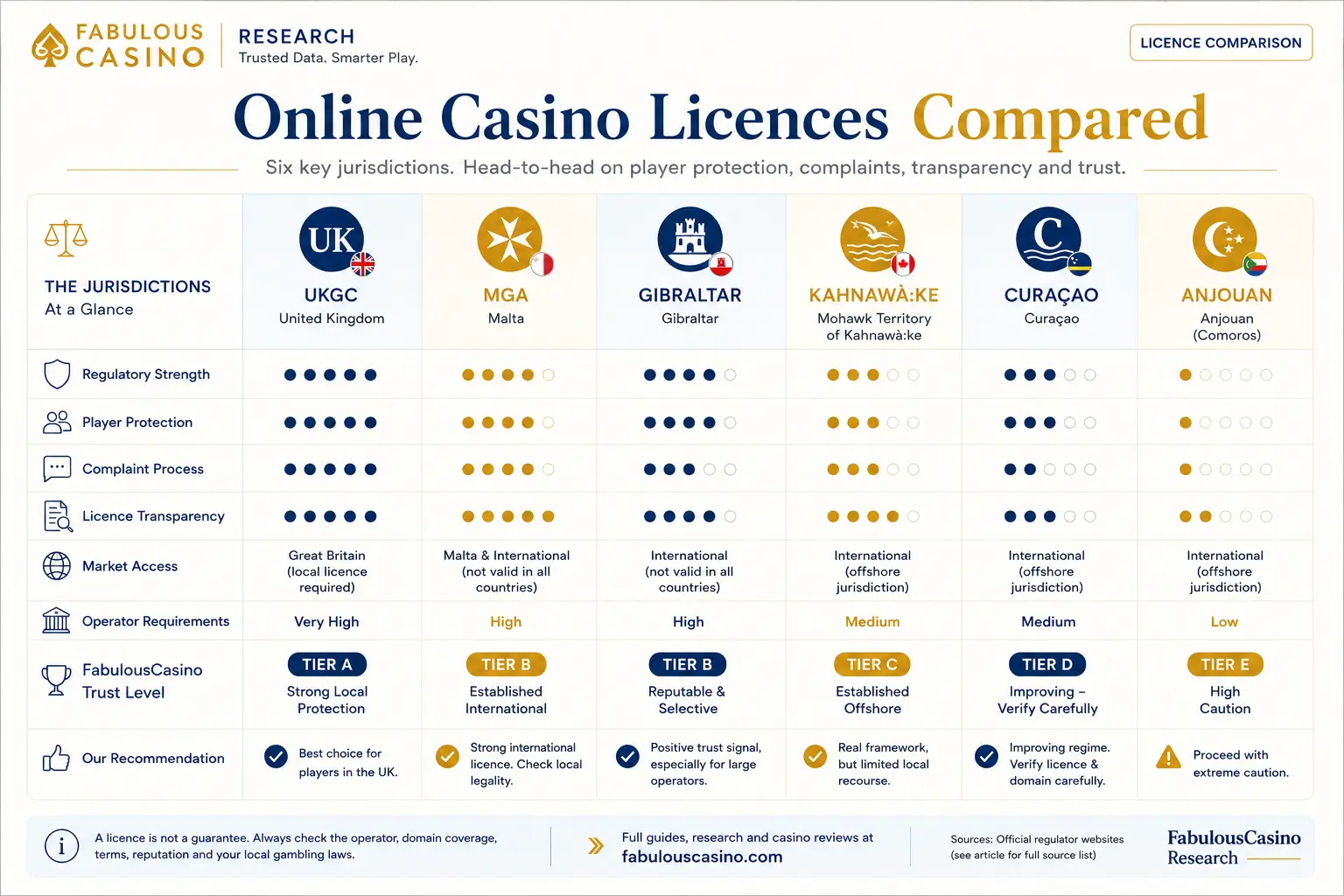
An online casino licence should tell players who regulates the operator, which rules it must follow and where they can turn when something goes wrong. However, not all casino licences provide the same level of protection.
A UK Gambling Commission licence is designed specifically for businesses serving players in Great Britain. Malta and Gibraltar operate established regulatory systems used by many international gaming companies. Kahnawà:ke has regulated interactive gaming since the early days of the industry, while Curaçao is rebuilding its framework under a new licensing regime. Anjouan has grown rapidly as an offshore licensing jurisdiction, but serious questions have been raised about its legal authority, independence and practical value to players.
At FabulousCasino, we do not treat a licence logo as a universal safety certificate. We assess what the licence actually means for the player: whether the operator can be verified, whether the rules are enforced, whether complaints can be escalated and whether the authority provides meaningful consumer protection.
Casino Licence Comparison at a Glance
| Licensing jurisdiction | Public verification | Player complaint route | Player protection | Main limitation | FabulousCasino assessment |
|---|---|---|---|---|---|
| UK Gambling Commission | Yes | Operator complaint plus independent ADR | Very strong | Primarily protects the British market | Strongest for UK players |
| Malta Gaming Authority | Yes | Operator, ADR and MGA Player Support | Strong | Not a universal licence for all European countries | Strong international licence |
| PAGCOR | Yes — accredited GSAs, registered brands and approved domains are publicly listed | Operator grievance process and direct PAGCOR regulatory contact; no UK-style independent ADR | Moderate to strong for Philippine domestic players | No valid offshore licences; GSA, operator, brand and domain must be matched carefully | Established state-backed local regulation |
| Gibraltar | Yes, through official regulatory information | Operator and Gambling Commissioner process | Strong | Smaller and less consumer-facing than UKGC | Reputable, high-entry-bar jurisdiction |
| Kahnawà:ke Gaming Commission | Yes | Direct Commission complaint process | Moderate | Limited local legal connection for most players | Established offshore framework |
| Curaçao Gaming Authority | Yes under the new framework | Operator process and regulatory reporting; limited individual dispute powers | Improving | Still transitioning from the old system | Improving, verify carefully |
| Anjouan | A public register is presented | Operator and stated ADR process | Unclear | Serious questions over legal authority and effective oversight | High caution |
FabulousCasino Licence Trust Levels
Our classifications are editorial assessments from a player-first perspective. They are not legal ratings and do not mean that every operator holding a particular licence performs equally well.
Tier A: Strong Local Player Protection
UK Gambling Commission The licence is tied to a specific regulated market and supported by detailed consumer rules, independent dispute resolution and active enforcement.
Tier B: Established International Regulation
p>Malta Gaming Authority, Gibraltar and PAGCOR-regulated domestic gaming
These jurisdictions operate recognised, state-backed regulatory frameworks with operator requirements, public verification resources and active regulatory oversight. PAGCOR belongs in this tier only for gaming platforms authorised to serve the Philippine domestic market.
PAGCOR publishes accredited Gaming System Administrators, registered casino brands and approved domain names. It also applies probity, anti-money-laundering and responsible-gaming requirements. However, its individual player-dispute process is less independent and less clearly defined than the ADR framework available to British players under UKGC regulation.
All former PAGCOR offshore gaming licences were cancelled in December 2024. Any casino currently claiming to hold a PAGCOR offshore or international gaming licence should therefore be treated as fraudulent or unauthorised.
Tier C: Established Offshore Framework
Kahnawà:ke Gaming Commission A long-running and genuine regulatory system with public permit information and a complaint process, but generally weaker practical protection for an international player than a strong local licence.
Tier D: Reforming – Verify Carefully
Curaçao Gaming Authority The new system is materially stronger than the historic master-licence model, but operators, domains and licence status must be checked carefully during the transition.
Tier E: High Caution
Anjouan The jurisdiction presents a formal licensing and complaint framework, but recent investigations and warnings have raised serious doubts about legal authority, regulatory independence and effective enforcement.
What Does an Online Casino Licence Actually Mean?
A licence means that a specific entity has received authorisation from a named authority to conduct certain gambling activities under specified conditions.
It does not automatically mean that:
- the casino may legally accept players from every country;
- every game or website operated by the company is covered;
- withdrawals will always be fast;
- every player complaint will be resolved in the player’s favour;
- the operator has a spotless history;
- the regulator guarantees deposited funds;
- the casino’s marketing claims are accurate.
The most useful licences are those that connect a player to a clear set of rules and a practical route for complaints.
When assessing a casino licence, we look at seven areas:
- Licence verification: Can the operator and domain be checked in a public register?
- Regulatory standards: What rules apply to ownership, finance, games, AML and player treatment?
- Player protection: Are safer-gambling tools, clear terms and account controls required?
- Complaints: Can disputes be referred to an independent body?
- Enforcement: Does the authority publish suspensions, fines or cancellations?
- Market relevance: Does the licence actually cover the country where the player lives?
- Practical recourse: Is the system accessible and useful when money is at stake?


1. UK Gambling Commission
FabulousCasino Assessment: Strongest for British Players
The UK Gambling Commission regulates commercial gambling in Great Britain. Any remote gambling business that offers gambling to consumers in Great Britain requires the appropriate UKGC operating licence, regardless of where the company itself is based.
Players can search the official public register to verify the legal operator, trading names, licensed activities, websites and licence status. UK-licensed businesses are also subject to detailed Licence Conditions and Codes of Practice. These cover areas including complaints, marketing, customer interaction, identity verification and safer gambling. (UK Gambling Commission)
The British framework also requires operators to provide a formal complaints procedure. After the operator’s internal process has been exhausted, an unresolved dispute can generally be referred to an independent Alternative Dispute Resolution provider. The ADR service is free to the consumer. (Gambling Commission)
UKGC Pros
- Strong rules designed specifically for British consumers
- Public and detailed licence register
- Independent ADR system for unresolved disputes
- Extensive safer-gambling and customer-interaction requirements
- Strict age and identity verification
- Visible enforcement through fines, suspensions and licence reviews
- Clear operator and domain identification
UKGC Cons
- Strict verification and compliance checks can create friction
- Game design, bonuses and payment options are more restricted than in many offshore markets
- The Commission does not personally adjudicate every contractual dispute
- The framework is designed for Great Britain and is not a global licence
- Holding a UKGC licence does not guarantee excellent support or fast withdrawals
What Makes the UKGC Different?
The most important difference is local accountability.
A UK player using a UKGC-licensed casino is dealing with an operator that has explicit permission to serve Great Britain. This creates a more direct relationship between the player, the operator and the regulator than an offshore licence that may not specifically authorise access in the player’s country.
FabulousCasino Recommendation
For players in Great Britain, a valid UKGC licence should be a minimum requirement.
Check the casino footer, follow the official register link and confirm that the exact domain and operating company match the register entry. Never rely on a UKGC logo alone.
Official sources:
- UK Gambling Commission public website and register
- How to complain about a gambling business
- Approved ADR providers
2. Malta Gaming Authority
FabulousCasino Assessment: Strong International Licence
The Malta Gaming Authority is one of the most recognised regulators in international online gambling.
A company offering gaming services from Malta, to people in Malta or through a Maltese legal structure may require a B2C Gaming Service Licence. The MGA maintains a searchable public register that allows users to check licensees by company, authorisation status, URL and gaming service. (Malta Gaming Authority)
The MGA also maintains a Player Support Unit and a formal complaint channel. Players are generally encouraged to contact the operator first. If the matter is not resolved, it may be referred to the MGA or an approved ADR entity, depending on whether it concerns a regulatory complaint or an individual contractual dispute. (Malta Gaming Authority)
Licensed businesses must provide safer-gambling tools, including self-exclusion and other player-control measures. The Authority also publishes enforcement notices when licences are suspended or cancelled. (Malta Gaming Authority)
MGA Pros
- Established European gaming regulator
- Searchable public register including licensed URLs
- Formal player complaint channel
- Required dispute-handling and ADR procedures
- Defined player-protection rules
- Regular compliance and enforcement activity
- Widely recognised by operators, suppliers and payment providers
MGA Cons
- An MGA licence is not a universal licence for all European countries
- National licensing laws still apply in locally regulated markets
- The difference between a complaint and a contractual dispute can be confusing
- Players may need to use the operator’s appointed ADR provider rather than the MGA itself
- A valid MGA licence does not guarantee that every casino term is player-friendly
Is an MGA Licence Valid Throughout Europe?
Not automatically.
Malta is an EU member state, but gambling regulation remains largely national. Countries such as Great Britain, Germany, the Netherlands, Sweden, Italy and others maintain their own licensing systems.
An operator holding an MGA licence may still need a separate local licence before targeting players in those countries. Players should therefore check both the MGA authorisation and the rules applicable in their own location.
FabulousCasino Recommendation
An MGA licence is a meaningful positive trust signal, particularly for international casinos with transparent ownership and a long operating history.
However, it should always be combined with a local legality check, clear withdrawal terms and a review of the specific operating company.
Official sources:
- MGA Remote Gaming Services
- MGA Licensee Register
- Lodge a complaint with the MGA
- MGA Player Protection
3. Gibraltar
FabulousCasino Assessment: Reputable and Selective
Gibraltar has hosted major online gambling businesses for many years and historically positioned itself as a jurisdiction for established operators rather than low-barrier start-ups.
Remote gambling is regulated under Gibraltar’s gambling legislation by its Licensing Authority and Gambling Division. Official Gibraltar information describes a system covering remote gambling laws, licensing, regulation, taxation and complaints. (gibraltar.gov.gi)
Gibraltar also provides a complaint-resolution process through the Gambling Commissioner. Players are expected to raise the issue with the operator first before escalating an unresolved complaint using the official process. (gibraltar.gov.gi)
Gibraltar Pros
- Long-established remote-gambling jurisdiction
- Traditionally associated with large, experienced operators
- Government-backed licensing and regulatory structure
- Official complaint-resolution route
- Strong reputation among major international gaming businesses
- Generally higher entry expectations than low-cost offshore jurisdictions
Gibraltar Cons
- Smaller and less visible to ordinary players than the UKGC or MGA
- Public-facing licence information can be less intuitive to navigate
- The licence does not authorise an operator in every target country
- International dispute enforcement may still be difficult
- Many Gibraltar operators serving regulated markets also require separate local licences
What Makes Gibraltar Different?
Gibraltar’s main value is not mass licence availability. It is its historical association with substantial gambling businesses, operational presence and regulatory oversight.
A Gibraltar licence can therefore be a positive indication of operator scale and experience. However, players should still confirm whether the casino also holds the local licence required for their country.
FabulousCasino Recommendation
We consider Gibraltar a strong licensing signal, particularly when the casino belongs to an established group and also holds relevant local authorisations.
It should not be treated as permission to serve every international market.
Official sources:
- Gibraltar Remote Gambling
- Gibraltar Financial Services and Gaming
- Gibraltar complaint-resolution form
4. Kahnawà:ke Gaming Commission
FabulousCasino Assessment: Established Offshore Framework
The Kahnawà:ke Gaming Commission is based in the Mohawk Territory of Kahnawà:ke in Canada. It has regulated interactive gaming since 1999, making it one of the longer-running offshore gaming regulators.
The Commission issues several forms of interactive-gaming authorisation and publishes information about its permit holders. It also accepts player complaints and employs a dedicated Dispute Resolution Officer. (Kahnawà:ke Gaming Commission)
The complaint process is a genuine advantage over jurisdictions that provide little more than a licence seal. Players can submit complaints directly through the Commission’s website or dedicated email channel. (Kahnawà:ke Gaming Commission)
Kahnawà:ke Pros
- Regulating interactive gambling since 1999
- Public information about permit holders
- Formal interactive-gaming regulations
- Dedicated player complaint process
- Full-time Dispute Resolution Officer
- Published information on complaints and responsible-gaming measures
- More established than many newer offshore jurisdictions
Kahnawà:ke Cons
- Does not replace local licensing in countries with regulated gambling markets
- Most international players have no close legal or geographic connection to Kahnawà:ke
- Cross-border enforcement may be difficult
- Consumer rules are less extensive than those of the UKGC
- Fewer mainstream brands now use it as their primary player-facing licence
Is Kahnawà:ke a Real Licence?
Yes. It is a functioning regulatory system with published regulations, permit holders, complaints procedures and enforcement notices.
That does not make it equivalent to a licence issued specifically for the player’s home country. Its value is best understood as an established offshore framework rather than a universal local consumer licence.
FabulousCasino Recommendation
A current Kahnawà:ke authorisation is more meaningful than an unverifiable offshore registration.
We would still check:
- the exact permit holder;
- the approved website;
- the operating company;
- the player’s local law;
- withdrawal and complaint history;
- whether the casino clearly explains dispute resolution.
Official sources:
- Kahnawà:ke Gaming Commission
- Interactive-gaming permit holders
- Player protection
- Dispute resolution and complaints
5. Curaçao Gaming Authority
FabulousCasino Assessment: Improving, but Verify Carefully
Curaçao is undergoing the most important regulatory transformation of the six jurisdictions compared here.
Historically, the market operated through a master-licence and sublicence system. This resulted in inconsistent standards, weak public transparency and major differences between operators displaying what appeared to be the same Curaçao licensing credentials.
The new National Ordinance on Games of Chance, known as the LOK, establishes the Curaçao Gaming Authority as the regulator for online gaming and introduces direct licences for B2C operators and gaming suppliers. The official portal states that operators can apply to offer online gaming in or from Curaçao under the LOK. (cga.cw)
The new framework also requires licensed operators to register player-facing domains and report complaint information to the regulator. (portal.cga.cw)
Curaçao Pros
- Direct licensing replaces the old sublicence model
- Centralised Curaçao Gaming Authority
- Stronger domain registration and verification
- More formal compliance and reporting obligations
- New complaint-policy requirements
- Greater transparency than under the historical system
- Potentially meaningful improvement in long-term regulatory quality
Curaçao Cons
- The market remains in a transitional period
- Many players still encounter old licence claims and outdated seals
- Historic Curaçao licensing developed a weak player-protection reputation
- A Curaçao licence does not authorise targeting locally regulated countries
- The CGA says it does not mediate or arbitrate individual player disputes
- Cross-border enforcement remains less accessible than in strong local markets
The CGA explicitly states that it does not resolve individual disputes between players and operators and cannot order an operator to compensate a player. Complaint information may instead support the regulator’s risk-based supervision and enforcement. (Curaçao Gaming Control Board)
That is an important limitation. The new system may improve operator oversight without giving players the same individual dispute remedy available through UK ADR structures.
Is a Curaçao Licence Still Weak?
It is no longer accurate to describe every Curaçao licence using only the weaknesses of the historic sublicence system.
The new framework is structurally stronger. However, the real test will be enforcement over time.
Players should distinguish between:
- an old master-licence or sublicence reference;
- a transitional authorisation;
- a current direct CGA licence;
- an unverified casino merely displaying Curaçao branding.
FabulousCasino Recommendation
Treat a current, verifiable direct CGA licence as an improving trust signal — not as an automatic guarantee.
Check the legal entity, exact domain and licence status through the official CGA resources. We would also place additional weight on withdrawal history, ownership transparency, payment processing and complaint handling.
Official sources:
- Curaçao Gaming Authority
- CGA online-gaming information
- CGA licensing portal
- CGA Player Complaints Policy Guidelines
6. Anjouan
FabulousCasino Assessment: High Caution
Anjouan has become a popular licensing option among offshore online casinos, crypto casinos and newly launched gambling businesses.
The website presenting itself as the Anjouan internet-gaming regulatory authority publishes a regulatory framework, application process, public register and third-party complaint policy. It states that operators must first handle complaints internally and that unresolved disputes may be escalated to an approved ADR provider. (Anjouan Gaming)
Taken at face value, these features resemble a formal regulatory structure.
However, serious and recent investigations have challenged the legal and institutional foundations of Anjouan gaming licences.
A 2025 ABC investigation reported concerns about entities issuing allegedly unauthorised gambling licences connected to the Comoros. In February 2026, Le Monde and CasinoZorgplicht reported that the licensing ecosystem involved privately managed bodies, questionable legal authority and weak effective oversight. The report also cited the Central Bank of the Comoros describing certain supposed offshore authorities as fictitious. (ABC News)
The Anjouan authority disputes criticism of its system and states that its licences operate under a legal framework adopted in 2005. This conflict itself is important: players are faced with competing claims about the authority, legality and enforcement behind the licence. (LinkedIn)
Anjouan Pros
From an operator perspective, the advertised advantages include:
- relatively accessible licensing;
- broad product coverage;
- a published register;
- stated AML, KYC and compliance obligations;
- a stated complaint and ADR process;
- support for international and crypto-oriented business models.
For players, however, most of these benefits depend on whether the rules are independently and effectively enforced.
Anjouan Cons
- Serious questions about legal authority and institutional legitimacy
- Allegations that key regulatory bodies are privately controlled
- Limited evidence of effective player-facing enforcement
- Weak practical connection between international players and the jurisdiction
- Frequently used by operators targeting countries without local permission
- High risk that a licence seal creates more confidence than the available protection justifies
- Disputed status makes complaints and enforcement less predictable
Is an Anjouan Licence Meaningless?
We would not say that every operator holding an Anjouan licence is automatically fraudulent.
A licence jurisdiction and an individual casino are not the same thing. An operator may have strong ownership, reliable payments and reputable suppliers despite using a weaker licence.
However, based on the current uncertainty, we do not consider an Anjouan licence alone to be meaningful proof of safety.
FabulousCasino Recommendation
Treat Anjouan as a high-caution licence.
Before recommending an Anjouan-licensed casino, FabulousCasino would require stronger additional evidence than for a UKGC- or MGA-licensed operator:
- named and verifiable ownership;
- clear operating company and address;
- established withdrawal history;
- transparent terms and limits;
- reputable payment and game providers;
- functioning support;
- independent dispute mechanism;
- clear country restrictions;
- evidence that the casino does not misuse the licence as global authorisation.
Sources and further reading:
- Anjouan Gaming regulatory framework
- Anjouan Gaming public register
- Anjouan third-party complaint policy
- ABC investigation into allegedly fake gambling licences
- Le Monde investigation into the Comoros online-casino ecosystem
7. PAGCOR – Philippine Amusement and Gaming Corporation
FabulousCasino Assessment: Established Local Regulation, Not an Offshore Licence
PAGCOR is a genuine state regulator with direct authority over licensed gaming activities in the Philippines. For Philippine domestic players, a current PAGCOR authorisation provides a substantially stronger regulatory connection than a general offshore licence.
The regulator publishes lists connecting accredited Gaming System Administrators with their approved brands, game offerings and domain names. Players should verify the exact casino URL rather than relying on a PAGCOR logo, certificate image or general relationship with a gaming platform.
PAGCOR does not currently issue offshore or international online gaming licences. All former Internet Gaming Licensees and authorised offshore providers were cancelled in December 2024. A casino claiming that its PAGCOR licence authorises it to accept international players should therefore be approached with extreme caution.
Which Casino Licence Is Best?
There is no single best licence for every player because the strongest licence is usually the one that directly regulates the casino in the player’s country.
Best for Players in Great Britain
UK Gambling Commission It offers the strongest local connection, detailed consumer rules and an established ADR structure.
Best Established International Licence
Malta Gaming Authority The MGA provides a substantial regulatory, player-protection and enforcement framework. Local licensing requirements must still be checked.
Best for Large, Established Operators
Gibraltar Gibraltar remains a positive signal when used by a substantial gaming group with relevant local authorisations.
Best Established Offshore Framework
Kahnawà:ke It has history, public permit information and a real complaint process, but it is not equivalent to a local market licence.
Most Improved Framework
Curaçao The LOK regime is a genuine structural improvement, but the new system must prove itself through consistent enforcement.
Licence Requiring the Most Caution
Anjouan Its advertised framework is overshadowed by serious unresolved questions about authority, independence and practical consumer protection.
A Licence Does Not Grant Global Market Access
One of the most misleading ideas in online gambling is that an offshore or international licence permits a casino to operate everywhere.
It does not.
A Curaçao, Malta, Gibraltar, Kahnawà:ke or Anjouan licence may authorise activities under that jurisdiction’s system. It does not override gambling law in Great Britain, Italy, Germany, the Netherlands, Ontario, US states or other locally regulated markets.
A casino may therefore hold a genuine licence in one jurisdiction and still lack permission to target players in another.
This distinction matters when reviewing offshore casinos:
Licensed somewhere is not the same as licensed for you.
How to Check an Online Casino Licence
1. Find the Legal Company Name
Look in the casino footer, terms and conditions or privacy policy.
Do not rely only on the brand name. The licensed entity may have a completely different corporate name.
2. Find the Licence Number
A credible casino should display the regulator, legal entity and licence or authorisation reference.
Missing or vague information is a warning sign.
3. Open the Regulator’s Official Register
Do not search only through affiliate sites or licence agents.
Use the regulator’s own domain and search for:
- company name;
- trading name;
- licence number;
- exact casino URL;
- licence status.
4. Check the Exact Domain
A company may own several casino brands. The existence of a company licence does not prove that every related website is covered. The exact domain should appear in the register or authorised website list where the regulator provides one.
5. Check Licence Status
Look for terms such as:
- active;
- licensed;
- suspended;
- surrendered;
- cancelled;
- revoked;
- expired;
- transitional.
A licence number can be real but no longer active.
6. Check Local Legality
Confirm whether the casino is authorised to serve your country or region. An international licence does not necessarily provide local legal access.
7. Review the Complaints Process
Before depositing, find out:
- who receives the first complaint;
- how long the operator has to respond;
- whether ADR is available;
- whether the regulator accepts player complaints;
- whether decisions are binding;
- what evidence must be submitted.
Casino Licence Red Flags
A licence claim deserves closer scrutiny when:
- the seal does not link to an official register;
- the link opens a licence agent instead of a regulator;
- the registered company does not match the casino terms;
- the exact domain is missing;
- the licence is expired or suspended;
- the operator describes an offshore licence as globally valid;
- the complaints process is missing;
- no legal company or address is stated;
- the casino uses several conflicting licence claims;
- support cannot explain who regulates the site;
- the authority has no independently verifiable public presence.
A sophisticated-looking licence certificate is not proof by itself.
Why Licence Quality Matters for Withdrawals
Licensing becomes especially important when a casino delays or refuses a withdrawal.
A strong regulatory structure may require:
- a documented internal complaints process;
- clear payment terms;
- timely communication;
- independent ADR;
- regulatory reporting;
- record retention;
- enforcement for systematic failures.
A weaker offshore licence may provide little practical help beyond forwarding a complaint.
That is why licence quality forms part of the FabulousCasino Withdrawal Lab. We do not judge a casino only by how fast one payment arrives. We also consider what protection exists if a payout does not arrive.
The FabulousCasino Licence Check
When reviewing an online casino, we ask:
- Is the licence genuine and currently active?
- Does it cover the exact casino domain?
- Is the licensed company clearly disclosed?
- Is the casino permitted to serve its target players?
- Does the authority maintain a public register?
- Is there a credible complaint process?
- Is independent dispute resolution available?
- Does the regulator publish enforcement actions?
- Are player funds and payment rules addressed?
- Does the operator have a consistent payout history?
A strong licence cannot compensate for every operational weakness. However, a weak or unverifiable licence can materially increase player risk.
FabulousCasino Verdict
Online casino licences are not equal.
The UK Gambling Commission provides the strongest player-facing system in this comparison for consumers in Great Britain. Malta and Gibraltar are established jurisdictions with meaningful operator requirements and complaint structures. Kahnawà:ke has a credible history as an offshore gaming regulator, although its protection is less locally connected for most international players.
Curaçao is moving in the right direction under the LOK and direct CGA licensing, but players should verify current licence and domain information carefully while the reform matures.
Anjouan requires the greatest caution. Although its licensing website presents a regulatory framework, public register and complaint process, credible investigations have raised serious concerns about legal authority, independence and effective enforcement.
Our central conclusion is simple:
A casino licence is valuable only when it is genuine, relevant to the player’s market and backed by rules that can be enforced in practice.
Do not ask only whether a casino is licensed.
Ask:
Who issued the licence, what does it cover, and what can the player actually do when something goes wrong?
FAQ
What is the safest online casino licence?
For players in Great Britain, the UK Gambling Commission provides the strongest local player-protection and dispute-resolution framework among the jurisdictions compared here. Players in other regulated countries should look for the licence issued by their own national or regional authority.
Is an MGA licence safe?
An MGA licence is a strong positive signal. The Malta Gaming Authority operates a public register, player-protection framework, complaint channel and enforcement system. However, an MGA licence does not automatically permit a casino to operate in every European country.
Is a Gibraltar casino licence reputable?
Yes. Gibraltar is an established gambling jurisdiction associated with many major operators. Its licence is a positive trust signal, but casinos may still require separate licences to serve regulated national markets.
Is Kahnawà:ke a real gambling licence?
Yes. The Kahnawà:ke Gaming Commission has regulated interactive gaming since 1999 and provides public permit information, player protection rules and a complaint process. It remains an offshore framework rather than a local licence for most international players.
Is a Curaçao licence safe in 2026?
Curaçao’s new LOK regime and direct CGA licensing are stronger than the historic master-licence system. However, the framework is still proving itself. Players should verify the exact company, domain and current licence status.
Is an Anjouan licence trustworthy?
An Anjouan licence should be treated with high caution. The licensing authority presents formal rules and a register, but recent investigations have raised serious questions about the system’s legal authority, independence and practical enforcement.
Does an offshore licence make a casino legal everywhere?
No. A licence issued in one jurisdiction does not override gambling laws elsewhere. A casino may be licensed offshore while lacking permission to target players in a particular regulated country.
How can I verify a casino licence?
Find the operator’s legal company name and licence number, then check them through the regulator’s official public register. Confirm that the exact casino domain is included and that the licence remains active.
Can a licensed casino still delay withdrawals?
Yes. A licence does not guarantee fast payments. It may, however, provide clearer rules, complaints procedures and enforcement options when the operator handles withdrawals unfairly.
Should I avoid every offshore casino?
Not necessarily. Offshore casinos vary considerably. Players should assess the licence, operating company, payment record, terms, ownership, game providers and complaint process together. A licence should be one part of the trust assessment, not the only part.
Responsible gambling note: Online casino games involve financial risk and should be treated as paid entertainment. Only play where online gambling is permitted, set strict spending limits and never gamble with money you cannot afford to lose.

Jake Sanford
Editor in Chief
Jake Sanford is the Editor in Chief of FabulousCasino and an experienced iGaming industry analyst with a focus on online casinos, player safety, and international gambling trends. His work combines hands-on research with practical insights to help players better understand casino platforms, bonuses, payments, and regulatory developments.