


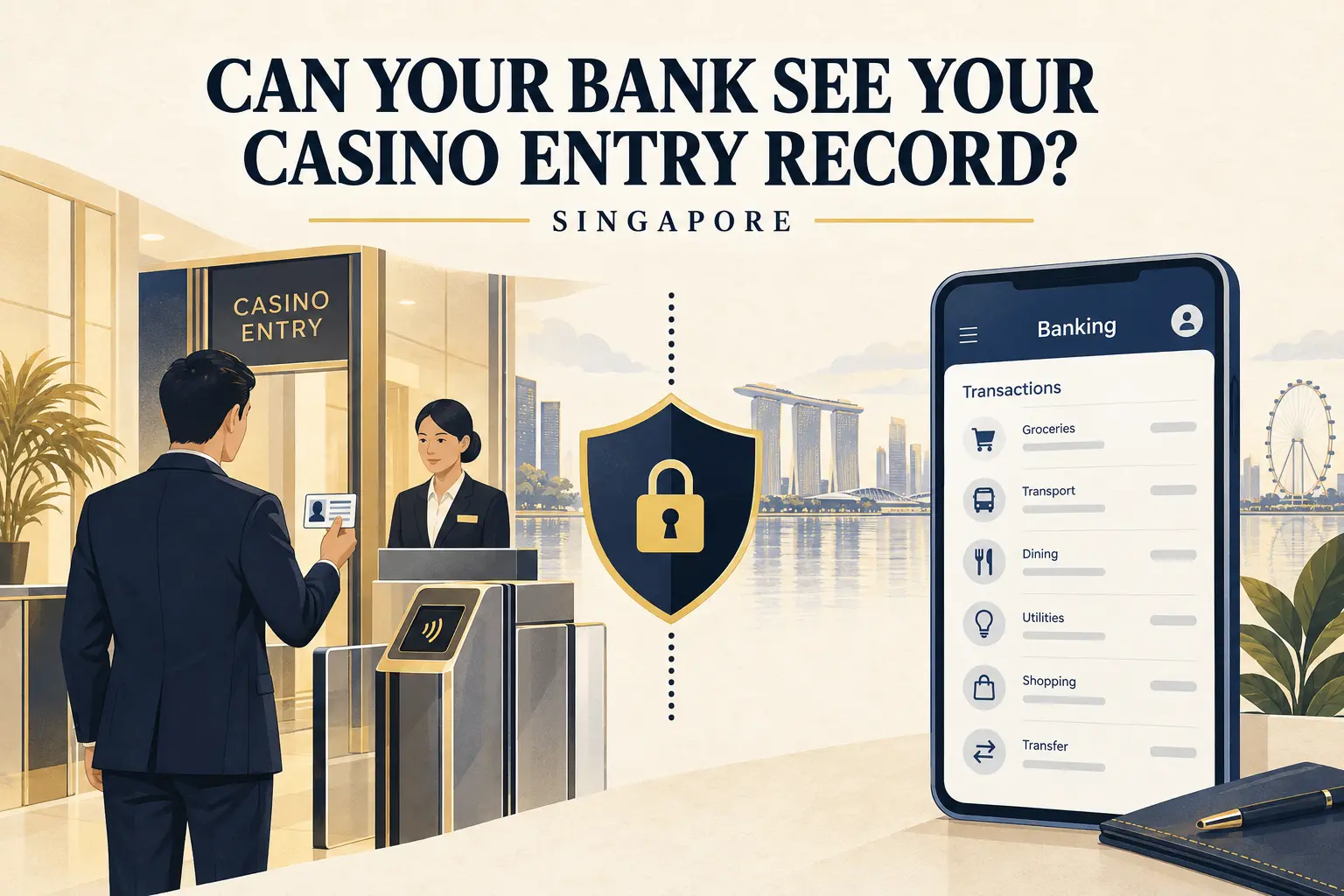
Your bank may nevertheless see financial activity connected with a casino. A card payment, bank transfer, PayNow transfer or cash withdrawal can leave a record in your account. Depending on the merchant or ATM descriptor, that record may identify the casino, integrated resort, payment processor or location. It does not give the bank a complete log of when you entered, how long you stayed or what happened on the gaming floor.
The short version: a casino entry record and a bank transaction record are two separate things. Your bank may see money moving. It does not routinely see the casino’s admission log.
This distinction is particularly important in Singapore, where physical casino admission is closely controlled and Singapore Citizens and Permanent Residents must pay an entry levy before entering. This guide explains what is recorded, who may hold that information and when casino-related activity may still become visible to a financial institution.
What Is a Casino Entry Record?
A casino entry record is information created when a person is admitted to, refused entry to or otherwise processed at a physical casino. In Singapore, this question normally concerns the two regulated land-based casinos at Marina Bay Sands and Resorts World Sentosa.
The precise data collected and retained can depend on the casino, the visitor and the reason for processing. It may include information connected with:
- identity and age verification;
- the date and time of a visit;
- Singapore Citizen or Permanent Resident status;
- payment or validity of a casino entry levy;
- casino exclusions and visit limits;
- membership or loyalty accounts;
- security screening and surveillance;
- anti-money laundering and regulatory checks.
Resorts World Sentosa states that it collects personal data when people visit its premises, including its casino, and that it may use personal data to manage admission, verify identity, prevent money laundering and enforce legal or regulatory obligations. It also says that cameras and facial-recognition technology may be used for identification and access management. Marina Bay Sands similarly states that it collects information through offline visits and when patrons play at its casino, including for customer due diligence, anti-money laundering and investigations.
These are casino-side records. They are not the same as a consumer credit report or the transaction history shown in a banking application.


Why Singapore Casinos Record Entry
Singapore does not treat entry to a casino like entry to an ordinary hotel, restaurant or shopping centre. Access controls support several separate rules.
The Gambling Regulatory Authority of Singapore states that every Singapore Citizen or Permanent Resident who wishes to enter a casino must pay an entry levy. The current levy is S$150 for 24 consecutive hours or S$3,000 for an annual levy.
Casinos must also enforce exclusion orders and visit limits. A visit limit can restrict the number of times an individual may enter Singapore casinos during a calendar month. That system could not operate without admission information being checked and visits being counted.
Foreign visitors do not pay the local entry levy, but that does not make entry anonymous. Casinos still need to establish identity, eligibility and legal gaming age and to operate their security and compliance controls.
Can a Singapore Bank Access the Casino’s Entry Log?
Not as part of ordinary retail banking. We found no public rule or published casino privacy statement giving banks routine access to a person’s casino admission history.
There is strong official evidence that casino-visit information is treated as confidential. In response to the question of whether someone can check if a family member is visiting a casino, Singapore’s Ministry of Social and Family Development states that the National Council on Problem Gambling is unable to provide the requested information because of data confidentiality.
If the NCPG does not provide a person’s visit information to a concerned family member on request, it would be wrong to assume that an ordinary bank employee can simply look up the same information.
However, confidentiality does not mean that the information can never be disclosed. Casino privacy notices permit disclosure to government bodies, regulators or law-enforcement authorities when required or permitted by law. Marina Bay Sands also refers to disclosure under legal process and in connection with suspected fraud or illegal activity. Resorts World Sentosa says it may disclose personal data to government agencies, authorities, operators or industry bodies where required, permitted, advised or expected.
That creates a limited but important distinction:
- Routine banking: no direct casino-entry lookup.
- A formal investigation or legal requirement: relevant records may potentially be requested or shared through the proper process.
This article provides general information, not legal advice about any particular investigation or disclosure request.
What Can Your Bank Actually See?
Your bank has detailed visibility over activity conducted through accounts and cards it provides. Depending on the transaction route, this can include:
- the transaction date and amount;
- the merchant or payment recipient;
- a merchant category or transaction type;
- a transfer reference;
- the ATM operator or location;
- incoming payments and cash deposits;
- patterns across repeated transactions.
What appears in the mobile app or monthly statement depends on the payment method and the descriptor supplied through the payment network. It might show the casino name, the wider resort, a payment company or an abbreviated description. A transaction should not be assumed to be invisible simply because the word “casino” does not appear on the customer-facing statement.
| Activity | Can the bank normally see it? | What it may show |
|---|---|---|
| Walking into the casino without using a bank product | No direct bank record | The casino may record admission, but the visit is not automatically sent to the bank |
| Paying an entry levy by card or bank-linked method | Yes, as a transaction | Amount, date and a merchant or processor descriptor |
| Withdrawing cash from an ATM at the resort | Yes | Cash withdrawal, fee and potentially ATM operator or location |
| Using cash already held | Not as an individual casino payment | No bank transaction is created at the point of play |
| Receiving a cheque or electronic payment from the casino | Yes, once deposited or received | Payer, amount and transaction information |
| Using a casino membership card | Not ordinarily | The casino may create a membership and activity record, separate from the bank |
Does the Casino Entry Levy Appear on a Bank Statement?
It can, if the levy is paid through a card, transfer or other bank-linked payment method. In that case, the bank sees the payment because it helped process it. What the customer sees on the statement depends on the final merchant descriptor.
The transaction still does not amount to a complete entry history. The GRA notes that an entry levy is not a payment made in exchange for actually entering or gambling and is generally non-refundable even where the purchaser does not use it. A levy purchase therefore indicates that money was paid, but it does not necessarily prove that the person entered the casino or gambled.
Conversely, an annual levy may cover repeated visits without creating a new levy payment on the bank statement for every entry. This is another reason why payment records and visit records should not be treated as interchangeable.
Can the Bank Tell That an ATM Withdrawal Was Made Inside a Casino?
The bank will see the cash withdrawal. It may also receive information identifying the ATM operator or location, although the detail displayed to the customer varies between banks and machines.
Even when the location points to Marina Bay Sands or Resorts World Sentosa, an ATM withdrawal does not prove that the money was gambled. Both are large integrated resorts containing hotels, restaurants, shops and attractions. The transaction establishes that cash was withdrawn at or near a particular location; it does not create a gaming-floor record.
Banks can nevertheless assess transactions in context. Repeated large cash withdrawals, unusual incoming payments or activity inconsistent with a customer’s known financial profile can lead to additional questions under a bank’s fraud, anti-money laundering or source-of-funds controls.
Can a Casino Visit Affect Your Credit Score in Singapore?
A casino entry is not, by itself, a normal item in a Singapore credit report. Credit reporting focuses on credit facilities and the way debts are managed, including repayment conduct, defaults and outstanding balances.
The visit can have an indirect financial effect if gambling contributes to missed payments, heavy unsecured borrowing, cash advances or persistent debt. A lender assessing a new application may also ask for account statements or consider its existing account relationship with the applicant. In that situation, visible gambling-related payments can form part of an affordability or risk assessment even though the lender still cannot see the casino’s entry log.
The practical distinction is:
- Casino visit: not automatically a credit-report entry.
- Casino-related transaction: may be visible to the bank processing it.
- Debt or missed repayment caused by gambling: can affect creditworthiness.
Can Your Family, Employer or Another Bank See the Record?
There is no general public casino-entry register. The Ministry of Social and Family Development’s official answer specifically says that the NCPG cannot provide a family member’s casino-visit information because of data confidentiality.
An employer or unrelated bank should therefore not be assumed to have ordinary access either. Different considerations can apply where the individual consents, a joint account exposes relevant transactions, a legal order requires disclosure or an authorised investigation is taking place.
A family member may also apply for a Family Exclusion Order where casino gambling has caused serious harm. That process should not be confused with an informal right to inspect another person’s visit history.
Who Holds Casino-Related Information?
There is no single record containing everything. Different organisations hold information for different purposes.
| Organisation | Information it may hold |
|---|---|
| Casino operator | Admission, identity, membership, surveillance, gaming, payment and compliance information |
| NCPG and relevant authorities | Exclusions, visit limits and information needed to administer or enforce those controls |
| Your bank | Transactions, transfers, ATM withdrawals, account activity and its customer due-diligence records |
| Credit bureau | Reported credit facilities and repayment conduct rather than a routine casino-visit history |
These datasets can sometimes interact for compliance or enforcement purposes, but that does not make them one shared consumer profile that every participating organisation can freely inspect.
Can You Request Your Own Casino Data?
Both integrated resorts publish channels for personal-data enquiries. Resorts World Sentosa provides a Request for Information process and says that a fee may apply depending on the data requested. Marina Bay Sands directs individuals to its Data Protection Office for access and correction requests.
Access rights are not necessarily unlimited. A request may be subject to identity checks, legal exceptions, retention rules and restrictions protecting other people or investigations. Anyone seeking a definitive record should contact the relevant casino’s Data Protection Officer and describe the information and date range required.
Land-Based Casino Records vs Online Casino Transactions
The phrase “casino entry record” belongs primarily to Singapore’s land-based casino system. Online casinos do not have a physical entry gate, but they create different records: account registrations, logins, device data, deposits, withdrawals, KYC documents and playing history.
Online gambling payments can be more directly visible to a bank because the financial transaction is part of the account journey. A transfer may identify a casino, merchant, payment agent or unfamiliar third-party recipient. Our guides to how Singapore blocks online casino payments and PayNow casino deposits and withdrawals explain that separate payment trail in more detail.
Players should also distinguish a bank’s checks from a casino’s own verification process. Our Casino KYC in Singapore guide explains the documents an online operator may request, while our source of wealth verification guide examines why larger or unusual transactions can trigger additional scrutiny.
For a wider overview, see our research into casino payment methods in Singapore and the main FabulousCasino Singapore market hub.
The FabulousCasino View
Singapore’s casino controls create a genuine record of physical access, but that does not mean every institution can see it.
Your bank ordinarily sees the financial activity passing through your accounts. The casino sees admission and activity within its own environment. The NCPG and relevant authorities hold or receive information needed to administer exclusions, visit limits and regulation. Those records have different purposes and different access rules.
A bank transaction may reveal a connection to a casino. It is not the same thing as access to your casino entry record.
If privacy matters in a specific legal, employment, lending or family dispute, do not rely on assumptions about what is “hidden” or “visible”. Ask the relevant organisation what information it holds, read its current privacy notice and obtain professional advice where the consequences are significant.
Frequently Asked Questions
Can my bank see that I entered Marina Bay Sands Casino?
Not through routine access to the casino’s entry records. The bank may see a related payment or ATM withdrawal made with its card or account, depending on the transaction descriptor.
Can my bank see that I entered Resorts World Sentosa Casino?
Not ordinarily. Resorts World Sentosa records information connected with visits and casino admission, but this is separate from the bank’s transaction records. Lawful disclosure may occur in limited regulatory, enforcement or legal circumstances.
Does the Singapore casino entry levy show on a bank statement?
It may appear if it is paid using a bank-linked method. The exact wording depends on the merchant or payment descriptor. Paying the levy does not necessarily prove that the purchaser entered or gambled.
Can a bank see how much I lost at a casino?
Not from an entry record. The bank can see account activity it processed, such as withdrawals, transfers and card payments. Those transactions do not by themselves establish how much was wagered, won or lost.
Can casino visits affect a loan application?
The visit itself is not a standard credit-report item. Visible gambling-related transactions, frequent cash advances, high debt or missed repayments may nevertheless influence a lender’s assessment of affordability and risk.
Can my family check my casino visits in Singapore?
The NCPG says it cannot provide a person’s casino-visit information to a family member because of data confidentiality. Families affected by harmful gambling can instead consider the formal Family Exclusion Order process.
Can I ask Marina Bay Sands or Resorts World Sentosa for my own data?
Both casinos publish personal-data enquiry or access channels. Requests remain subject to identity verification, applicable law, permitted fees and any legal restrictions on disclosure.
Primary Sources

Aidan Lee Chong
Head of Asia
Aidan Lee Chong leads the Asia-Pacific division at FabulousCasino and has been actively involved in the iGaming industry for many years. Originally from Kuching, Malaysia, he built his reputation through the development of multiple gaming and affiliate platforms tailored to Asian markets. His background combines operational industry experience with deep insight into regional player trends and online casino growth across SEA/APAC.