

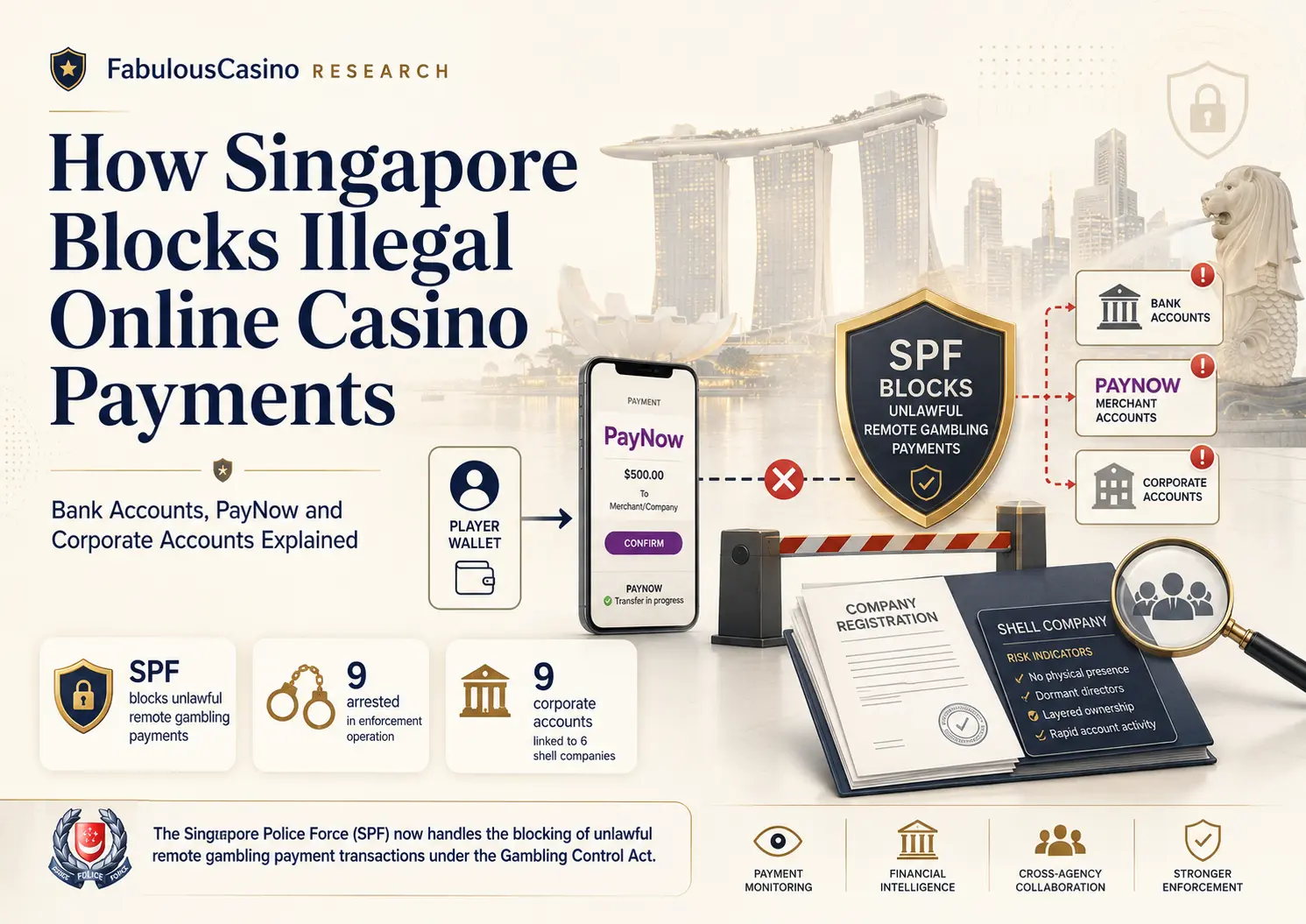
How Singapore Blocks Illegal Online Casino Payments
Singapore operates several layers of enforcement against unlawful remote gambling. These include blocking websites and advertisements, restricting access to payment services and taking direct action against individuals or companies suspected of facilitating illegal gambling transactions.
Since 1 January 2025, the Singapore Police Force (SPF) has been responsible for blocking access to unlawful remote gambling services, advertisements promoting those services and related payment transactions. The Gambling Regulatory Authority states that Singapore Pools is the only operator licensed to provide remote gambling services in Singapore.
In practice, this means enforcement can extend well beyond the casino website itself.
Singapore Uses Payment Blocking as an Enforcement Tool
Payment blocking has been part of Singapore’s approach to unlawful remote gambling for years, but the scale of intervention has become increasingly visible.
According to the Ministry of Home Affairs, by 31 December 2024 Singapore had blocked more than 3,800 illegal gambling websites and more than 145,000 illegal gambling transactions involving the Singapore public. Those blocked transactions represented approximately S$37 million.
The measures do not eliminate offshore gambling entirely. Singapore’s own authorities acknowledge that illegal operators can create new websites and that not every platform can be identified immediately.
That is one reason the financial layer matters.
A new casino domain can be launched quickly. Rebuilding banking relationships, payment accounts, corporate structures and local transaction channels may require considerably more effort.


What Can Singapore Actually Block?
The enforcement framework can affect several parts of the payment chain.
| Payment or infrastructure layer | Potential enforcement action |
|---|---|
| Bank accounts | Accounts linked to unlawful gambling transactions may be blocked, investigated or frozen. |
| Corporate bank accounts | Accounts belonging to companies suspected of facilitating gambling payments may be investigated. |
| Credit card payments | Payment services connected to illegal remote gambling can be blocked. |
| Payment network transactions | Authorities can work with financial institutions and payment network operators to prevent transactions. |
| Websites and apps | Access can be blocked or content can be taken down. |
| Advertising | Promotion of unlawful gambling services can be restricted or removed. |
The GemBet Case: Why Corporate Accounts Matter
A July 2026 enforcement operation provides a particularly useful example.
The Singapore Police Force arrested nine people aged between 17 and 55 over their suspected involvement in creating shell companies and corporate bank accounts that were allegedly handed over to a syndicate operating the illegal online gambling platform GemBet.
Police said six suspects were believed to have used their SingPass credentials to register businesses and open corporate bank accounts. Control of those entities, bank accounts and banking credentials was then allegedly relinquished to runners connected with the syndicate.
During the operation, police identified nine corporate bank accounts linked to six shell companies and froze more than S$39,000 in suspected criminal proceeds.
The important point for casino players is not simply that arrests were made.
It demonstrates how an offshore gambling platform can potentially create a payment experience that appears local even though the gambling service itself is not locally licensed.
How a Local-Looking Payment Route Can Work
Consider a simplified example.
- A player accesses an offshore online casino.
- The casino offers a Singapore-friendly payment method.
- The player is instructed to transfer funds to a Singapore bank or corporate account.
- The local account receives the payment.
- The gambling platform credits the player’s casino balance.
From the player’s perspective, the transaction may look surprisingly domestic.
The recipient may have a Singapore company name. The payment may take place through normal banking infrastructure. The transfer may even use a familiar local interface.
None of those characteristics establish that the gambling operator itself is authorised in Singapore.
Where Does PayNow Fit In?
PayNow deserves particular attention because it is one of Singapore’s most familiar payment systems.
For legitimate everyday payments, PayNow provides a convenient way to transfer Singapore dollars between individuals and businesses through participating banks and financial institutions.
But the appearance of PayNow inside an offshore casino cashier should not be interpreted as regulatory approval.
A gambling platform may potentially connect players with a local receiving account or merchant structure without itself holding a Singapore remote gambling licence.
This creates an important distinction:
PayNow availability describes a payment route. It does not describe the regulatory status of the casino using it.
Can Singapore Block PayNow Gambling Transactions?
There is no special legal category called a “PayNow casino licence”.
Singapore’s enforcement powers are broader. Authorities can target payment services and bank accounts linked to unlawful remote gambling.
The Ministry of Home Affairs has specifically stated that the Singapore Police Force can block payment services such as bank accounts and credit card payments connected to illegal remote gambling.
Where a PayNow transfer ultimately relies on an account that authorities identify as part of an unlawful gambling operation, that account or transaction infrastructure may therefore become subject to enforcement action.
World Cup 2026 Increased the Pressure
Singapore stepped up gambling enforcement around the 2026 FIFA World Cup because major sporting events typically increase illegal betting activity.
Between 1 May and 20 July 2026, police arrested or investigated 60 people in connection with illegal gambling or related account misuse.
During the same period, authorities:
- blocked or removed more than 600 illegal gambling websites, mobile apps and social-media items;
- worked with payment network operators and financial institutions;
- blocked at least 6,900 attempted banking transactions connected to illegal betting;
- prevented transactions worth more than S$600,000.
This shows that Singapore’s strategy is increasingly multi-layered.
The target is not simply the URL.
Shell Companies Can Make Offshore Casinos Look More Local
The use of corporate accounts introduces another layer of complexity.
A player making a payment to a company registered in Singapore might reasonably assume that the company is part of the casino operator or that the gambling service has some formal Singapore presence.
That assumption can be wrong.
Corporate registrations can potentially be used as payment intermediaries while the actual gambling platform operates elsewhere.
The July 2026 GemBet investigation illustrates why casino ownership and payment-company ownership should be treated separately.
A Singapore Company Name Is Not a Casino Licence
This distinction is particularly important when assessing offshore casinos.
A Singapore-facing casino may potentially have:
- a Singapore-specific website;
- SGD deposits;
- PayNow or bank-transfer options;
- Singapore company names appearing in the cashier;
- local customer acquisition or marketing;
and still not be licensed to provide remote gambling services in Singapore.
According to the Gambling Regulatory Authority, Singapore Pools remains the only operator licensed to provide remote gambling services in Singapore.
What Happens When a Gambling Payment Is Blocked?
The exact outcome depends on where enforcement occurs in the payment chain.
A transaction may fail before funds leave the player’s bank account. A receiving account may become unavailable. A bank account may be frozen as part of an investigation. Alternatively, an operator may simply replace one payment route with another.
Players should therefore be cautious when an offshore casino repeatedly changes:
- bank-account details;
- recipient company names;
- PayNow recipients;
- deposit instructions;
- payment domains;
- merchant descriptors.
A changing payment recipient does not automatically prove misconduct, because payment processors legitimately change. But frequent unexplained changes can be relevant when assessing operational stability.
Does Payment Blocking Mean Player Funds Are Protected?
No.
Payment enforcement is designed primarily to restrict unlawful gambling activity and disrupt the infrastructure supporting it.
It should not be confused with a player-protection scheme or deposit guarantee.
If authorities freeze an account connected with suspected criminal activity, players should not assume that casino balances or deposits will automatically be returned through the enforcement process.
Why This Matters for Casino Due Diligence
Traditional casino reviews frequently treat payment methods as a simple feature list:
PayNow ✓ — Bank Transfer ✓ — Crypto ✓
For Singapore, that is not enough.
A meaningful assessment should ask additional questions:
- Who receives the payment?
- Does the recipient name remain consistent?
- Is the recipient the casino operator, a payment provider or an unrelated company?
- Does the casino clearly disclose its operating entity?
- Which jurisdiction regulates that operator?
- Can withdrawals use the same payment route?
- Have payment instructions changed frequently?
Those questions do not automatically determine whether a casino is reliable.
But together they provide a much better picture than the presence of a PayNow logo.
TrustLab: How FabulousCasino Treats Singapore Payment Claims
Within the FabulousCasino TrustLab framework, local payment availability is treated as an operational factor, not proof of licensing or legitimacy.
A casino offering SGD deposits or PayNow may receive credit for convenience where those methods can be verified.
But payment availability does not override questions about:
- operator identity;
- licensing jurisdiction;
- withdrawal reliability;
- ownership transparency;
- payment consistency;
- regulatory exposure.
This is particularly important in Singapore because the difference between a locally convenient casino and a locally authorised casino is substantial.
Singapore’s Online Gambling Rules in One Minute
| Question | Answer |
|---|---|
| Are offshore online casinos licensed in Singapore? | No general offshore casino licensing regime exists for Singapore-facing remote casino operators. |
| Who can legally provide remote gambling in Singapore? | Singapore Pools is the only operator licensed by GRA to provide remote gambling services. |
| Can Singapore block casino websites? | Yes. |
| Can Singapore block gambling payments? | Yes. Payment services and accounts linked to unlawful gambling can be targeted. |
| Does PayNow mean a casino is legal? | No. |
| Can corporate bank accounts be investigated? | Yes. Recent enforcement actions have specifically involved corporate accounts and shell companies. |
The Fabulous Take
Singapore’s approach to illegal online gambling explains why evaluating an offshore casino requires more than checking whether the website loads or whether PayNow appears in the cashier.
The authorities increasingly target the infrastructure behind the transaction: websites, advertisements, bank accounts, corporate accounts and payment flows.
The GemBet investigation is particularly revealing because it demonstrates how local corporate and banking infrastructure can allegedly sit underneath an offshore gambling platform.
For players, the lesson is simple:
A local payment method can make an offshore casino easier to use. It does not make the casino local, licensed or protected by Singapore gambling regulation.
For FabulousCasino, that distinction is exactly why payment methods belong inside a wider operator and TrustLab assessment rather than being treated as another green tick in a comparison table.

Frequently Asked Questions
Can Singapore block payments to online casinos?
Yes. Singapore authorities can block payment services linked to unlawful remote gambling, including bank accounts and credit card payments.
Can Singapore block PayNow casino payments?
Authorities can target bank accounts and payment infrastructure associated with unlawful gambling. The availability of PayNow does not prevent the underlying account or payment route from becoming subject to enforcement.
Does a casino accepting PayNow have a Singapore licence?
No. PayNow is a payment method and does not indicate that the casino is licensed to provide remote gambling in Singapore.
Who is licensed for online gambling in Singapore?
The Gambling Regulatory Authority states that Singapore Pools is the only operator licensed to provide remote gambling services in Singapore.
Why do offshore casinos use Singapore corporate accounts?
There can be legitimate reasons for businesses to use local payment intermediaries, but recent police investigations show that corporate accounts and shell companies may also be used to facilitate illegal gambling transactions.
What happened in the GemBet investigation?
In July 2026, Singapore Police arrested nine people suspected of involvement in creating companies and corporate bank accounts allegedly used by a syndicate operating the GemBet platform. Police identified nine corporate accounts linked to six shell companies and froze more than S$39,000 in suspected criminal proceeds.

Aidan Lee Chong
Head of Asia
Aidan Lee Chong leads the Asia-Pacific division at FabulousCasino and has been actively involved in the iGaming industry for many years. Originally from Kuching, Malaysia, he built his reputation through the development of multiple gaming and affiliate platforms tailored to Asian markets. His background combines operational industry experience with deep insight into regional player trends and online casino growth across SEA/APAC.