


Full T&C apply. 18+ New customers only. Min deposit €10. All deposit bonuses are subject to a x35 wagering requirement within 7 days after activation. The maximum stake when wagering the bonus is 5 EUR. All types of bonus are disabled for cryptocurrencies, without exception.
What Does Source of Wealth Mean?
Source of wealth describes the economic activities, events or circumstances through which a person accumulated their total or overall wealth.
Common sources include:
- salary and employment income;
- self-employment or business profits;
- ownership or sale of a company;
- investment returns;
- property ownership or a property sale;
- inheritance;
- a pension;
- legal settlements;
- trust distributions;
- cryptocurrency investments;
- lottery or gambling winnings.
The question is not simply, “Which bank account did this money come from?” It is:
What activity or event created the player’s wealth, and is the gambling activity reasonably consistent with that financial background?
A player who says their wealth came from employment might be asked about their occupation, employer, annual income and length of employment. Someone whose wealth came from selling a business could instead be asked for company records and the sale agreement.
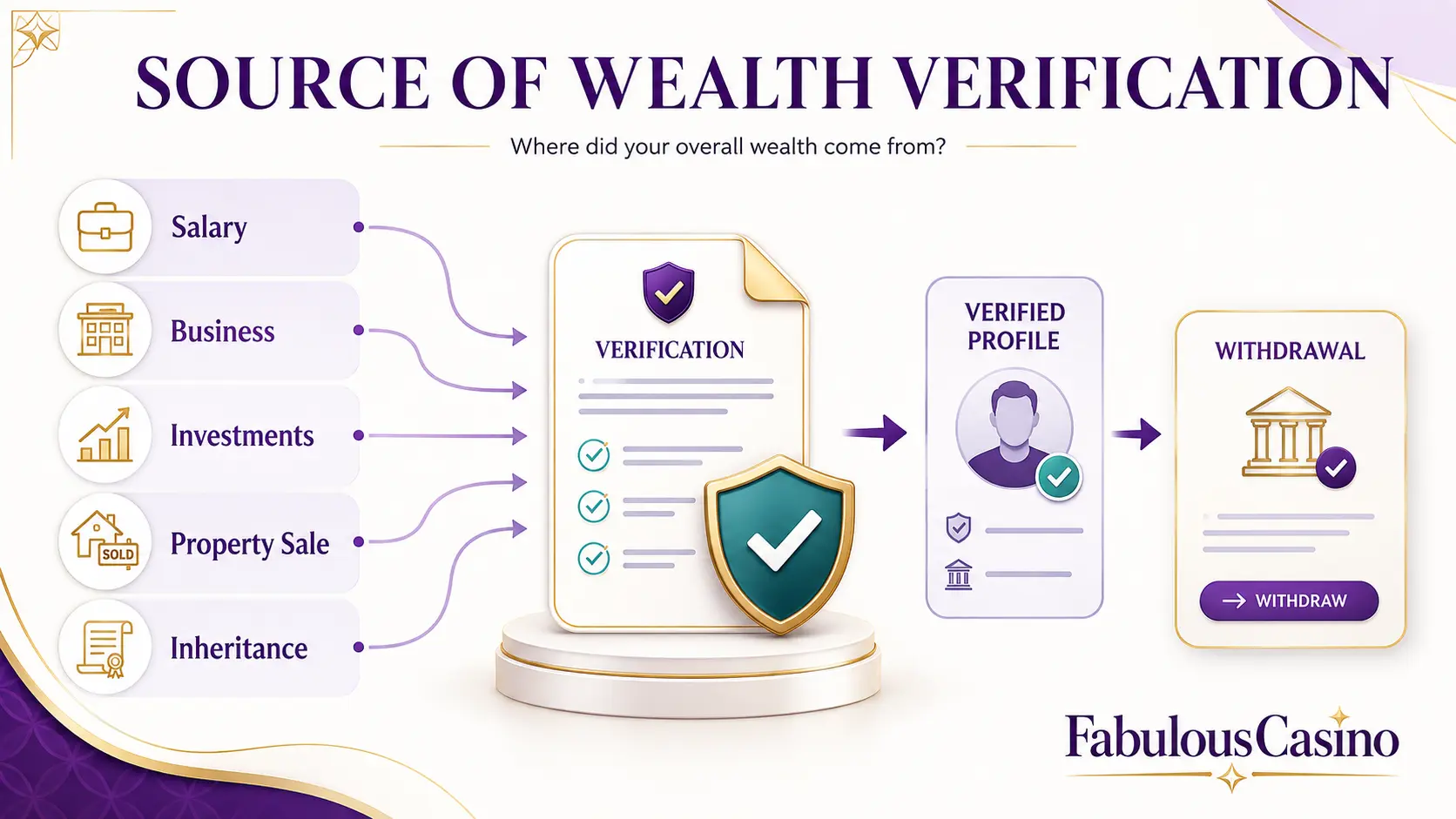
Source of wealth verification examines how a player accumulated their overall wealth—not merely where one casino deposit originated.
Source of Wealth vs Source of Funds
The two terms are related, but they do not mean the same thing.
| Check | What it examines | Example question | Possible evidence |
|---|---|---|---|
| Source of funds | The immediate origin of money used in a particular transaction or gambling account | Where did this €10,000 deposit come from? | Bank statement, payment record, investment withdrawal or sale receipt |
| Source of wealth | How the player accumulated their overall financial wealth | How did this player acquire enough wealth to support this level of gambling? | Payslips, tax returns, company accounts, investment statements, inheritance or property-sale documents |
Consider a player who deposits €20,000 from a savings account.
- The source of funds is the savings account from which the €20,000 was transferred.
- The source of wealth might be ten years of employment income, the sale of a company or an inheritance.
A bank statement can establish the payment route without fully explaining how the underlying wealth was created. This is why a casino may request more than proof that the bank account belongs to the player.
Why Do Casinos Ask for Source of Wealth?
1. Anti-money-laundering obligations
Casino accounts can potentially be used to deposit, move, convert or withdraw criminal proceeds. Operators therefore monitor whether a player’s transactions appear consistent with what they know about that customer.
The UK Gambling Commission’s anti-money-laundering guidance states that enhanced due diligence may include obtaining information about a customer’s source of funds and source of wealth. Operators may also need independent, reliable evidence to understand the customer’s financial situation and the reasons for particular transactions.
You can read the regulator’s official guidance on enhanced customer due diligence and ongoing monitoring.
2. Transactions that do not match the customer profile
A check may be triggered when gambling activity appears inconsistent with the information available to the casino.
For example:
- deposit levels rise suddenly;
- the player deposits unusually large amounts;
- declared income appears low compared with gambling expenditure;
- several payment methods are used;
- money arrives from a third party;
- the player makes large deposits followed by limited play and a withdrawal;
- transactions involve a high-risk country;
- the customer’s occupation or business presents additional financial-crime risks.
None of these factors automatically proves wrongdoing. They can nevertheless cause the operator to seek a clearer explanation.
3. Enhanced due diligence
Source of wealth checks are often part of enhanced due diligence, or EDD. These additional checks are used when a customer, transaction or business relationship presents a higher risk than usual.
According to current UK Gambling Commission guidance, source of wealth checks are mandatory in certain circumstances involving politically exposed persons and particular high-risk third-country relationships or transactions.
The wider principle is risk-based: the stronger the identified risk, the more information and verification the operator may reasonably require.
4. Politically exposed persons
A politically exposed person, commonly called a PEP, is someone who holds or has held a prominent public function. Depending on the applicable rules, enhanced measures can also apply to family members and close associates.
PEP status does not mean that a person has committed a crime. It means that their position may expose them to increased risks involving bribery, corruption or misuse of public funds.
The international FATF Recommendations require reasonable measures to establish the source of wealth and source of funds in relevant higher-risk PEP relationships.
5. Ongoing monitoring
Verification does not necessarily end when an account is opened. Casinos may continue monitoring payment patterns, account activity and changes in customer behaviour.
A player who initially deposited small amounts may therefore face additional checks after substantially increasing their activity. Previously supplied documents may also become outdated.
Is Source of Wealth the Same as an Affordability Check?
No, although the checks can overlap.
A source of wealth check focuses primarily on financial crime:
- Is the wealth legitimate?
- How was it accumulated?
- Does the explanation match the available evidence?
- Is the gambling activity consistent with the customer profile?
An affordability or financial-risk check focuses more directly on potential gambling harm:
- Can the customer reasonably sustain this level of spending?
- Does the gambling create signs of financial distress?
- Should the operator restrict the account or contact the player?
The same document may inform both processes. For example, a payslip can help explain the customer’s wealth and indicate whether their gambling expenditure appears sustainable. Nevertheless, operators should explain why information is being requested rather than treating every financial check as interchangeable.


What Can Trigger a Casino Source of Wealth Check?
There is no universal public threshold that applies to every player, operator and jurisdiction. Casinos generally use a combination of regulatory requirements, internal risk rules and individual account behaviour.
Possible triggers include:
- large individual deposits;
- high cumulative deposits or losses;
- a rapid increase in gambling activity;
- deposit levels inconsistent with known income;
- high-value withdrawals;
- third-party payments;
- multiple cards, bank accounts or e-wallets;
- unusual cryptocurrency transactions;
- links to high-risk jurisdictions;
- PEP identification;
- negative media or sanctions-screening results;
- money moving through the account with little genuine gambling;
- conflicting information supplied by the player;
- previous documents that no longer explain current activity.
A withdrawal request may bring unresolved checks to the operator’s attention, but a casino should not deliberately postpone foreseeable verification until the player attempts to cash out.
Which Source of Wealth Documents Can a Casino Request?
The appropriate documents depend on the explanation given by the player. There is no single document that proves every possible source of wealth.
Employment income
- recent payslips;
- an employment contract;
- annual income statements;
- tax returns;
- bank statements showing salary payments;
- a letter from the employer.
Self-employment or business ownership
- company accounts;
- business bank statements;
- tax returns;
- dividend statements;
- shareholder records;
- company registration documents;
- evidence of drawings or distributions.
Sale of a company
- the sale or purchase agreement;
- share-transfer records;
- lawyer or accountant confirmation;
- bank statements showing receipt of the proceeds;
- relevant tax documentation.
Investments
- brokerage statements;
- investment portfolio reports;
- dividend statements;
- records showing the purchase and sale of investments;
- bank statements showing proceeds entering the account;
- tax declarations covering investment income.
Property sale
- the property sale contract;
- land registry records;
- a completion statement;
- lawyer or notary documentation;
- bank statements showing receipt of the sale proceeds.
Inheritance
- a will or probate document;
- a grant of representation;
- a letter from the estate’s lawyer or administrator;
- bank statements showing receipt of inherited funds;
- inheritance tax documentation.
Pension income
- pension statements;
- retirement-benefit letters;
- tax documents;
- bank statements showing regular pension payments.
Cryptocurrency wealth
- exchange account statements;
- transaction histories;
- wallet addresses and blockchain records;
- evidence of the original asset purchases;
- tax returns reporting cryptocurrency gains;
- proof of control over the relevant wallet.
Crypto documentation can become particularly complicated when assets have moved through self-hosted wallets, decentralised exchanges, mixers or several blockchains. A transaction visible on-chain does not by itself establish who owned the wallet or how the original assets were acquired.
Previous gambling or lottery winnings
- operator account statements;
- withdrawal confirmations;
- bank statements showing receipt of the winnings;
- official lottery documentation;
- tax records where applicable.
A screenshot of a balance without identifying details or transaction history may not be sufficient.
Does the Casino Need to Prove Every Euro of Your Wealth?
Not necessarily. Source of wealth verification should be proportionate to the risk and the activity being reviewed.
An operator may need enough information to build a credible picture of:
- the main origin of the customer’s wealth;
- the approximate value of that wealth;
- the legitimacy of the activities that created it;
- whether the gambling activity is plausible in that context.
Someone with several sources of wealth may be able to establish their profile through a combination of evidence rather than documenting the history of every asset they have ever owned.
Conversely, a vague statement such as “savings,” “investments” or “business income” may not be enough where the casino has identified a meaningful risk. The operator may reasonably ask how much wealth was accumulated, over what period and through which activities.
What Happens After You Submit the Documents?
The casino’s compliance team may compare the documents with:
- your identity and registered address;
- your stated occupation;
- deposit and withdrawal history;
- payment methods used on the account;
- declared income or wealth;
- public company and property information;
- sanctions and PEP databases;
- the expected pattern of gambling activity.
The possible outcomes include:
- the verification is accepted and the account continues normally;
- additional or clearer documents are requested;
- deposit or loss limits are imposed;
- the account is temporarily restricted;
- the withdrawal is processed after the review;
- the business relationship is ended;
- the operator submits a regulatory report without disclosing that action to the player.
Passing source of wealth verification does not mean the casino must allow unlimited gambling. Responsible gambling, commercial and jurisdictional restrictions may still apply.
How Long Does Source of Wealth Verification Take?
There is no reliable universal timeframe. A straightforward employment-income check may be resolved quickly, while business ownership, inheritance, cryptocurrency or cross-border wealth can require more detailed analysis.
Factors affecting the review include:
- whether the documents are complete and readable;
- whether names and addresses match;
- whether the evidence covers the relevant period;
- whether documents require translation;
- the complexity of the wealth source;
- the number of accounts or companies involved;
- whether third-party verification is required;
- the operator’s compliance staffing and procedures.
A legitimate review can take time. That does not make an unexplained or open-ended delay acceptable.
Can a Casino Withhold a Withdrawal During the Check?
A casino may temporarily restrict transactions while completing checks required by applicable law or its regulatory obligations. That does not automatically mean the player has forfeited the balance.
The operator should distinguish between:
- a temporary compliance review;
- an account restriction;
- termination of the customer relationship;
- confiscation of funds.
These outcomes are not interchangeable. A request for documents does not itself establish that the money is illegitimate.
The UK Gambling Commission has stated that operators should obtain necessary information promptly and should not wait until withdrawal if they could reasonably have requested it earlier. Its guidance on account withdrawals also makes clear that compliance controls should not be used as an arbitrary barrier to accessing funds.
When Does a Legitimate Check Become a Withdrawal Obstacle?
Requesting source of wealth evidence is not inherently unfair. The quality of the process matters.
Potential warning signs include:
- the casino cannot explain what information is missing;
- the same documents are requested repeatedly without explanation;
- new requirements appear every time the player complies;
- documents are rejected without identifying the problem;
- the operator requests information unrelated to the identified risk;
- support provides contradictory instructions;
- the player is encouraged to cancel and continue gambling;
- the withdrawal remains reversible throughout a lengthy review;
- the casino accepts large deposits but begins checks only after a win;
- no alternative is offered when a requested document cannot reasonably exist;
- the operator treats verification as automatic grounds for confiscation.
A well-run casino should be able to tell the player what category of evidence is required, which period it must cover and how it can be submitted securely.
What Should You Do If a Casino Requests Source of Wealth?
1. Ask what must be established
Request a clear explanation of whether the casino is checking source of funds, source of wealth, affordability or a combination of these.
2. Identify the actual source accurately
Do not choose the easiest-looking answer if it is not true. If your wealth came from several sources, explain the main ones and how they connect.
3. Build a simple evidence trail
Documents should tell a coherent story. For example:
- A property sale agreement identifies the asset and sale value.
- A completion statement confirms the transaction.
- A bank statement shows the proceeds entering your account.
- A later bank statement shows the casino deposit.
This is more persuasive than sending a random collection of financial documents without context.
4. Add a short written explanation
A concise timeline can help the reviewer understand complex documents. State what each file shows without including unnecessary personal information.
5. Submit documents securely
Use the casino’s official verification portal or another confirmed secure channel. Be cautious if support asks you to send sensitive documents to an unfamiliar email address or messaging account.
6. Keep copies and a communication record
Save the documents submitted, upload confirmations, support conversations and dates. This record may be important if the review becomes a complaint.
7. Ask before obscuring information
It is reasonable to protect unrelated personal data, but hiding information required to verify the source can cause rejection. Ask the casino which details may be redacted.
Can You Refuse a Source of Wealth Check?
You can decline to provide personal financial information, but the casino may then be unable to complete its required checks.
Depending on the circumstances, it may:
- restrict further deposits;
- suspend gambling activity;
- close the account;
- delay transactions while determining how existing funds must be handled;
- end the customer relationship after returning funds where legally permitted.
Refusal does not automatically prove money laundering. It can nevertheless prevent the operator from satisfying its regulatory obligations.
If you believe the request is excessive, ask the casino to explain the legal or risk basis, the exact evidence needed and its complaint process. Avoid simply ignoring the request while repeatedly resubmitting the withdrawal.
How Should Casinos Protect Financial Documents?
Source of wealth files can reveal highly sensitive information, including income, assets, account numbers, business interests and family circumstances.
A responsible operator should:
- request only information relevant to the review;
- provide a secure upload method;
- limit employee access;
- protect documents during storage and transfer;
- explain how the information will be used;
- retain it only as required by law and legitimate business needs;
- respond appropriately to data-access and privacy requests.
Players should verify that they are communicating with the genuine casino before uploading documents. Financial verification requests are also a useful theme for phishing attempts.
TrustLab View: What We Expect From Casinos
TrustLab does not mark a casino down merely because it performs a legitimate source of wealth check. Effective anti-money-laundering controls are part of operating a credible gambling business.
Our assessment instead considers how those controls are applied.
We look for:
- financial checks that reflect actual risk rather than arbitrary obstruction;
- early identification of foreseeable verification requirements;
- a clear distinction between source of funds, source of wealth and affordability;
- specific document requests;
- secure submission methods;
- reasonable response times;
- consistent communication from support and compliance teams;
- protection of sensitive player data;
- no encouragement to reverse the withdrawal and continue gambling;
- no confiscation without a properly stated basis;
- a functioning complaints process when the review becomes disputed.
The critical question is not simply whether the casino requested financial documents. It is whether the request was necessary, proportionate and competently managed.
A compliance check protects the gambling system. A poorly managed compliance check merely traps the player inside it.
Frequently Asked Questions
What is source of wealth verification at a casino?
It is a check designed to establish how a player accumulated their overall wealth. The casino may examine employment, business ownership, investments, property, inheritance or other legitimate sources.
Is source of wealth the same as source of funds?
No. Source of funds concerns the immediate origin of money used for a transaction. Source of wealth concerns the broader activities or events that created the person’s overall financial position.
Why is my bank statement not enough?
A bank statement can show that money came from your account, but it may not explain how you originally acquired it. The casino may need documents covering the underlying source, such as salary, a business sale or inheritance.
Can a casino ask for payslips and tax returns?
Yes, when those documents are relevant and proportionate to the source being verified. The operator should explain what it needs and why.
Does a large withdrawal automatically trigger source of wealth verification?
Not automatically. A large withdrawal may bring the account to the compliance team’s attention, but checks are generally based on the complete risk profile and transaction history.
Can gambling winnings be a source of wealth?
Yes, but the player may need account histories, withdrawal confirmations, bank records or official lottery documentation showing how the winnings were obtained.
Can cryptocurrency profits be used as evidence of wealth?
Yes. The evidence may need to connect the original asset purchase, trading or investment history, wallet ownership, blockchain transfers, exchange withdrawals and conversion into conventional currency.
Can a casino confiscate winnings because I cannot provide one document?
Failure to provide sufficient evidence can prevent the operator from completing its review, but it should not be treated as automatic proof that all funds or winnings are illegitimate. The outcome depends on the facts, terms, licence and applicable law.
How long should the verification take?
There is no universal deadline. The operator should nevertheless review complete documents within a reasonable period, explain missing information and avoid repetitive or open-ended requests.
What can I do if the casino keeps requesting new documents?
Ask for a complete written list of outstanding requirements and the reason previous evidence was insufficient. Keep records, use the casino’s formal complaint procedure and escalate to the relevant regulator or dispute-resolution body where available.
Final Verdict
Source of wealth verification examines how a player built their overall financial wealth. It goes beyond identifying the bank account, card or wallet used for one casino deposit.
A casino may reasonably request evidence of salary, business income, investments, property sales, inheritance or another legitimate source when its risk assessment requires a deeper review.
The existence of the check is therefore not the problem. The real test is how the casino conducts it.
A trustworthy operator requests relevant documents, explains the process, protects sensitive data and reaches a decision without unnecessary delay. An operator that waits until withdrawal, repeatedly moves the goalposts or provides no clear route to resolution turns a legitimate compliance control into a player-experience failure.
FabulousCasino examines source of wealth procedures as part of the TrustLab Withdrawal Assessment, Transparency Index and Licence Framework. We distinguish necessary financial-crime controls from practices that create disproportionate or unexplained barriers to legitimate withdrawals.

Enrico Braunschweig
Founder
Enrico Braunschweig is the Founder of FabulousCasino and a long-time entrepreneur in the digital marketing and iGaming industry. With nearly two decades of experience in affiliate marketing, online casino acquisition, and SEO-driven publishing, he focuses on building trusted gaming brands with a strong emphasis on transparency, product quality, and long-term player value.