

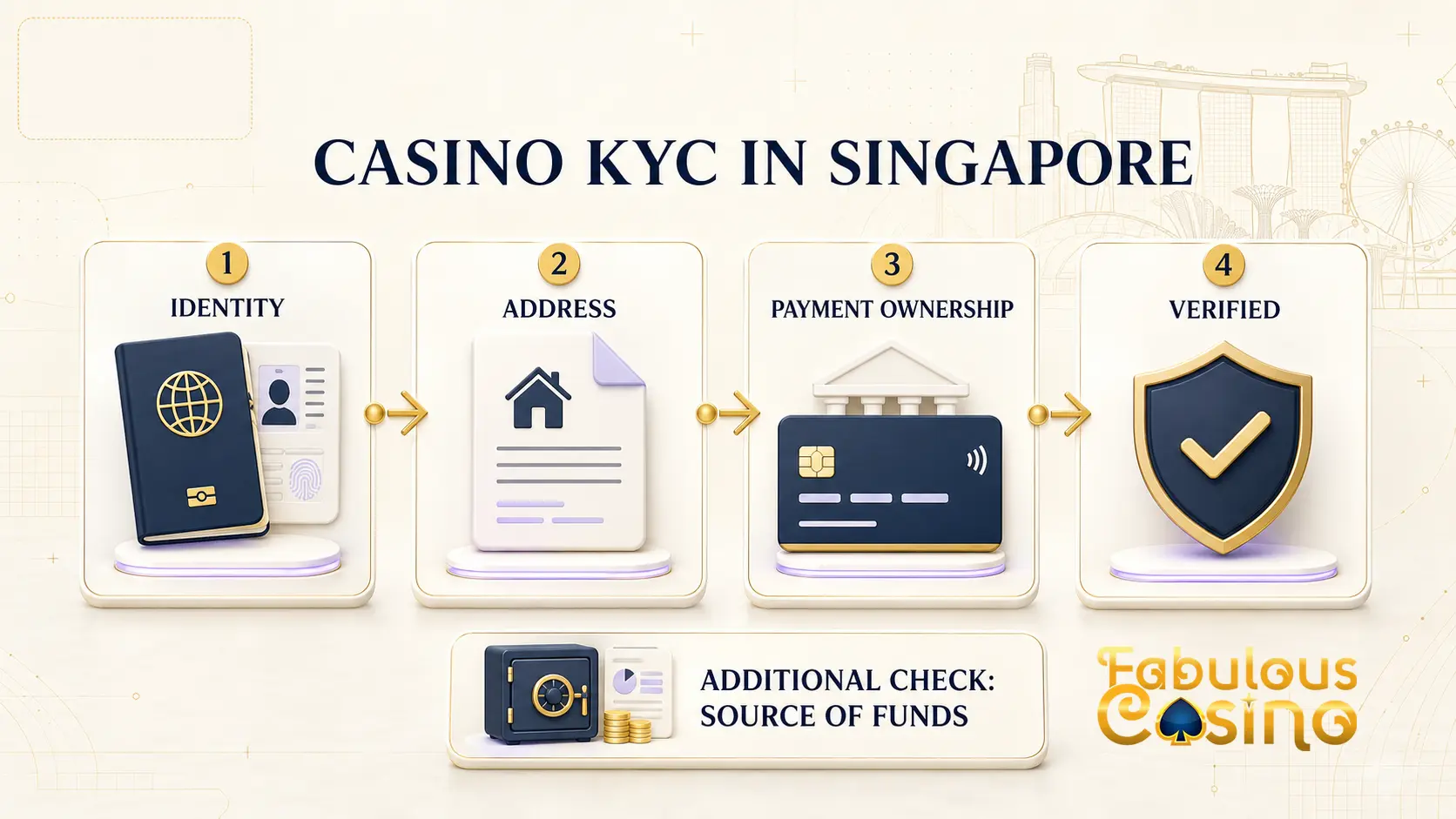
Additional documents may be requested when:
- the player makes a large deposit or withdrawal;
- the payment account belongs to another person;
- the registered details do not match the documents;
- the casino detects unusual account activity;
- the source of the gambling funds requires clarification.
KYC is not automatically a sign that a casino intends to delay payment. Identity and anti-money-laundering checks are normal parts of regulated gambling and financial services.
However, the timing, relevance and handling of the request matter.
A legitimate KYC check verifies the player. It should not become an endless search for new reasons to postpone a valid withdrawal.
What Does Casino KYC Mean?
KYC means Know Your Customer.
The basic objective is to establish that:
- the player is a real person;
- the player is old enough to use the service;
- the account details are accurate;
- the payment methods belong to the account holder;
- the account is not being used for fraud or money laundering;
- the player is not opening duplicate or prohibited accounts.
KYC can be completed electronically or through uploaded documents.
An electronic check may compare the player’s name, date of birth, address, telephone number or identity details against reliable data sources. If the information cannot be confirmed automatically, the casino may request documentary evidence.


Is There a Special Singapore Casino KYC Process?
There is no single verification process used by every online casino accepting players from Singapore.
The required checks depend on:
- the casino’s legal operator;
- the licence under which the account is opened;
- the operator’s anti-money-laundering obligations;
- the player’s country and risk profile;
- the payment method;
- the size and pattern of transactions;
- the results of electronic verification.
A casino licensed in another jurisdiction may apply the rules of that licence and its own compliance procedures. The fact that it accepts SGD, PayNow or Singapore registrations does not mean it is licensed by Singapore’s Gambling Regulatory Authority.
The GRA states that Singapore Pools is the only operator licensed to provide remote gambling services in Singapore. Foreign licences do not by themselves authorise an online casino to offer gambling to people located in Singapore.
Players should check the current GRA guidance on unlawful remote gambling.
Why Do Casinos Verify Players?
A casino may perform KYC for several connected reasons.
Age verification
The operator must establish that the customer meets the applicable minimum gambling age.
Identity verification
The casino needs to confirm that the person controlling the account is the person named during registration.
Payment ownership
Deposits and withdrawals should generally use accounts or payment methods belonging to the verified player.
Duplicate-account detection
KYC can reveal whether the player has already registered at the casino or within a connected group of sister sites.
Bonus enforcement
Operators use identity, household and payment information to identify multiple claims of a new-player bonus.
Anti-money-laundering checks
Casinos can be used to deposit money, create gambling activity and attempt to withdraw the funds as apparently legitimate winnings. KYC helps identify and reduce this risk.
Responsible gambling
Reliable identification helps operators recognise self-excluded players and connect accounts belonging to the same person.
When Does an Online Casino Request KYC?
KYC can occur at several stages of the player journey.
| KYC stage | What may happen |
|---|---|
| Registration | Name, date of birth, address, telephone number and email are checked |
| Before the first deposit | The casino may require basic identity or age verification |
| After a deposit | Payment ownership or an account-name mismatch may be reviewed |
| Before gambling | Some licensed markets require identity verification before play is permitted |
| Before withdrawal | Documents may be requested if verification remains incomplete |
| During a later review | New activity or increased transaction levels can trigger enhanced checks |
Early verification is generally better for the player. It reveals missing documents or account mismatches before a substantial balance is waiting for withdrawal.
The UK Gambling Commission, for example, requires its licensees to establish a customer’s identity before gambling is permitted. It also states that a withdrawal should not trigger information requests that the operator could reasonably have made earlier.
Those rules apply to Great Britain licensees and should not automatically be projected onto every international casino. They nevertheless provide a useful standard for assessing the timing of verification.
See the Commission’s guidance on age and identity verification.
Which Documents Are Usually Required?
The exact list varies, but most casino KYC requests fall into a small number of categories.
| Purpose | Common documents | What must normally be visible |
|---|---|---|
| Identity | Passport, NRIC, FIN or driving licence | Name, photograph, date of birth, document number and expiry date |
| Address | Bank statement, utility bill or government correspondence | Name, residential address, issuer and recent date |
| Payment ownership | Bank statement, PayNow profile or card evidence | Player name and sufficient details to identify the account |
| Face match | Selfie, document selfie or liveness check | Clear face and, where requested, the identity document |
| Source of funds | Payslip, bank statement, tax document or sale record | Origin of the specific money used for gambling |
| Source of wealth | Employment, business, investment or asset documentation | How the player accumulated their wider financial resources |
Not every player will be asked for every document.
A routine identity check may require only one identity document and one address document. Source-of-funds and source-of-wealth reviews are usually additional, risk-based checks.
Can a Singapore Player Use an NRIC for Casino KYC?
An NRIC can establish identity, date of birth and Singapore residency. Whether it is accepted depends on the casino and its verification provider.
Some international operators prefer a passport because their automated system is designed to process internationally standardised travel documents.
Players should consider the sensitivity of an NRIC before uploading it.
Singapore’s Personal Data Protection Commission states that organisations may collect NRIC information when required by law or when necessary to establish or verify identity to a high degree of accuracy. It also warns against using NRIC numbers as passwords or routine authentication credentials.
See the PDPC’s guidance on NRIC and national identification numbers.
Before supplying an NRIC copy to an international casino, check:
- the identity of the legal operator;
- the casino’s licence;
- its privacy policy;
- which company receives the document;
- whether an external verification provider is used;
- how long the data is retained;
- whether a passport would be accepted instead.
Passport vs NRIC for Casino Verification
| Document | Potential advantage | Potential limitation |
|---|---|---|
| Passport | Widely supported by international verification systems | Does not normally prove the current residential address |
| NRIC | Strong Singapore identity document | Sensitive identifier and not accepted by every international system |
| FIN | Can establish the identity of eligible foreign residents | Additional address or residency evidence may still be required |
| Driving licence | Can show identity and sometimes address | Acceptance varies significantly between casinos |
The best document is usually the one explicitly accepted by the casino and capable of passing the required check without unnecessary disclosure.
What Counts as Proof of Address in Singapore?
A proof-of-address document connects the player’s name with the residential address registered at the casino.
Common examples include:
- a bank or credit-card statement;
- a utility bill;
- government correspondence;
- a recognised financial account statement;
- another official document accepted by the operator.
The document may need to:
- be issued within the last three months;
- show the full name;
- show the complete residential address;
- display the issue date;
- identify the issuing organisation;
- be supplied as an original PDF or clear photograph.
Three months is a common operator requirement, not a universal Singapore rule. Some casinos accept documents issued within six months, while others maintain a shorter period.
What If the Address Uses a Different Format?
Singapore addresses can be presented in several slightly different ways.
One document might show:
10 Example Road #08-12 Singapore 123456
Another might show:
10 Example Rd, Singapore 123456
Small formatting differences should normally be explainable. More substantial differences can trigger a review.
Common problems include:
- the unit number is missing;
- an old residential address remains on the casino account;
- the document belongs to another household member;
- the registered name is abbreviated;
- the postal code is incorrect;
- the player registered using a non-residential address.
If the account information is wrong, contact the casino before uploading documents repeatedly. Editing or altering a document to force a match can create a much more serious verification problem.
How Does PayNow Affect Casino KYC?
PayNow payments connect the casino transaction to a registered bank or eligible financial account.
The operator may check whether:
- the PayNow account belongs to the casino player;
- the sender name matches the registered casino name;
- the deposit originated from a third party;
- the withdrawal destination belongs to the same person;
- the transaction can be connected to the account deposit.
A player called Jonathan Tan Wei Ming might register at the casino as Jon Tan while the bank displays the complete legal name. This can usually be explained, but it may prevent automatic matching.
More serious problems arise when:
- a spouse or friend made the deposit;
- the PayNow recipient or sender is unrelated to the account;
- the player uses a business account for personal gambling;
- the casino requests a withdrawal to a different person;
- multiple players use the same payment account.
PayNow availability does not remove KYC. A fast deposit can still lead to a manual ownership check before withdrawal.
How Can You Prove Ownership of a PayNow Account?
The casino may request evidence showing the player’s registered name and the relevant transaction.
Depending on the operator, this could include:
- a bank statement containing the transaction;
- a PayNow registration screen showing the account holder;
- a payment receipt with the transaction reference;
- confirmation issued by the bank;
- a redacted bank-account overview.
The document should show enough information to establish ownership without disclosing unnecessary security data.
Never provide:
- internet-banking passwords;
- one-time passwords;
- card PINs;
- CVV security codes;
- Singpass login credentials;
- remote access to a telephone or computer.
What Is a Casino Selfie Check?
A selfie check compares the person controlling the account with the photograph on the identity document.
The operator may request:
- a normal selfie;
- a selfie holding the identity document;
- a selfie holding a handwritten code and date;
- a short video;
- an automated liveness check.
Liveness checks can ask the player to turn their head, blink or follow on-screen instructions. Their purpose is to reduce the use of stolen documents, static photographs and manipulated identities.
A selfie request is not automatically suspicious. The upload route matters.
Documents should preferably be submitted through:
- the casino’s secure account portal;
- the named verification provider;
- an official support channel identified on the casino website.
A request to send identity documents to an unknown Telegram account or private messaging number deserves considerably more scrutiny.
What Is Source of Funds?
Source of funds describes where the money used for a particular gambling activity or transaction came from.
Possible evidence includes:
- recent payslips;
- bank statements showing salary payments;
- business income records;
- investment statements;
- inheritance documentation;
- property or asset sale records;
- evidence of legitimate gambling winnings.
The operator is not merely checking that money exists in the account. It may need to understand how the player obtained it.
A large bank balance without a visible origin may not answer a source-of-funds question.
Source of Funds vs Source of Wealth
| Check | Question being answered | Example |
|---|---|---|
| Source of funds | Where did the money used for these deposits come from? | Monthly salary credited to a DBS account |
| Source of wealth | How did the player accumulate their overall financial resources? | Employment income, company ownership and investments |
A source-of-wealth review is generally broader and more intrusive. It is more likely to occur with high-value, unusual or higher-risk activity.
The Malta Gaming Authority, for example, states that its relevant casino and gaming licensees must use a risk-based approach to anti-money-laundering controls.
See the MGA’s anti-money-laundering overview.
What Can Trigger Enhanced Casino KYC?
Enhanced checks do not depend on one universal monetary threshold.
Possible triggers include:
- a sharp increase in deposit size;
- high cumulative transaction value;
- deposits followed by little or no gambling;
- rapid deposits and withdrawal requests;
- multiple payment methods;
- third-party transfers;
- frequent changes in personal details;
- different countries appearing in account activity;
- VPN or location inconsistencies;
- payments inconsistent with the known customer profile;
- politically exposed person status;
- adverse compliance or sanctions results.
Singapore’s casino regulations require customer due diligence and enhanced checks for higher-risk patrons at its locally regulated land-based casinos. A 2023 GRA enforcement action against Resorts World Sentosa concerned failures to identify third parties depositing S$5,000 or more into patron accounts.
This local land-casino requirement does not create a universal S$5,000 online-casino KYC threshold. It does demonstrate why third-party gambling payments receive particular attention.
See the GRA’s published enforcement announcement.
Can a Casino Request KYC Again?
Yes. Verification is not always a one-time event.
A casino may repeat or update KYC when:
- an identity document expires;
- the player changes address;
- a new payment method is added;
- the account becomes significantly more active;
- previous information is no longer considered reliable;
- the operator or licence changes;
- an enhanced due-diligence review is triggered.
A repeated request should have a clear purpose. Asking for an updated passport after the previous one expired is different from repeatedly rejecting the same valid document without explaining what is missing.
How Long Does Casino KYC Take?
There is no universal verification time.
A basic automated check can finish within minutes. Manual reviews may take hours or several business days.
The time depends on:
- document quality;
- data consistency;
- verification-provider availability;
- weekends and public holidays;
- the need for translation;
- payment ownership questions;
- enhanced due diligence;
- the casino’s compliance workload.
“Instant verification” usually describes a successful automated check. It should not be interpreted as a guarantee that every account will pass immediately.
Why Was My KYC Document Rejected?
| Problem | Practical response |
|---|---|
| Image is blurred | Photograph the document again in good, even lighting |
| Document edges are missing | Include all four corners and the complete page |
| Document has expired | Upload a current accepted document |
| Address is outdated | Update the account and provide a current address document |
| Name does not match | Ask which legal-name format the casino requires |
| Screenshot is not accepted | Download the original PDF statement where possible |
| Document is password protected | Supply an accessible copy through the secure upload portal |
| Information was edited | Provide an unaltered original document |
| Payment belongs to another person | Explain the transaction and expect additional ownership checks |
Do not repeatedly upload different versions without understanding the rejection. Ask support to identify the missing or unacceptable element.
Should You Edit or Redact KYC Documents?
Do not alter information required for the verification.
Cropping, covering or editing the name, document number, photograph, issue date or address can cause rejection.
Limited redaction may be appropriate for information the casino does not require, but it should be confirmed first.
For example, when proving card ownership, a casino may permit or require:
- the middle card digits to be hidden;
- the CVV to be covered completely;
- only the first and last digits to remain visible.
Never send an image showing the complete card number together with the CVV.
Can KYC Delay a Casino Withdrawal?
Yes. A casino can hold a withdrawal while required identity, payment or anti-money-laundering checks remain incomplete.
That does not mean every KYC delay is reasonable.
TrustLab examines:
- whether the casino could have requested the information earlier;
- whether the request is relevant to the account activity;
- whether document requirements are explained clearly;
- whether the operator reviews submissions within a reasonable period;
- whether each rejection identifies a correctable problem;
- whether new documents are requested one at a time without explanation;
- whether the casino continues accepting deposits while blocking withdrawals;
- whether verified funds are released promptly after approval.
KYC can explain why a withdrawal is paused. It does not justify silence, moving requirements or indefinite document collection.
Can a Casino Ask for a Deposit Before Verifying a Withdrawal?
A request to make a small deposit can sometimes be connected to payment-method ownership or account verification.
However, players should be highly cautious when told they must deposit additional money to:
- unlock winnings;
- pay tax in advance;
- activate a withdrawal;
- raise an account level;
- prove that the account is genuine;
- release a frozen jackpot;
- pay an anti-money-laundering fee.
KYC normally verifies existing information. It should not create an open-ended demand to send more money.
Casino KYC Red Flags
A verification request deserves additional scrutiny when:
- the casino’s legal operator cannot be identified;
- documents must be sent to an unrelated personal email address;
- support asks for a bank password or one-time code;
- the player is asked to provide Singpass access;
- remote access to the player’s device is requested;
- the casino demands an additional deposit to complete KYC;
- valid documents are rejected without a reason;
- new requirements appear after every completed step;
- the withdrawal is cancelled repeatedly during verification;
- the casino refuses to identify its verification provider;
- the privacy policy does not name the company processing personal data.
How to Complete Casino KYC With Fewer Delays
- Register using the complete legal name shown on your identity document.
- Enter the correct date of birth and residential address.
- Use payment methods held in your own name.
- Check document requirements before requesting a withdrawal.
- Use current, unaltered documents.
- Include all document edges and keep text readable.
- Download original PDF statements where accepted.
- Do not submit screenshots containing passwords, codes or full card security details.
- Keep copies of submitted documents and support messages.
- Ask for a specific explanation if a document is rejected.
Completing KYC early cannot guarantee a fast withdrawal, but it removes one of the most common causes of avoidable delay.
How Should a Casino Protect KYC Data?
KYC documents can contain:
- national identification numbers;
- signatures;
- photographs;
- dates of birth;
- home addresses;
- bank information;
- employment and income records.
The casino’s privacy policy should explain:
- the legal company collecting the information;
- the purpose of collection;
- external verification providers;
- international data transfers;
- document-retention periods;
- security and access controls;
- how privacy enquiries can be submitted.
The Singapore PDPA provides a baseline standard for personal-data protection in Singapore. An overseas casino is not automatically governed by the PDPA merely because it accepts a Singapore player, so the operator’s jurisdiction and privacy framework still matter.
See the PDPC’s overview of the Personal Data Protection Act.
What to Do When Casino Verification Is Stuck
- Ask which exact document or information remains outstanding.
- Request the reason each submitted document was rejected.
- Confirm the accepted file format, issue date and document type.
- Ask whether identity, address, payment or source of funds remains unverified.
- Keep the withdrawal active unless there is a clear reason to cancel it.
- Save the terms, transaction history and all correspondence.
- Use the casino’s formal complaint procedure if no progress is made.
- Escalate to the relevant regulator or dispute body where available.
When contacting support, a precise question produces a more useful record than repeatedly asking when the withdrawal will arrive.
For example:
“Please confirm which verification category remains incomplete, which submitted document was rejected, the reason for rejection and the exact document required to complete the review.”
How TrustLab Assesses Casino KYC
FabulousCasino does not treat the absence of KYC as an automatic advantage.
A casino promising “no verification ever” may be avoiding basic controls or may request documents later when the player has more money at risk.
TrustLab looks for a process that is:
- proportionate to the account activity;
- explained before withdrawal;
- handled through a secure channel;
- consistent with the casino’s published operator and licence;
- clear about payment ownership;
- responsive when documents are rejected;
- completed without unnecessary withdrawal delays.
We distinguish between:
- normal verification: relevant documents with understandable requirements;
- enhanced due diligence: additional checks supported by the account’s risk or transaction profile;
- KYC friction: slow or poorly explained processing;
- KYC obstruction: repeated or irrelevant demands that prevent a legitimate withdrawal.
The FabulousCasino View
KYC should begin with a simple principle: the casino must know who owns the account and where the money comes from when additional checks are justified.
The player should also know:
- which company receives the documents;
- why each document is required;
- how the information is protected;
- when verification is complete;
- what remains before the withdrawal can be processed.
A five-minute automated identity check and a month-long withdrawal dispute should not both be described simply as “standard KYC”. The quality of the process matters.
Good KYC protects the account and clears the withdrawal path. Bad KYC leaves the player verified enough to deposit but never verified enough to be paid.
Frequently Asked Questions
What documents do Singapore players need for casino KYC?
Common requests include a passport or NRIC, proof of address, a selfie or liveness check and evidence showing ownership of the deposit or withdrawal account.
Can I use my NRIC for online casino verification?
Some casinos accept it, while others prefer a passport. Before uploading an NRIC, identify the operator, verification provider and privacy policy.
Do I need proof of address if my NRIC shows an address?
Possibly. The casino may require a separate, recently issued document to verify the current residential address.
How recent must proof of address be?
Many operators require a document issued within the last three months, but the permitted period varies.
Can I use a bank statement as proof of address?
Usually, provided it shows the player’s full name, address, issuer and a sufficiently recent date.
Why does the casino want a selfie?
A selfie or liveness check helps confirm that the person controlling the account matches the person shown on the identity document.
Does PayNow remove the need for KYC?
No. The casino may still need to verify the player and confirm that the PayNow-linked account belongs to them.
Can I deposit through another person’s PayNow account?
Third-party deposits can trigger payment-ownership and anti-money-laundering checks. Players should use payment methods held in their own name.
Why is KYC requested only when I withdraw?
The operator may not have completed verification earlier or the withdrawal may have triggered additional checks. TrustLab considers whether the request could reasonably have been made before the withdrawal.
How long does casino KYC take?
Automated checks can take minutes. Manual identity, payment or source-of-funds reviews may take longer, depending on the documents and operator.
What is source of funds?
It is evidence explaining where the money used for gambling originated, such as salary, business income, investments or an asset sale.
Can a casino ask for source of wealth?
Yes, particularly where activity is high-value or considered higher risk. Source of wealth concerns how the player accumulated their overall financial resources.
Can a casino confiscate money if KYC fails?
The answer depends on the circumstances, applicable law and casino terms. A failed identity check, suspected fraud and a minor document-format problem are not equivalent situations.
Is a casino asking for KYC trustworthy?
Not automatically. KYC is a normal control, but the operator, licence, document relevance, upload security and withdrawal conduct must still be assessed.
Is a no-KYC casino safer or faster?
Not necessarily. The operator may perform checks later, impose limits or provide weaker protection if an account or payment dispute occurs.
Final Verdict
Casino KYC for Singapore players can involve identity, address, payment ownership and financial-source checks.
The basic process is usually straightforward when:
- the registration details are accurate;
- documents are current and readable;
- payments come from the player’s own account;
- the casino explains what is required;
- documents are handled through a secure system.
The main problems arise when verification begins only after a withdrawal, payment names do not match or the operator continues adding unexplained requirements.
KYC should verify the customer—not create an indefinite obstacle between an approved account balance and its owner.
The question is not whether a casino performs KYC. It is whether the process is timely, proportionate, secure and followed by payment.
Verification requirements differ between operators, licences and jurisdictions. FabulousCasino recommends checking the casino’s current KYC, payment and privacy terms before depositing.

Aidan Lee Chong
Head of Asia
Aidan Lee Chong leads the Asia-Pacific division at FabulousCasino and has been actively involved in the iGaming industry for many years. Originally from Kuching, Malaysia, he built his reputation through the development of multiple gaming and affiliate platforms tailored to Asian markets. His background combines operational industry experience with deep insight into regional player trends and online casino growth across SEA/APAC.