

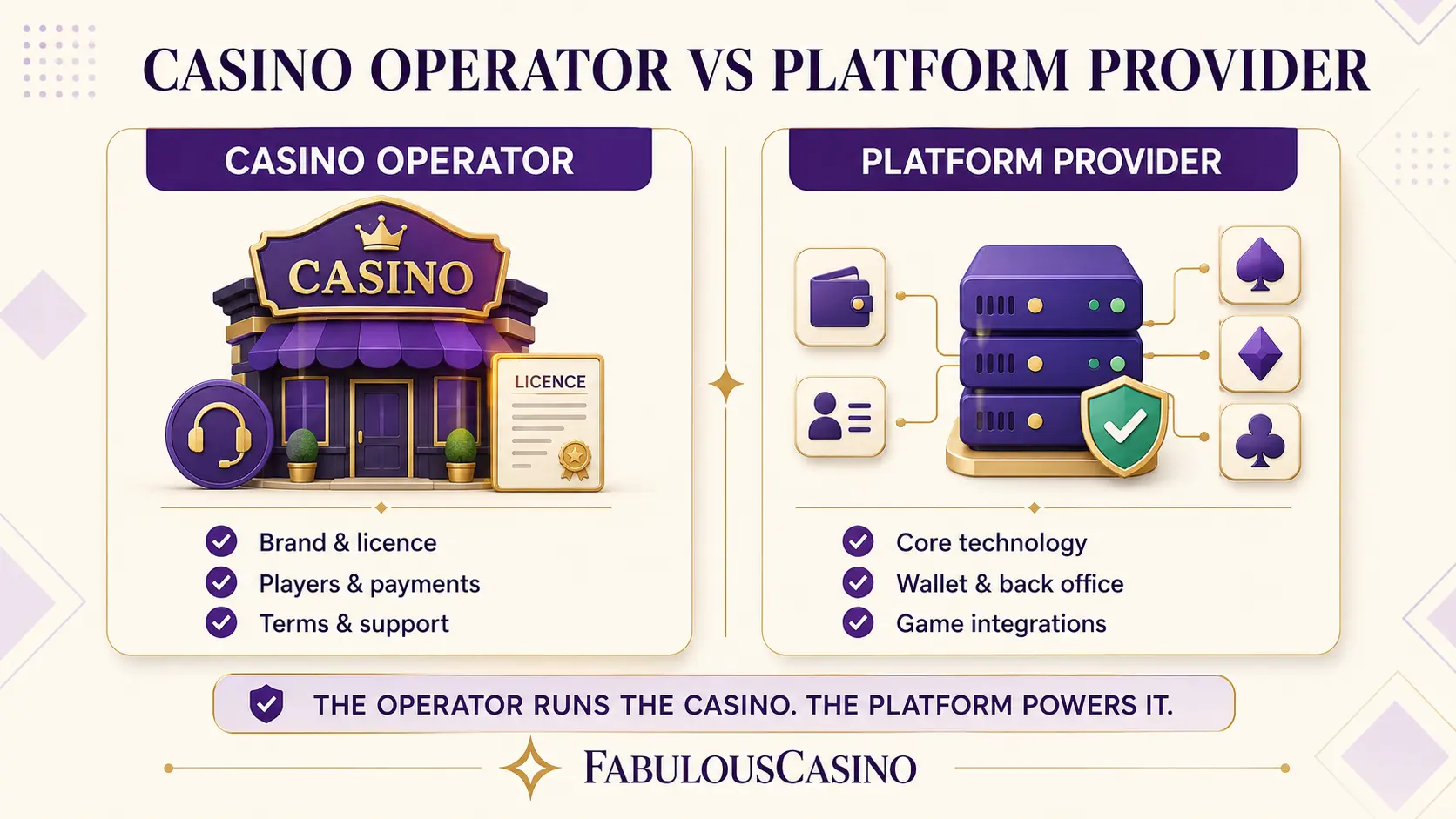
 The casino operator manages the brand and player relationship, while the platform provider supplies the underlying technology.
Casino Operator vs Platform Provider at a Glance
| Area | Casino operator | Platform provider |
|---|---|---|
| Primary role | Runs the gambling business | Provides the technical infrastructure |
| Player relationship | Normally contracts directly with the player | Usually has a B2B relationship with the operator |
| Casino brand | Owns or controls the brand | May power many unrelated brands |
| Gambling licence | Normally holds or operates under the relevant B2C licence | May require a separate B2B or software licence |
| Player funds | Usually responsible for deposits and withdrawals | May supply the wallet or payment technology |
| Terms and conditions | Sets or adopts the player-facing terms | May supply templates or technical rules |
| Customer support | Ultimately responsible for the service offered to players | May provide support tools or outsourced services |
| Games | Selects which games to offer | May aggregate games from multiple studios |
| Account closure | Normally makes or authorises the decision | Provides the tools used to implement it |
What Is a Casino Operator?
The casino operator is the company responsible for offering gambling services to players. In the simplest structure, it is the legal entity named in the casino’s terms and conditions and on the relevant gambling licence.
The operator normally controls or oversees:
- the casino brand and website;
- player registrations and accounts;
- deposits and withdrawals;
- identity and anti-money-laundering checks;
- bonus terms and promotional campaigns;
- customer support and complaints;
- responsible gambling controls;
- regulatory reporting;
- relationships with payment and software suppliers.
The UK Gambling Commission explains that a remote casino operating licence is required when a business offers casino games to customers and contracts directly with those players. This player relationship is one of the clearest ways to distinguish the operator from a technology supplier. See the Commission’s guidance on the remote casino operating licence.
The operator is usually the company you are playing with
A casino’s trading name may be completely different from the legal name of its operator.
For example, a website may display a memorable consumer brand while its footer and terms identify a less familiar limited company. That company—not necessarily the casino name—is usually the entity with which the player has entered into a contract.
This is why a proper casino investigation should identify both:
- Brand: the public-facing name used by the casino.
- Operator: the legal company providing the gambling service.
What Is a Casino Platform Provider?
A platform provider supplies the technology required to launch or manage an online casino. It normally operates as a business-to-business supplier rather than as the company accepting players.
Depending on the agreement, a platform can provide:
- player account management;
- registration and login systems;
- a central wallet;
- payment integrations;
- identity-verification tools;
- bonus and loyalty engines;
- game aggregation;
- risk-management tools;
- responsible gambling controls;
- affiliate tracking;
- customer relationship management;
- reporting and back-office software;
- the casino’s website or front-end.
Some providers sell individual modules. Others supply an almost complete turnkey casino system.
For example, EveryMatrix describes its platform products as covering player account management, payments, casino content, affiliate management and engagement tools. Playtech similarly offers an integrated platform through which operators can manage players, games and other parts of the business. These companies can provide much of the machinery behind a casino without necessarily being the player-facing operator.
You can see how these systems are presented in the official descriptions of EveryMatrix’s player account management platform and Playtech’s operator platform.
B2C Operator and B2B Supplier: The Regulatory Difference
The distinction between operators and suppliers is also reflected in licensing frameworks.
The Malta Gaming Authority separates:
- B2C Gaming Service Licences for companies offering gambling services to players; and
- B2B Critical Gaming Supply Licences for companies supplying or managing important gaming technology.
The MGA provides separate guidance for remote gaming services and game providers and back-office suppliers.
The UK Gambling Commission makes a similar distinction between businesses that provide gambling to consumers and companies that manufacture, supply or adapt gambling software. Its compliance guidance states that gambling software used by licensed remote operators must come from an appropriately licensed software supplier.
This means a platform provider can be regulated without being the company directly responsible for your casino account.
Why Do Players Confuse the Two?
The distinction is often hidden behind a seamless website.
A platform provider may supply the casino’s:
- layout and navigation;
- registration process;
- cashier;
- bonus structure;
- game catalogue;
- account interface;
- support software.
As a result, dozens of casinos can look and behave almost identically even though different companies operate them.
Players may notice the same payment page, account menu, bonus wording or technical error across several brands and assume that all of them have the same owner. Sometimes they do. In other cases, they merely use the same platform.
Shared technology is evidence of a commercial connection—not proof of common ownership.
Is a Platform Provider the Same as a Game Provider?
No. These are separate roles, although one company may perform more than one of them.
Casino operator
Runs the casino and provides gambling services to players.
Platform provider
Supplies the core technology used to manage accounts, payments, games, bonuses and back-office operations.
Game provider
Develops or supplies individual games such as slots, blackjack tables, roulette games or live casino products.
Game aggregator
Connects the casino to games from multiple studios through a single technical integration.
A platform provider may include game aggregation in its product. It may also develop games of its own. Nevertheless, the platform, aggregator and game studio should not automatically be treated as the same entity.
What Is a Turnkey Casino Platform?
A turnkey platform gives the operator most of the infrastructure required to launch a casino. Rather than building its own account system, wallet, cashier, back office and game integrations, the operator rents or licenses an existing technology stack.
The package may include:
- website templates;
- player account management;
- games and aggregation;
- payments;
- bonuses and loyalty features;
- fraud-monitoring tools;
- reporting;
- technical maintenance;
- regulatory support.
However, “turnkey” does not automatically mean that the technology supplier owns or operates every casino using the system. The contractual and licensing structure must still be checked.
What Is a White-Label Casino?
A white-label arrangement goes further than a conventional technology contract.
In a typical platform agreement, the casino operator holds its own licence and uses third-party software. In some white-label structures, another company may provide the licence, compliance infrastructure, payments and operational framework as well as the technology.
The public-facing brand may primarily handle:
- branding;
- marketing;
- player acquisition;
- content and promotions;
- selected customer-facing activities.
The white-label partner may exercise greater control over compliance, payments and account management.
This creates an important exception to the simple operator-versus-platform distinction: a platform company, group company or associated entity can sometimes also be the licensed operator.
The names must therefore be verified rather than inferred from the website’s technology.


Who Is Responsible for Paying Casino Withdrawals?
The licensed operator is normally responsible for the player’s account balance and withdrawal request, even when a platform provider supplies the cashier, wallet or risk-management system.
A platform failure can cause a technical delay, but the player’s contractual relationship is usually with the operator.
If a withdrawal is delayed, the relevant questions are:
- Which legal company operates the casino?
- Which company is named in the terms and conditions?
- Who holds the gambling licence?
- Which entity appears on payment records?
- Is the platform simply a supplier, or is it also part of the licensed structure?
“Our payment provider is reviewing the withdrawal” does not necessarily transfer responsibility away from the casino operator. A supplier may process the transaction, but the operator remains responsible for explaining the status and handling the player relationship.
Who Sets the Bonus Terms?
The operator is normally responsible for the bonus offered under its brand, including the wording and enforcement of its terms.
A platform may supply the bonus engine and standard configurations such as:
- wagering requirements;
- maximum bets;
- game contribution rates;
- expiration periods;
- maximum cashout limits.
Several casinos using the same platform may consequently publish very similar bonus rules. That does not remove the operator’s responsibility for ensuring its terms are clear, fair and consistent with its licence.
Can the Same Platform Power Good and Bad Casinos?
Yes. A strong platform can be used by operators with very different standards.
The technology may influence:
- website stability;
- payment options;
- game availability;
- account security;
- bonus functionality;
- withdrawal workflows.
But the operator still determines or influences:
- how quickly withdrawals are reviewed;
- how verification is handled;
- which terms are imposed;
- how support treats players;
- whether complaints are resolved fairly;
- which markets the casino targets.
A familiar platform is therefore a useful data point, not a guarantee of quality.
How Can You Identify the Actual Casino Operator?
Start with the documents that define the legal relationship rather than the graphics displayed on the homepage.
1. Read the website footer
Look for a company name, registered address, licence number and regulatory authority.
2. Open the terms and conditions
The opening paragraphs usually identify the company with which the player is contracting.
3. Check the privacy policy
The data controller may reveal another relevant company within the operating group, although it is not always identical to the casino operator.
4. Verify the licence independently
Search the regulator’s official register rather than relying only on a logo or licence claim displayed by the casino.
5. Examine payment records
The company name appearing on a card statement, bank transfer or e-wallet transaction may help identify the payment entity. It should be treated as evidence, but not necessarily as definitive proof of the licensed operator.
6. Separate ownership from technology
A platform name found in source code, cookies, game URLs or technical documentation does not by itself establish ownership.
Why the Difference Matters for Casino Research
Identifying the wrong company can distort an entire casino assessment.
If a platform provider is mistakenly labelled as the operator, researchers may:
- attribute the wrong licence to the casino;
- identify unrelated brands as sister sites;
- send complaints to the wrong company;
- misrepresent ownership changes;
- assume that all casinos on one platform follow the same policies;
- assign operational problems to a technology supplier that does not control them.
Conversely, ignoring the platform can hide useful connections. Casinos sharing infrastructure may have similar payment flows, bonus systems, account interfaces or technical limitations.
A credible investigation should therefore document both relationships without confusing them.
The TrustLab View
TrustLab treats the casino operator and platform provider as separate research fields.
For each casino, we aim to establish:
- the public-facing brand;
- the legal operator;
- the licence holder;
- the ownership group;
- the platform provider;
- important payment and game suppliers;
- confirmed sister sites;
- the company responsible for player complaints.
We do not describe two casinos as sister sites merely because they use the same technology. Sister-site relationships require stronger evidence (like here), such as common ownership, a shared operator, matching legal documents or confirmation from an official corporate source.
This distinction forms part of the TrustLab Licence Framework and Transparency Index. It helps us determine not only how a casino works, but who is accountable when something goes wrong.
Frequently Asked Questions
Is the platform provider the owner of the casino?
Not necessarily. A platform provider normally supplies technology to the operator. It may power many casinos owned by unrelated companies. Ownership must be established separately.
Can a platform provider also be a casino operator?
Yes. Some groups provide both B2B technology and B2C gambling services, sometimes through separate legal entities. White-label arrangements can also give a platform group a larger operational role.
Who holds the gambling licence?
The company offering gambling services to players normally holds or operates under the relevant B2C licence. Technology suppliers may hold separate B2B, software or critical-supply licences.
Who is responsible if a casino refuses to pay?
The licensed operator is normally the primary responsible party because it holds the player relationship. A platform or payment provider may be involved in processing the withdrawal, but that does not automatically remove the operator’s responsibility.
Does using the same platform make casinos sister sites?
No. Casinos can share a platform without sharing an owner or operator. Common technology alone is not sufficient proof of a sister-site relationship.
Is a platform provider the same as a software provider?
A platform provider is a type of software supplier, but the term generally refers to a broader system covering player accounts, wallets, integrations and back-office functions. A software provider may supply only a single product or game.
Can changing platform affect existing players?
Yes. A platform migration can change the account interface, payment integrations, game catalogue, bonuses or verification process. The operator should still protect player balances and communicate any material changes.
Final Verdict
The operator runs the casino. The platform provider powers the technology behind it.
The operator is normally responsible for the licence, player contract, deposits, withdrawals, terms and complaints. The platform provider supplies systems such as the wallet, account management, game integrations and back office.
Sometimes the relationship is more complicated—particularly with turnkey and white-label casinos—but the core research rule remains the same:
Never infer casino ownership from technology alone. Identify the brand, operator, licence holder and platform as separate entities.
FabulousCasino documents these relationships as part of every operator profile and TrustLab assessment. Where ownership or operational responsibility cannot be independently confirmed, we say so rather than filling the gap with assumptions.

Jake Sanford
Editor in Chief
Jake Sanford is the Editor in Chief of FabulousCasino and an experienced iGaming industry analyst with a focus on online casinos, player safety, and international gambling trends. His work combines hands-on research with practical insights to help players better understand casino platforms, bonuses, payments, and regulatory developments.