



Fabulous TL;DR
- E-wallet access combines payments, identity, convenience and distribution.
- Removing gambling links from wallet apps is not identical to banning every wallet transfer, but it can still sharply reduce activity.
- A gaming authorisation does not guarantee stable access to banks, wallets or payment rails.
- Good payment resilience means compliant alternatives, clear withdrawals and realistic contingency planning — not hidden workarounds.
- TrustLab should assess payment continuity separately from licensing and game quality.
What Happened to Philippine E-Wallet Gambling Links?
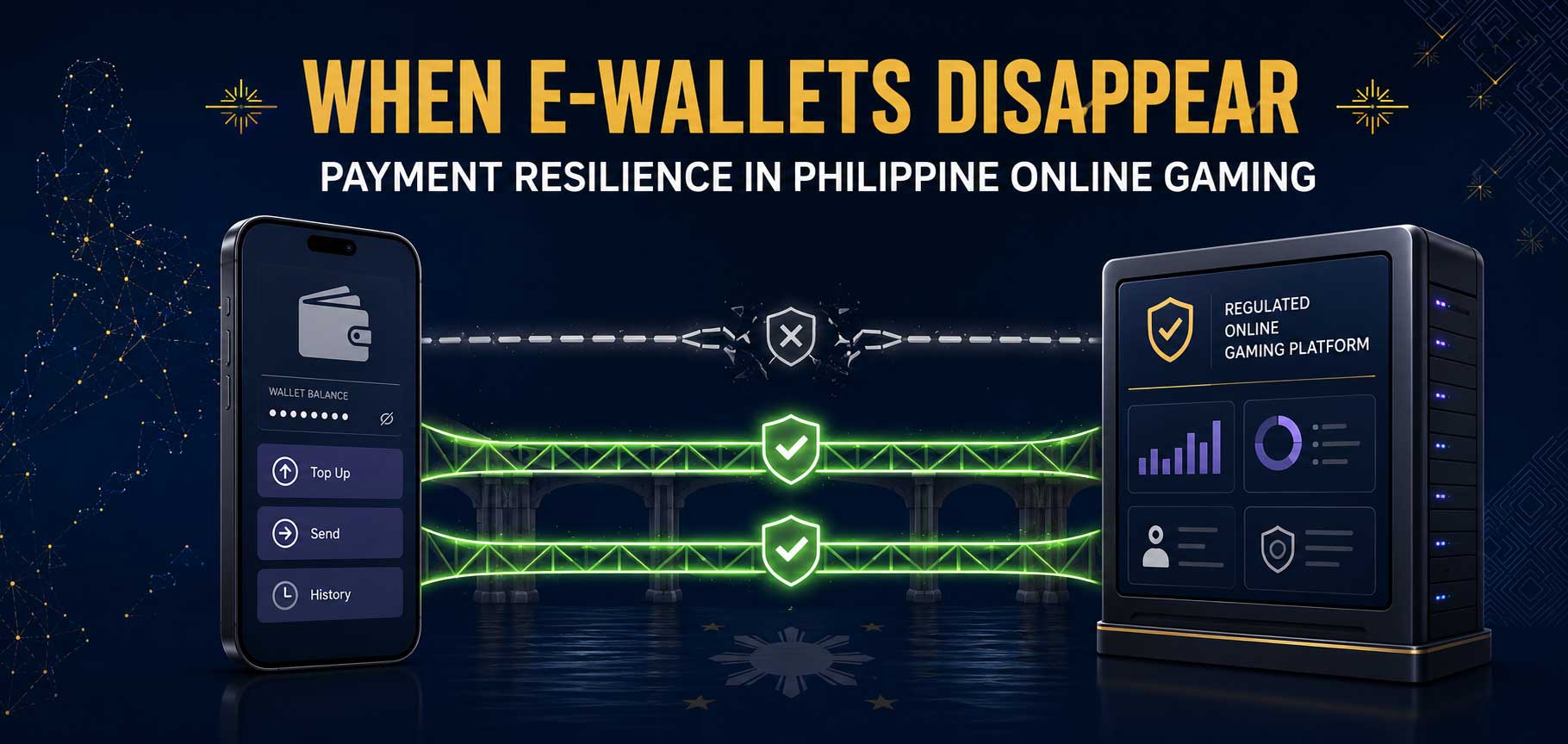
On 14 August 2025, BSP Deputy Governor Mamerto Tangonan told a Philippine Senate hearing that the central bank had directed supervised institutions to remove icons and links that redirected users to online gambling sites. E-wallet providers were given 48 hours to disconnect those in-app pathways.
The wording matters. The measure was widely described as an e-wallet “ban”, but the initial action focused specifically on embedded links and direct integrations inside payment applications. It did not mean that every account balance was frozen or that every lawful digital payment in the Philippines disappeared overnight.
Still, the practical impact was substantial. Wallet apps did more than move money. They placed gambling products directly inside a familiar financial environment, reduced the number of steps between intent and deposit and supplied a trusted interface for users who might never enter card details on a casino website.
Why E-Wallets Matter So Much
In a highly mobile market, an e-wallet can perform several jobs at once:
| Function | Why it matters to players | Why it matters to operators |
|---|---|---|
| Payment rail | Fast deposits and familiar withdrawals | Higher deposit completion and lower checkout friction |
| Identity layer | Existing verified account and device | Useful KYC signals and traceable transaction records |
| Discovery channel | Casino links visible within a frequently used app | Distribution and customer acquisition |
| Trust interface | A known wallet may feel safer than an unknown cashier | Borrowed consumer confidence |
| Mobile experience | Fewer redirects and forms | Better conversion on low-attention mobile journeys |
This explains why “payment method” is too narrow a description. When an operator loses an e-wallet integration, it may lose visibility, conversion, data and customer confidence at the same time.
The Financial Impact Was Visible
The wider market impact appeared quickly. PAGCOR officials reported a sharp drop in online gambling transactions after major wallets removed direct connections. Public-company disclosures later provided a more concrete example.
DFNN, a Philippine-listed gaming technology company, reported that gaming commission income fell to approximately PHP 21.6 million in the first half of 2026, down 66.9% year on year. Reporting on the company’s filing attributed the decline primarily to the disconnection of its online gaming platform from e-wallet providers. Second-quarter commission income was also substantially below the first quarter.
One company does not represent the entire Philippine market, and management explanations should not be treated as independent proof of every causal factor. Even so, the scale of the decline demonstrates how deeply payment access can affect a regulated gaming business.
The Fabulous Take: A licence tells you whether an operator is authorised. It does not tell you whether players can deposit reliably today, withdraw tomorrow or keep using the same payment route next month.
What Payment Resilience Actually Means
Payment resilience is an operator’s ability to maintain lawful, understandable and reliable deposits and withdrawals when one provider, channel or regulatory rule changes.
It does not mean bypassing the regulator. It does not mean cycling through anonymous merchant accounts, disguising gambling transactions or pushing players towards unverified crypto wallets. Those practices may keep deposits flowing temporarily while increasing player and compliance risk.
A resilient operator should instead have:
- more than one compliant payment relationship;
- clear ownership of its cashier and settlement process;
- documented fallback procedures;
- realistic withdrawal timeframes for every supported method;
- proper reconciliation and segregation controls where required;
- communication prepared before a payment route disappears; and
- a plan for customers with pending balances or withdrawals.
The point is continuity with accountability. A casino should be able to change rails without changing its identity, inventing a new payment story or leaving customers to discover the problem after they request a withdrawal.
Why Deposits Usually Recover Faster Than Withdrawals
When a popular payment method disappears, operators have a strong incentive to restore deposits quickly. Withdrawals are harder.
A replacement deposit method can sometimes be added with a new cashier integration. Withdrawals may still require identity checks, source-of-funds controls, account-name matching, transaction reconciliation and adherence to the original payment method rule. A method that accepts incoming funds is not necessarily ready to return them.
This creates several player risks:
- a familiar wallet remains shown for deposits but no longer supports withdrawals;
- the casino asks the player to verify an unfamiliar alternative method after winning;
- processing times increase without a clear explanation;
- support agents provide inconsistent instructions; or
- the operator uses a third-party account whose name does not match the casino.
A well-managed casino explains these changes before the player deposits. It does not wait until funds are locked behind a pending withdrawal.
Licensed Does Not Mean Payment-Proof
Casino comparisons often treat licensing as a master switch: licensed equals safe, unlicensed equals unsafe. Reality is more complicated.
A regulator may authorise the gaming activity while a central bank supervises wallets, banks and payment institutions. Commercial payment companies apply their own risk policies. Banks can reduce exposure to gambling even without a complete legal prohibition. App stores, telecom providers and identity vendors add further dependencies.
These systems overlap, but they are not controlled by a single licence. An operator can satisfy one regulator and still lose an essential commercial partner. That is why payment stability deserves its own assessment rather than being hidden inside a generic “banking options” score.
What Players Should Check Before Depositing
- Is the method currently available? Do not rely on an old review or cached logo.
- Does it support withdrawals? Deposit-only methods create additional friction later.
- Whose name appears on the transaction? Unexpected personal or unrelated company names require caution.
- Are limits and fees disclosed? Check minimums, maximums and currency conversion before paying.
- Will another method be required? Ask what happens if the original wallet cannot receive funds.
- Has the operator communicated recent changes? Clear notices are a useful sign of operational control.
Players should also keep screenshots of the cashier, transaction reference and payment terms. If a method changes while a withdrawal is pending, those records can help establish what was offered at the time of deposit.
Payment Resilience as a TrustLab Signal
FabulousCasino’s TrustLab should not reward an operator merely for displaying a long row of payment logos. Quantity can be cosmetic. What matters is whether the methods work, who processes the funds and how the operator responds when access changes.
A useful Payment Resilience assessment examines:
- Availability: Are advertised methods actually live for the target country?
- Deposit and withdrawal parity: Can the same route generally return funds?
- Processing transparency: Are company names, fees, limits and timeframes clear?
- Concentration risk: Does the casino depend overwhelmingly on one wallet or provider?
- Change management: Does it warn customers and protect pending balances when a route closes?
- Compliance quality: Are alternatives regulated and traceable rather than improvised?
This signal should remain separate from the licence assessment. A casino can perform well in one and poorly in the other.
The Bigger ASEAN Lesson
The Philippine case is unusually visible, but the underlying lesson applies across Southeast Asia. Local banking rules, wallet policies and enforcement priorities can change faster than a casino’s licence status. Operators that depend on one dominant payment path may look strong until that path closes.
For players, the best casino is therefore not simply the one offering the fastest deposit today. It is the operator capable of explaining where the money goes, returning it through a lawful route and managing change without transferring the risk to the customer.
Payment resilience is not about finding a way around the rules. It is about remaining reliable when the rules — or the commercial partners implementing them — change.
Frequently Asked Questions
Are e-wallets banned for online gambling in the Philippines?
The August 2025 BSP action required supervised institutions to remove in-app icons and links that redirected customers to online gambling platforms. Describing this as a universal ban on every possible wallet transaction can overstate the specific measure.
Can Philippine online casinos still accept digital payments?
Payment availability depends on the operator, the provider and current regulatory rules. Players should verify the live cashier and withdrawal terms rather than relying on historic payment lists.
Why did e-wallet delinking reduce gaming revenue?
It added friction and removed a major discovery and conversion channel. E-wallets were not only payment tools; their in-app integrations connected users directly with gaming platforms.
What happens to a withdrawal if the original e-wallet is unavailable?
The operator may require another verified method, but the process should be explained clearly and should not be used to impose unreasonable delay. Players may need additional KYC or proof that the alternative account belongs to them.
Is cryptocurrency a resilient alternative?
Not automatically. Crypto can reduce dependence on a single wallet, but it introduces volatility, address errors, compliance questions and weaker recourse. Resilience should be measured by legality, transparency and reliability — not simply by technical availability.
Sources and Methodology
- GMA News: BSP order to remove gambling links from e-wallets
- Asia Gaming Brief: regulatory and industry context
- DFNN disclosure via the Philippine Stock Exchange
- Asia Gaming Brief: DFNN first-half 2026 results
Reviewed: August 2026. Payment availability can change without notice and may vary by operator, account and location.

Aidan Lee Chong
Head of Asia
Aidan Lee Chong leads the Asia-Pacific division at FabulousCasino and has been actively involved in the iGaming industry for many years. Originally from Kuching, Malaysia, he built his reputation through the development of multiple gaming and affiliate platforms tailored to Asian markets. His background combines operational industry experience with deep insight into regional player trends and online casino growth across SEA/APAC.