

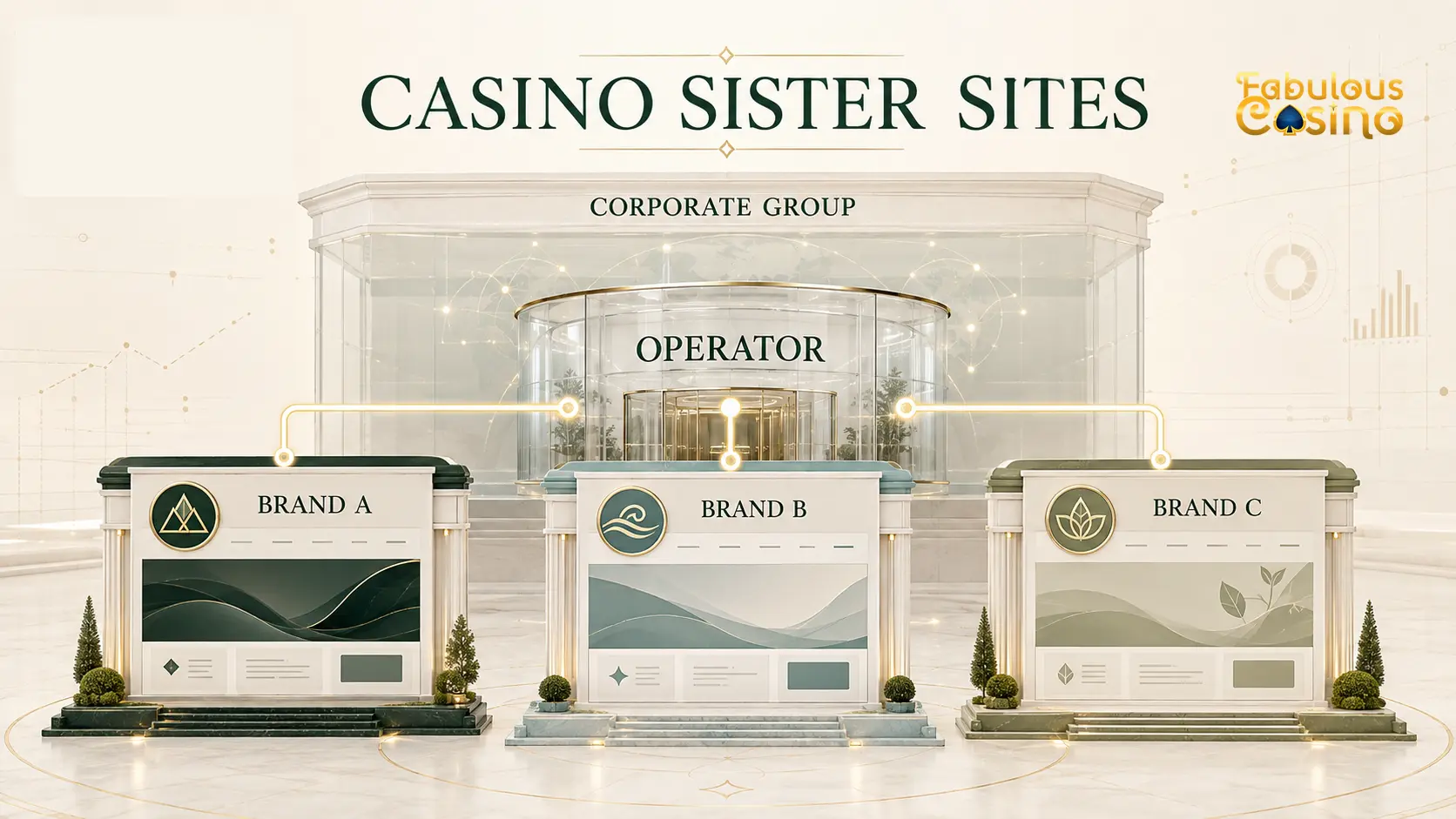
However, the term is used loosely. Casinos described as sister sites may share:
- the same legal operator;
- the same parent company;
- the same gambling licence;
- a white-label operator;
- a casino platform;
- payment and customer-support infrastructure;
- or only a similar website template.
These relationships are not interchangeable.
Two casinos using the same software platform are not necessarily owned or operated by the same company. Conversely, two brands with completely different designs can belong to the same operator group.
What Are Casino Sister Sites?
Casino sister sites are separate casino brands with a meaningful business relationship behind them.
The strongest and clearest relationship exists when both websites name the same legal company as the operator.
For example:
| Casino | Published operator | Relationship |
|---|---|---|
| Casino A | Example Gaming Limited | Same legal operator |
| Casino B | Example Gaming Limited |
These casinos are direct sister sites because the same company is responsible for operating both brands.
The relationship becomes more complicated when different legal entities belong to the same corporate group:
| Casino | Published operator | Parent company |
|---|---|---|
| Casino C | Example Malta Limited | Example Entertainment Group |
| Casino D | Example Gibraltar Limited | Example Entertainment Group |
These brands can still reasonably be described as corporate sister sites, but they may operate under different licences, terms, payment systems and regulatory obligations.
Five Types of Casino Sister-Site Relationships
FabulousCasino separates casino relationships into five main categories.
1. Same Legal Operator
This is the most direct sister-site relationship.
Both casinos name the same registered company as the business providing gambling services. They may also share:
- the same gambling licence;
- account-management systems;
- KYC and source-of-funds procedures;
- payment processors;
- withdrawal teams;
- customer support;
- general terms and conditions;
- responsible-gambling controls.
Brand-specific differences can still exist. One casino may target high-value players, another may focus on slots and a third may offer sports betting alongside casino games.
The same operator does not mean every condition is identical. Each casino’s published terms must still be checked separately.
2. Same Corporate Group, Different Operators
A large gambling group may own several licensed operating companies.
This can happen because:
- different licences are required for different countries;
- brands were acquired with their existing companies;
- the group separates casino, bingo and sports betting operations;
- local regulation requires a domestic legal entity;
- brands use different payment or technology structures.
These casinos share an ultimate corporate owner but may not share the same direct operator.
The distinction affects questions such as:
- which company holds the player’s balance;
- which licence covers the account;
- where a complaint must be submitted;
- which privacy policy applies;
- whether account restrictions carry across brands;
- whether previous customers qualify for a welcome bonus.
3. Same White-Label Operator
A white-label operator provides the regulated and operational framework behind independently branded casino websites.
The brand’s marketing partner may control elements such as:
- the casino name;
- visual identity;
- customer acquisition;
- promotional strategy;
- affiliate relationships;
- market positioning.
The licensed operator may remain responsible for:
- the gambling account;
- regulatory compliance;
- player verification;
- payments and withdrawals;
- responsible-gambling procedures;
- game and platform integrations;
- complaint handling.
In Great Britain, the Gambling Commission explains that responsibility for compliance on white-label gambling websites remains with the licence holder and cannot be transferred to the marketing partner.
The Commission’s public register can identify domains recorded as white labels. It also makes an important distinction: the operator holds the licence—not the casino domain itself.
See the Gambling Commission’s guidance on licensee responsibility for white-label partners and its register of gambling businesses and domains.
4. Same Platform, Different Owners
Many apparently related casinos are connected only through a shared technology provider.
A platform can supply:
- the website framework;
- casino account software;
- game aggregation;
- bonus tools;
- payment integrations;
- affiliate tracking;
- customer-relationship systems;
- responsible-gambling features.
Independent operators using the same platform can consequently have:
- similar navigation;
- the same account interface;
- similar cashier pages;
- overlapping game libraries;
- similar bonus structures;
- identical technical error messages.
None of this proves common ownership.
A platform provider is comparable to infrastructure. Two businesses using the same infrastructure are not automatically the same business.
Shared software can explain why two casinos look related. It does not establish who owns or legally operates them.
5. Former, Acquired or Rebranded Sister Sites
Casino relationships change over time.
A brand can be:
- sold to another group;
- moved to a new operating company;
- transferred to another licence;
- migrated to a different platform;
- merged with another casino;
- closed and later relaunched;
- rebranded under a new domain.
Two casinos that were sister sites in the past may no longer share an operator. Equally, an acquired casino may become part of a new group even while its design and customer-facing brand remain unchanged.
Any sister-site claim should therefore include a date or be based on current information.


What Do Sister Casinos Usually Share?
The amount of shared infrastructure depends on the relationship.
| Feature | Same operator | Same corporate group | Same white-label operator | Same platform only |
|---|---|---|---|---|
| Legal operator | Usually yes | Not necessarily | Usually yes | No |
| Ultimate owner | Usually yes | Yes | Not necessarily | No |
| Gambling licence | Often | May differ | Often | May differ |
| Casino platform | Often | Sometimes | Often | Yes |
| Payment processing | Often | Sometimes | Often | Not necessarily |
| Customer support | Sometimes | Sometimes | Often | Not necessarily |
| Player terms | Often similar | Can differ | Often similar | Can differ completely |
| Welcome-bonus eligibility | May be shared | May be shared | Frequently restricted | Usually independent |
This table describes common structures, not universal rules. The published terms and legal information of the individual casino remain decisive.
How Can You Find a Casino’s Sister Sites?
A credible sister-site assessment should begin with the legal operator rather than the website design.
Step 1: Read the Casino Footer
The footer should identify the company responsible for operating the casino.
Look for:
- the full legal company name;
- company registration number;
- registered address;
- gambling licence number;
- regulator;
- alternative trading names;
- copyright owner.
The copyright name alone is not conclusive. A trademark owner, marketing company and legal gambling operator can be three different entities.
Step 2: Check the Terms and Conditions
The general terms often contain more precise information than the homepage footer.
Search for phrases such as:
- “operated by”;
- “owned and operated by”;
- “contract between you and”;
- “licence holder”;
- “our group”;
- “partner brands”;
- “associated websites”;
- “network of casinos”.
Welcome-bonus terms are particularly useful because they may name other brands whose customers are excluded from the promotion.
Step 3: Check the Privacy Policy
The privacy policy should identify the company acting as data controller or describe the companies with which player information can be shared.
This can reveal:
- a parent company;
- operating subsidiaries;
- other brands in the group;
- shared payment companies;
- centralised account services.
The data controller is not always the casino operator, but the information can help establish the wider company structure.
Step 4: Search the Regulator’s Register
Where available, an official licence register is more reliable than an affiliate list of alleged sister casinos.
The Gambling Commission business register, for example, allows searches by:
- business name;
- trading name;
- domain name;
- operator account number.
Its domain records distinguish between active, inactive and white-label websites.
Regulatory records still require interpretation. A shared licence holder can establish an operational connection without proving that the consumer-facing brands have the same beneficial owner.
Step 5: Check Corporate Records
Company registers can help identify:
- directors;
- shareholders where disclosed;
- registered offices;
- parent companies;
- previous company names;
- mergers and ownership changes.
Corporate ownership is sometimes difficult to trace through multiple jurisdictions. A published operator can be verified even when the ultimate beneficial owner is not publicly visible.
FabulousCasino distinguishes between confirmed information and reasonable inference rather than filling ownership gaps with assumptions.
Step 6: Compare the Operational Details
Shared operational patterns can support other evidence.
Examples include:
- identical verification emails;
- the same payment descriptor;
- shared support addresses;
- matching terms and conditions;
- the same complaint process;
- identical responsible-gambling contact details;
- a common account or loyalty programme.
These clues are useful, but they should not replace legal or regulatory evidence.
What Does Not Prove That Casinos Are Sister Sites?
Several common similarities are too weak to establish an ownership relationship by themselves.
The same games
Thousands of casinos offer games from suppliers such as Pragmatic Play, Evolution, Play’n GO, NetEnt and Hacksaw Gaming. A shared game provider does not indicate a shared casino owner.
A similar website design
Operators can use the same template, platform or external design agency.
The same bonus percentage
Offers such as “100% up to $500” are used across unrelated casinos.
The same affiliate programme
An affiliate network can manage marketing for multiple independent operators.
The same customer-support software
Tools used for live chat, email or ticket management are available to many companies.
The same payment methods
Visa, Mastercard, cryptocurrency and e-wallet integrations are not evidence of common ownership.
The same licence jurisdiction
Two casinos licensed in the same jurisdiction are not sister sites unless the licence, operator or corporate relationship also connects them.
The same IP address or hosting provider
Cloud services, content-delivery networks and shared hosting infrastructure can place unrelated websites on the same technical network.
Technical similarities can generate a research lead. They do not by themselves establish legal ownership.
Are Sister Casinos Safe?
Being part of a large group can provide advantages, but sister-site status is not a safety certificate.
Possible advantages include:
- established payment infrastructure;
- experienced compliance teams;
- consistent verification procedures;
- larger customer-support operations;
- recognised software suppliers;
- clear escalation and complaint routes.
Possible concerns include:
- the same restrictive terms across many brands;
- shared withdrawal delays;
- group-wide bonus exclusions;
- centralised account restrictions;
- the same complaint-handling weaknesses;
- repeated launches of similar short-lived brands.
A group with ten casino brands does not have ten independent operational records. If withdrawals, KYC or customer disputes are managed centrally, the behaviour of one sister casino can be relevant to the assessment of the others.
A new casino brand does not create a new operator history.
Can One Sister Site Have Better Withdrawals?
Yes.
Sister casinos can have different:
- withdrawal limits;
- pending periods;
- payment methods;
- VIP payment rules;
- verification thresholds;
- account currencies;
- country restrictions;
- processing priorities.
Even when the same payments team manages several brands, individual casino terms can produce different player experiences.
One brand may offer instant cryptocurrency withdrawals while another processes withdrawals manually. One may permit €5,000 per transaction while another caps weekly payments at €2,000.
For this reason, FabulousCasino does not assign an identical withdrawal assessment automatically to every casino in a group.
Group history is relevant evidence. Brand-specific testing remains necessary.
Do Sister Casinos Share Player Accounts?
Sometimes, but not always.
Possible structures include:
- one account working across every group brand;
- separate accounts connected to a central customer profile;
- separate casino accounts managed by the same operator;
- completely independent accounts despite common ownership.
A player may therefore be able to register separately at several sister sites even though the operator can identify the accounts as belonging to the same person.
The terms should explain whether:
- only one account is allowed across the network;
- one account is permitted at each brand;
- verification documents can be reused;
- limits apply at brand or operator level;
- self-exclusion affects connected websites.
Can You Claim a Welcome Bonus at Every Sister Site?
Not necessarily.
Some casino groups offer a separate welcome bonus at every brand. Others limit customers to one new-player promotion across the entire network.
Common terms include:
- one welcome bonus per person;
- one bonus per household;
- one bonus per payment method;
- one bonus per IP address;
- one bonus across associated brands;
- no bonus for existing customers of named sister sites.
A player can successfully open a new account and still be ineligible for the advertised welcome offer.
Before depositing, check whether the bonus terms name:
- the operator’s other casinos;
- associated websites;
- partner brands;
- the entire white-label network;
- previously closed casinos.
If the restriction is material to eligibility, it should be disclosed clearly rather than applied only after the player requests a withdrawal.
Do Sister Sites Share KYC Information?
Casinos within the same operating group may use centralised verification systems, subject to their privacy notices and applicable data-protection rules.
This can mean that:
- documents submitted at one brand are recognised at another;
- duplicate accounts are detected across the group;
- source-of-funds checks consider activity on connected brands;
- fraud or chargeback information is shared internally;
- responsible-gambling reviews include group-level activity.
Players should not assume that submitting documents at one casino automatically verifies every sister account. They should also not assume that each brand operates in complete isolation.
The privacy policy should explain which company controls the information and the circumstances under which it can be shared.
Does Self-Exclusion Apply Across Sister Casinos?
The answer depends on the licence, operator, account structure, jurisdiction and self-exclusion system.
A self-exclusion may apply:
- only to the selected casino brand;
- to all brands operated by the same licensee;
- across a corporate group;
- across participating operators through a national exclusion system.
Players should not rely on the informal term “sister site” to determine the scope of protection.
The casino’s responsible-gambling policy should state:
- which websites are covered;
- whether connected accounts will be closed;
- whether marketing stops across the group;
- whether a national exclusion programme applies.
Where gambling is causing harm, attempting to move between sister sites is not a meaningful safety strategy. A broader exclusion tool may be required.
Do Sister Casinos Have the Same Licence?
They can, but they do not have to.
The same operator may register several domains under one operating licence. A corporate group may also use separate licensed companies for different markets such as Singapore.
A single brand can even have different operators depending on the player’s country.
For example:
- Company A operates the casino for players in Great Britain;
- Company B operates it for selected European markets;
- Company C operates an international version of the same brand.
The logo and domain may remain similar while the legal relationship changes according to location.
This is why a licence assessment must identify:
- the relevant domain;
- the player’s country;
- the legal operator serving that country;
- the licence under which the account is opened.
Can Sister Sites Have Different Owners?
Yes, particularly in white-label arrangements.
A marketing company may own or control the consumer-facing brand while a separate licensed company operates the gambling service.
Several casino brands can therefore share the same operator without having the same ultimate brand owner.
The reverse is also possible: one corporate group can own multiple brands that are operated by different licensed subsidiaries.
Any ownership assessment should separate:
| Role | What it means |
|---|---|
| Brand owner | Controls the casino name, trademark or marketing identity |
| Legal operator | Provides the gambling service and contracts with the player |
| Licence holder | Holds the regulatory permission used by the casino |
| Platform provider | Supplies the technical casino infrastructure |
| Parent company | Owns or controls one or more companies in the structure |
| Ultimate beneficial owner | The person or entity ultimately controlling the business |
One company can perform several of these roles, but the names should not be treated as synonyms.
Why Do Operators Launch Multiple Casino Brands?
Multiple brands allow an operator to target different audiences without rebuilding the complete operational infrastructure.
One group might create separate casinos for:
- cryptocurrency players;
- live casino players;
- slot-focused players;
- VIP or high-roller customers;
- specific countries and languages;
- casual mobile users;
- sportsbook customers;
- different advertising channels.
The underlying cashier, compliance system and game platform can remain similar while each brand presents a different identity.
There is nothing inherently suspicious about this model. The concern arises when new brands are used to obscure:
- the operator’s previous history;
- regulatory action;
- unresolved complaints;
- restrictive bonus rules;
- frequent closures and relaunches.
What Happens When a Sister Casino Closes?
A casino closure does not necessarily mean the operator or group has disappeared.
Players may be:
- given time to withdraw their balances;
- migrated to another sister casino;
- asked to create a new account at another brand;
- contacted by the same operator under a different casino name.
A migration should explain:
- which company holds the remaining balance;
- whether bonuses will be transferred;
- whether the existing terms still apply;
- how personal data will be processed;
- whether account limits and exclusions remain active;
- how players can decline the transfer and withdraw instead.
In Great Britain, remote licence holders must report when they start or stop using a gambling domain. The Gambling Commission requires information concerning outstanding player balances and how customers will be informed when a domain stops trading.
See the Commission’s domain-change reporting guidance.
Can a Sister Site Escape the Reputation of Its Operator?
A new brand can have improved terms, management or technology, but a different name does not erase the record of the company operating it.
Relevant group-level evidence can include:
- regulatory sanctions;
- licence suspensions or surrenders;
- repeated withdrawal complaints;
- unfair or unclear terms;
- weak white-label oversight;
- unresolved player balances following closures.
The Gambling Commission has taken action against licence holders for failures involving third-party and white-label websites. Its guidance makes clear that the licensed operator remains responsible for compliance across those brands.
This does not mean that every sister casino should receive an identical judgment. It means the operator’s wider record belongs in the assessment.
The FabulousCasino Sister-Site Test
FabulousCasino does not identify sister sites from design similarities or copied affiliate lists.
We examine:
- Published operator: Which company contracts with the player?
- Licence holder: Which entity holds the relevant gambling licence?
- Registered domains: Which other brands are recorded against that operator?
- Corporate ownership: Is there a confirmed parent-company relationship?
- White-label structure: Does the operator run the casino for a third-party brand?
- Terms and privacy documents: Which associated companies and websites are named?
- Operational evidence: Are accounts, payments, support or verification managed centrally?
- Timeline: Is the relationship current or historical?
We then classify the relationship as:
| Classification | Meaning |
|---|---|
| Confirmed sister site | The same legal operator runs both casinos |
| Corporate sister site | Different operating companies share a confirmed parent group |
| White-label relation | The same licensed operator runs separately branded partner sites |
| Platform relation only | The casinos use common technology without confirmed common ownership |
| Former sister site | The brands were previously connected but the relationship has changed |
| Unconfirmed relation | Similarities exist, but the available evidence does not establish the connection |
The FabulousCasino View
Casino sister sites are useful because they reveal the operational history hidden behind a new brand name.
A new website can have:
- a new logo;
- a new bonus;
- a new domain;
- a different colour scheme;
- a completely different market position.
But if the same company controls player funds, verification and withdrawals, the operator’s previous performance remains relevant.
At the same time, FabulousCasino avoids treating every technical similarity as proof of ownership. Using the same games, platform or website template does not turn unrelated casinos into sister sites.
The important question is not whether two casinos look related. It is whether the same company, licence or corporate group stands behind the player account.
A sister-site relationship is neither an automatic endorsement nor an automatic warning. It is evidence that helps place the casino in its correct operational context.
Frequently Asked Questions
What is a casino sister site?
A casino sister site is another casino brand connected through the same operator, corporate group or white-label operating structure.
Do sister casinos have the same owner?
Sometimes. Direct sister sites may share the same legal operator and owner. White-label casinos can share an operator while their consumer-facing brands have different owners.
Do sister sites use the same licence?
They often do when the same operator runs several domains. Casinos within a larger corporate group can also use different operating companies and licences.
Are casinos on the same platform sister sites?
Not necessarily. Independent operators can purchase technology from the same platform provider. Shared software alone does not prove common ownership.
Do sister casinos share player accounts?
Some do, while others create separate accounts connected to a central customer profile. The casino terms should explain the account structure.
Can I claim a bonus at every sister casino?
Not always. Some operators restrict customers to one welcome bonus across associated brands, households, payment methods or an entire casino network.
Do sister casinos share KYC documents?
They may use centralised verification systems, subject to their privacy policies and applicable data-protection rules. Verification at one brand does not automatically guarantee approval at another.
Does self-exclusion apply to all sister sites?
It depends on the operator, licence, jurisdiction and exclusion programme. Players should check exactly which brands are included rather than relying on the informal sister-site relationship.
Can sister casinos have different withdrawal times?
Yes. They can have different payment limits, pending periods, cashier options and brand-specific terms even when some payment operations are shared.
How can I verify a casino’s sister sites?
Check the legal operator in the footer and terms, search the relevant regulator’s register, review corporate records and examine the privacy and bonus policies for named associated brands.
Is a white-label casino fully licensed?
The licensed operator—not the brand or domain—holds the operating licence. In regulated white-label arrangements, responsibility for the gambling activity remains with that licence holder.
Are sister casinos safer than independent casinos?
Not automatically. An established group may offer stronger infrastructure, but weaknesses in withdrawals, verification or complaint handling can also affect multiple brands.
Can two sister casinos have different terms?
Yes. Bonuses, withdrawal limits, restricted countries, account rules and payment methods can differ between brands. Each casino should be assessed individually.
Final Verdict
Casino sister sites are brands connected through a shared operator, owner or operating structure.
The relationship may involve:
- the same legal company;
- different subsidiaries of one corporate group;
- a shared white-label operator;
- a former ownership relationship;
- or only a common platform provider.
Only the first four represent a meaningful corporate or operational relationship. Similar design and technology alone are not sufficient evidence.
Identifying sister sites helps players understand:
- who controls their account;
- which licence applies;
- whether bonus restrictions extend across brands;
- how verification and payments may be managed;
- whether the operator has a wider regulatory or complaint history.
The correct starting point is always the published legal operator—not the logo, website template or game lobby.
A casino brand tells you how a website is marketed. Its sister sites help reveal the business operating behind it.
Casino ownership, licensing and white-label arrangements can change. FabulousCasino records the date of its research and distinguishes confirmed operator relationships from platform similarities and unverified ownership claims.

Enrico Braunschweig
Founder
Enrico Braunschweig is the Founder of FabulousCasino and a long-time entrepreneur in the digital marketing and iGaming industry. With nearly two decades of experience in affiliate marketing, online casino acquisition, and SEO-driven publishing, he focuses on building trusted gaming brands with a strong emphasis on transparency, product quality, and long-term player value.