

Some people make a living around casino gambling. Far fewer make a sustainable living from playing casino games themselves.
This FabulousCasino Research article examines what “playing for a living” would actually require, which gambling activities can contain a player advantage and why screenshots, withdrawals and winning sessions do not establish professional profitability.
The Short Answer
For the overwhelming majority of players, the answer is no.
Games such as slots, roulette, baccarat and standard casino blackjack normally give the casino a built-in edge. Skill can improve some decisions, reduce avoidable losses or lower the house advantage, but it does not automatically turn the game into positive expected value.
A credible professional gambling model needs all of the following:
- a genuine and repeatable mathematical advantage;
- sufficient bankroll to survive normal losing periods;
- access to games or promotions where the advantage remains available;
- accurate records of every stake, cost, rebate and result;
- discipline to stop when the opportunity disappears;
- legal, tax and payment arrangements appropriate to the player’s location;
- income that remains adequate after expenses and unpaid working time.
If the plan is simply to play more often, increase stakes after losses or wait for a winning run, it is not a professional model. It is increased exposure to gambling risk.
What Does “Making a Living” Actually Mean?
A living is not one large win. It is not the amount withdrawn from a casino and it is not the total value of winning bets.
For gambling to function as an occupation, the player must generate enough long-term net profit to cover:
- housing and ordinary living costs;
- healthcare, insurance and retirement provision;
- taxes where applicable;
- travel, accommodation, banking and currency costs;
- software, data or specialist equipment;
- periods without playable opportunities;
- downswings in which the player earns nothing or loses money.
An employee can have a bad week and still receive a salary. A professional gambler can make correct decisions for weeks and finish with less money than they started with. That difference makes average profit, volatility and access to capital equally important.


The First Test: Where Does the Player’s Edge Come From?
Every serious claim about earning a living from casino play should begin with one question:
What identifiable mechanism changes the game from negative expected value to positive expected value?
Possible answers can include:
- playing against weaker players rather than against the casino;
- card counting under favourable blackjack rules and conditions;
- a promotion, rebate or loyalty return worth more than the expected gaming loss;
- a progressive jackpot that has reached an unusually favourable value;
- a pricing or procedural error that can lawfully be exploited;
- a verified statistical edge in a betting market.
“I have a system”, “I know when a slot is hot” and “I double after every loss” do not identify an edge. They describe beliefs or staking patterns. Neither changes the underlying probabilities.
House Edge, RTP and Expected Loss
The house edge is the casino’s expected share of the money wagered over repeated play. Return to player, or RTP, expresses the expected proportion returned to players.
In a simplified model:
House edge = 100% − RTP
A slot with a theoretical RTP of 96% therefore has a theoretical house edge of 4%.
If a player wagers €1 per spin for 1,000 spins, the turnover is €1,000 even if only €100 was deposited and winnings were repeatedly recycled. The theoretical expected loss is:
€1,000 × 4% = €40
This does not mean the player will lose exactly €40. They could win a jackpot, finish €300 ahead or lose the entire deposit. Expected value describes the average direction across a sufficiently large amount of comparable play, not the result promised to one person during one session.
The UK Gambling Commission explains that actual RTP is calculated by dividing wins by turnover and monitors whether games operate as designed and advertised. It also notes that fully random games rely on statistical chance rather than adjusting each individual session to force a specified return. See its guidance on live RTP performance monitoring and how gaming machines meet their stated RTP.
Why Turnover Matters More Than the Starting Deposit
Casino losses are often misunderstood because players remember deposits and withdrawals but do not measure turnover.
Consider a player who deposits €500 and plays €5 roulette bets. During the session, wins are reused for further bets. After 1,000 bets, the player has generated €5,000 of turnover despite initially depositing only €500.
On a single-zero roulette even-money bet with a house edge of approximately 2.70%, the expected cost of that turnover is:
€5,000 × 2.70% = €135
The player may finish above or below that figure, but the expected cost grows with every additional wager. Playing for longer does not make the underlying disadvantage disappear. It gives the mathematical edge more opportunities to operate.
House Edge Does Not Describe the Whole Risk
Two games can have similar RTP figures and produce very different player experiences.
Variance describes how widely short-term results can move around their average. A high-volatility slot may produce long losing sequences interrupted by rare large wins. A lower-volatility game may distribute smaller returns more frequently.
A professional income requires money at predictable intervals. Casino variance does the opposite: it can create substantial gains and losses with no respect for rent dates, tax deadlines or living expenses.
This is why a player can have a theoretical edge and still go broke. Positive expected value is necessary for a defensible professional model, but it does not remove variance or guarantee survival.
Can You Make a Living Playing Slots?
Ordinary slot play does not provide a sustainable income model.
Slots use defined game mathematics and random outcome generation. The published RTP applies across a large body of play, while individual results can vary dramatically. Choosing a higher-RTP version may reduce the expected cost, but an RTP below 100% still represents negative expected value before any external benefit is counted.
A 97% slot is not expected to pay a player 97% of each deposit. Nor does it become “due” after a losing sequence.
Specialists sometimes identify unusual situations involving:
- must-award-by jackpots;
- persistent game states;
- promotional multipliers;
- cashback or free play;
- progressives whose current value changes the expected return.
Those are forms of advantage analysis, not ordinary slot strategy. They require exact rules, observation, available capital and access to the opportunity before somebody else takes it. Casinos can also change promotions, restrict play or remove games.
FabulousCasino verdict: regular slot play should be treated as paid entertainment, not employment.
Can You Make a Living Playing Roulette?
Standard roulette bets retain a casino advantage.
On a European single-zero wheel, an even-money bet covers 18 of the 37 numbers but pays as though the chance were one half. The zero creates the house edge. On an American double-zero wheel, the additional 00 increases the disadvantage.
No betting progression changes the number of pockets or the payout table.
The Martingale system, for example, attempts to recover previous losses by doubling an even-money bet after each loss. It does not create positive expected value. Instead, it converts many small wins into exposure to a rare but extremely large losing sequence. Table limits and finite bankrolls prevent unlimited doubling.
Wheel bias and dealer-signature theories have existed historically, but a genuine modern opportunity would require reliable data, a persistent physical imperfection and a casino that did not correct it. That is fundamentally different from predicting random online spins.
FabulousCasino verdict: roulette systems can reorganise when losses occur, but they cannot turn ordinary roulette into a salary.
Can You Make a Living Playing Baccarat?
Baccarat is sometimes presented as a professional game because the Banker bet has a relatively low house edge under common rules.
Low disadvantage is not the same as player advantage.
The common Banker and Player bets remain negative-expectation wagers. Tie and many side bets generally carry a materially higher house edge. Scoreboards showing roads, streaks and previous hands do not change the composition of the next properly dealt shoe in a way that creates a simple betting system.
Highly specialised techniques such as edge sorting have produced famous disputes, but they depend on unusual card, dealing and procedural conditions. They are not a normal method available to an online baccarat player and can result in withheld winnings and litigation.
FabulousCasino verdict: baccarat can offer comparatively low-cost play when sensible bets are used, but standard baccarat does not provide a dependable living.
Can You Make a Living Playing Blackjack?
Blackjack requires a more qualified answer.
Basic strategy can reduce the casino advantage by selecting the mathematically appropriate action for the player’s hand, dealer up-card and game rules. It does not necessarily give the player an edge.
Card counting can identify situations in which the remaining cards are more favourable to the player. A skilled counter may vary stakes and decisions when the composition of the undealt deck creates a measurable advantage.
However, the real-world profession is considerably harder than learning a counting system. Profitability depends on:
- the number of decks;
- how deeply the dealer penetrates the shoe before shuffling;
- blackjack payouts and table rules;
- the counter’s accuracy;
- the permitted bet spread;
- hands played per hour;
- travel and team costs;
- casino surveillance and countermeasures;
- the ability to continue finding playable tables.
Most online RNG blackjack reshuffles in a way that prevents conventional shoe tracking. Live-dealer games may use early reshuffles or limited penetration that weakens or removes the opportunity.
Casinos can also refuse future play, restrict stakes or remove promotional benefits, subject to the law and rules in the relevant jurisdiction.
FabulousCasino verdict: professional blackjack advantage play exists, but it is a specialised, capital-intensive and adversarial activity—not evidence that ordinary blackjack is a viable career.
Can You Make a Living Playing Video Poker?
Some video poker paytables can theoretically approach or exceed 100% return when played with perfect strategy and when external benefits are included.
The important qualifications are often omitted:
- the exact game and paytable must be available;
- the player must apply the correct strategy to every hand;
- the advertised return may include a rare royal flush;
- the bankroll must withstand substantial variance;
- loyalty points, multipliers and promotions must be valued accurately;
- the casino may limit or discontinue the offer.
A game returning 99.5% with perfect play remains negative before benefits. Playing it imperfectly reduces the return further. A theoretical return slightly above 100% can also produce long losing periods because a meaningful part of the value may be concentrated in rare hands.
FabulousCasino verdict: limited positive situations can exist, but they depend on a particular paytable, precise execution and benefits that may not remain available.
Is Poker Different?
Yes. In poker, players generally compete against one another while the operator charges rake or tournament fees. A sufficiently skilled player can outperform opponents by more than the cost collected by the cardroom.
Large-scale research supports the conclusion that skill affects long-term poker performance. A 2015 study analysing 456 million real-money online poker hands found persistence and predictability in player performance, with simulations indicating that skill dominated chance when measured over 1,500 or more hands. Read the peer-reviewed PLOS ONE study on online poker performance.
That does not mean most poker players can earn a living. A player must beat:
- the other players;
- the rake;
- variance;
- travel or platform costs;
- the continuing improvement of the player pool;
- the opportunity cost of time spent studying and playing.
A winning player at one stake may become a losing player after moving up. A profitable live player may not beat faster and more analytical online games. Tournament players can experience especially long periods without a major result.
FabulousCasino verdict: poker can support professional players because the principal contest is player against player. It is still a difficult competitive occupation with unstable returns, not a guaranteed route from gambling interest to income.
What Is Advantage Play?
Advantage play means participating only when the combined mathematics favour the player.
Depending on the game and jurisdiction, examples can include:
- blackjack card counting;
- favourable video poker;
- valuable progressive states;
- loss rebates or cashback;
- promotions that exceed expected gaming loss;
- comps with a measurable resale or replacement value;
- sports or market prices that are demonstrably incorrect.
The calculation should include every condition and cost:
Expected gambling result + reliable rewards − fees − expenses − errors = expected net value
A promotion does not automatically create an advantage. Wagering requirements, excluded games, maximum bets, maximum cashout, withdrawal rules and bonus-abuse clauses can materially change its value.
Legal advantage play should also be distinguished from cheating, device interference, collusion, false identities, manipulated documents or prohibited multi-accounting. Those activities can lead to confiscation, account closure and legal consequences.
Can Bonus Hunting Become a Job?
Bonus hunting can produce positive expected value where the real value of a promotion exceeds the expected cost of completing it.
Professional analysis must account for:
- the qualifying deposit;
- the amount and type of bonus;
- wagering requirements;
- game contribution rates;
- maximum allowed stake;
- restricted strategies or games;
- maximum cashout;
- deposit and withdrawal fees;
- KYC and payment ownership;
- the probability and cost of account restrictions;
- time spent finding and completing offers.
An offer can look profitable before its maximum cashout is considered and become unattractive afterwards. A bonus balance is not equivalent to withdrawable cash.
Operators can also restrict future promotions or close accounts in accordance with applicable terms. A method based on a continual supply of new accounts or identities is neither sustainable nor legitimate.
FabulousCasino verdict: promotion hunting can create temporary opportunities, but access and conditions are controlled by operators. It should not be mistaken for guaranteed recurring employment.
The €50,000 Question: Profit or Turnover?
Claims of gambling success often use the wrong number.
A person might say they “won €50,000” when €50,000 was:
- the payout from one bet;
- the amount shown in a withdrawal screenshot;
- the value of all winning transactions before losses;
- the highest account balance reached;
- the sum of cashouts from several casinos;
- revenue from streaming or sponsorship.
None of those figures establishes net gambling profit.
A meaningful record begins with:
Net gambling profit = withdrawals + remaining cash balance − deposits − direct playing costs
A professional-income calculation then deducts business expenses, taxes and the value of unpaid working time.
If somebody deposits €80,000 across a year, withdraws €70,000 and posts a €20,000 jackpot screenshot, they have not earned €20,000. Unless other balances remain, they have lost €10,000.
Why Winning Sessions Prove Very Little
A negative-expectation player will still have winning bets, winning sessions and sometimes winning months.
Short-term success may result from normal variance. The professional question is whether results remain positive across a sufficiently large and honestly recorded sample after all costs.
A credible track record should identify:
- the game and exact rules;
- total turnover;
- hours played;
- deposits and withdrawals;
- opening and closing balances;
- bonuses, rebates and comps;
- fees and expenses;
- net result;
- the longest and largest drawdown.
Selective screenshots produce survivorship bias. Winners have a reason to post; losing players and failed systems frequently disappear from view.
Gambling Income vs Income Built Around Gambling
Some highly visible “professional gamblers” earn substantial money without relying on their casino result.
External income can include:
- streaming contracts;
- operator sponsorship;
- affiliate commission;
- advertising revenue;
- appearance fees;
- subscriptions and donations;
- coaching;
- books, courses and paid communities;
- selling gambling picks or systems.
There is nothing inherently wrong with earning money from media or expertise when it is disclosed honestly. But it changes the claim.
If a streamer loses €30,000 playing slots and earns €100,000 from sponsorship and affiliate revenue, the business may be profitable while the gambling remains unprofitable.
A profitable gambling audience is not proof of profitable gambling.
How Large a Bankroll Would You Need?
There is no universal professional bankroll.
The requirement depends on:
- the size of the edge;
- variance of the activity;
- stake size;
- correlation between bets;
- the acceptable risk of ruin;
- whether living expenses are held separately;
- how quickly stakes can be reduced;
- whether the opportunity may disappear.
A bankroll is not money reserved for next month’s rent. Professional capital and living capital must be separated. Otherwise, an ordinary downswing creates pressure to increase risk, abandon the strategy or chase losses.
Even a player with a 1% theoretical advantage expects only €1 per €100 wagered before expenses. Producing €50,000 of expected value at that edge requires €5 million of qualifying turnover.
That volume also increases exposure to mistakes, rule changes, payment delays, limits and variance.
What Is Risk of Ruin?
Risk of ruin is the probability that normal losses reduce the bankroll so far that the player can no longer continue the strategy.
A player can have a positive expected return and an unacceptable risk of ruin if:
- stakes are too large for the bankroll;
- the edge has been overestimated;
- variance is higher than expected;
- living costs are removed during a downswing;
- the player increases stakes to recover losses;
- several supposedly independent opportunities are correlated.
“I can afford the next bet” is not bankroll management. A professional plan must survive sequences that are improbable but entirely possible.
What Would a Realistic Hourly Rate Look Like?
A professional gambler should calculate expected hourly value rather than focusing only on possible wins.
Suppose a legitimate opportunity provides:
- €10,000 turnover per working day;
- a verified 0.7% edge after the game’s house advantage;
- €70 expected gross value;
- €20 daily travel, payment and operating costs;
- six hours of research, travel, waiting and play.
The expected net value is €50, or approximately €8.33 per hour before tax. The player can still lose money on that day.
The spectacular size of individual wagers can conceal a modest expected income. If the same opportunity disappears after a casino review, the theoretical annual projection becomes meaningless.
Can Gambling Systems Create a Professional Edge?
A staking system controls how much is wagered. It does not change the probability or payout of the underlying event.
Common systems include:
- Martingale;
- reverse Martingale;
- Fibonacci;
- D’Alembert;
- Labouchere;
- stop-win and stop-loss rules.
Some systems alter volatility or enforce useful limits. None converts a negative-expectation roulette spin, baccarat hand or slot spin into a positive-expectation wager.
Stopping after a win may preserve that session’s result, but it does not improve the expectation of future sessions. Restarting tomorrow does not reset the mathematics.
Does Discipline Make You a Winning Casino Player?
Discipline is essential for controlling cost and harm. It cannot manufacture an advantage.
A disciplined recreational player can:
- set a fixed entertainment budget;
- avoid chasing losses;
- choose lower-edge bets;
- reject poor bonus terms;
- stop when gambling is no longer enjoyable.
Those decisions may reduce losses. They do not make negative-expectation play a job.
Legal, Tax and Banking Questions
Gambling law and taxation vary substantially by country, gambling product and the player’s circumstances.
A person considering professional gambling may need to establish:
- whether the gambling activity and operator are legal where the player is located;
- whether winnings or professional gambling profits are taxable;
- whether losses and business expenses can be deducted;
- which records must be retained;
- whether a business registration is required;
- how source of funds and source of wealth will be demonstrated;
- whether banks or payment providers permit the transaction pattern.
Tax treatment cannot be inferred from another player’s location. In the United States, for example, the Internal Revenue Service distinguishes gambling income and loss reporting and applies specific rules to people in the trade or business of gambling. See IRS Topic No. 419. Other countries take different approaches.
Frequent large casino payments can also trigger KYC and financial checks. A player should be able to reconcile deposits, balances, withdrawals and winnings with complete records.
How to Test a Claim of Professional Casino Profit
- Identify the exact activity. “Casino” is too broad. Is the person playing slots, poker, blackjack, promotions or sports markets?
- Identify the source of the edge. It must be measurable rather than intuitive.
- Check whether the edge survives all rules. Include fees, rake, bonus restrictions, commissions and maximum cashout.
- Measure turnover. Deposits alone do not show exposure.
- Measure net results. Include every losing account and session.
- Separate gambling from media income. Sponsorship and affiliate revenue belong in a different column.
- Use a meaningful sample. A weekend, jackpot or winning month is insufficient.
- Record drawdowns. Average profit does not reveal how much capital was required to survive.
- Subtract time and expenses. A positive result may still provide a poor hourly return.
- Ask whether the opportunity is repeatable. A closed account or discontinued promotion cannot fund next year.
Professional Gambling Red Flags
Be particularly sceptical when somebody claiming to earn a living from casino play:
- shows withdrawals but never deposits;
- reports wins but not turnover;
- uses a few sessions as proof;
- claims a betting pattern changes fixed probabilities;
- calls an RTP figure a guaranteed personal return;
- sells access to a secret slot or roulette system;
- refuses to disclose sponsorship or affiliate relationships;
- counts bonuses at face value without the terms;
- suggests borrowing to create a bankroll;
- guarantees daily or monthly income;
- explains every loss as a failure to follow the system;
- encourages account sharing, false identities or altered KYC documents.
A genuine edge can be described in mathematical and operational terms. Secrecy alone is not evidence that it exists.
When the Idea of “Playing for a Living” Becomes Dangerous
Replacing employment income with gambling can increase pressure to continue, raise stakes and recover losses. Money previously treated as entertainment becomes responsible for essential bills.
Warning signs include:
- using rent, food or emergency savings as bankroll;
- borrowing to continue playing;
- increasing stakes because income is urgently needed;
- hiding losses or deposits;
- treating every loss as money that must be won back;
- being unable to stop when the claimed edge is unavailable;
- selling possessions or missing payments to fund gambling.
Gambling disorder involves repeated gambling that continues despite significant problems in a person’s life. The American Psychiatric Association’s overview of gambling disorder explains the condition and available treatment.
If gambling is being used to pay debts or essential expenses, the safest next step is not a higher stake or a new system. It is to stop and seek appropriate local support.
What TrustLab Would Ask
TrustLab does not assess a player’s career prospects, but the same evidence-first approach applies to casino-income claims.
We would ask:
- Is the game fair and independently tested?
- Are its rules, RTP and likelihood of winning available before play?
- Does the casino publish the exact game version?
- Are bonuses and maximum cashout rules clear?
- Can the operator void winnings under broadly worded advantage-play terms?
- Are withdrawals, KYC and payment ownership handled predictably?
- Does the player’s claimed edge depend on a condition the operator can remove?
- Is income actually generated by gambling or by promoting the casino?
The UK Gambling Commission’s remote technical standards require rules, game descriptions and information concerning the likelihood of winning to be made available to players. See RTS 3 on game rules and the likelihood of winning.
Transparency helps a player understand a game. It does not guarantee that the game can produce a professional income.
The FabulousCasino View
It is technically possible to make a living from certain forms of gambling, but that fact is routinely used to support claims that do not follow from it.
Professional poker does not prove that slots can generate a salary. Blackjack card counting does not prove that a betting progression beats roulette. A profitable streaming business does not prove that the streamer wins at the casino.
A sustainable professional model requires an identifiable edge, sufficient capital, accurate records and repeatable access. Without those elements, increased play generally means increased expected cost.
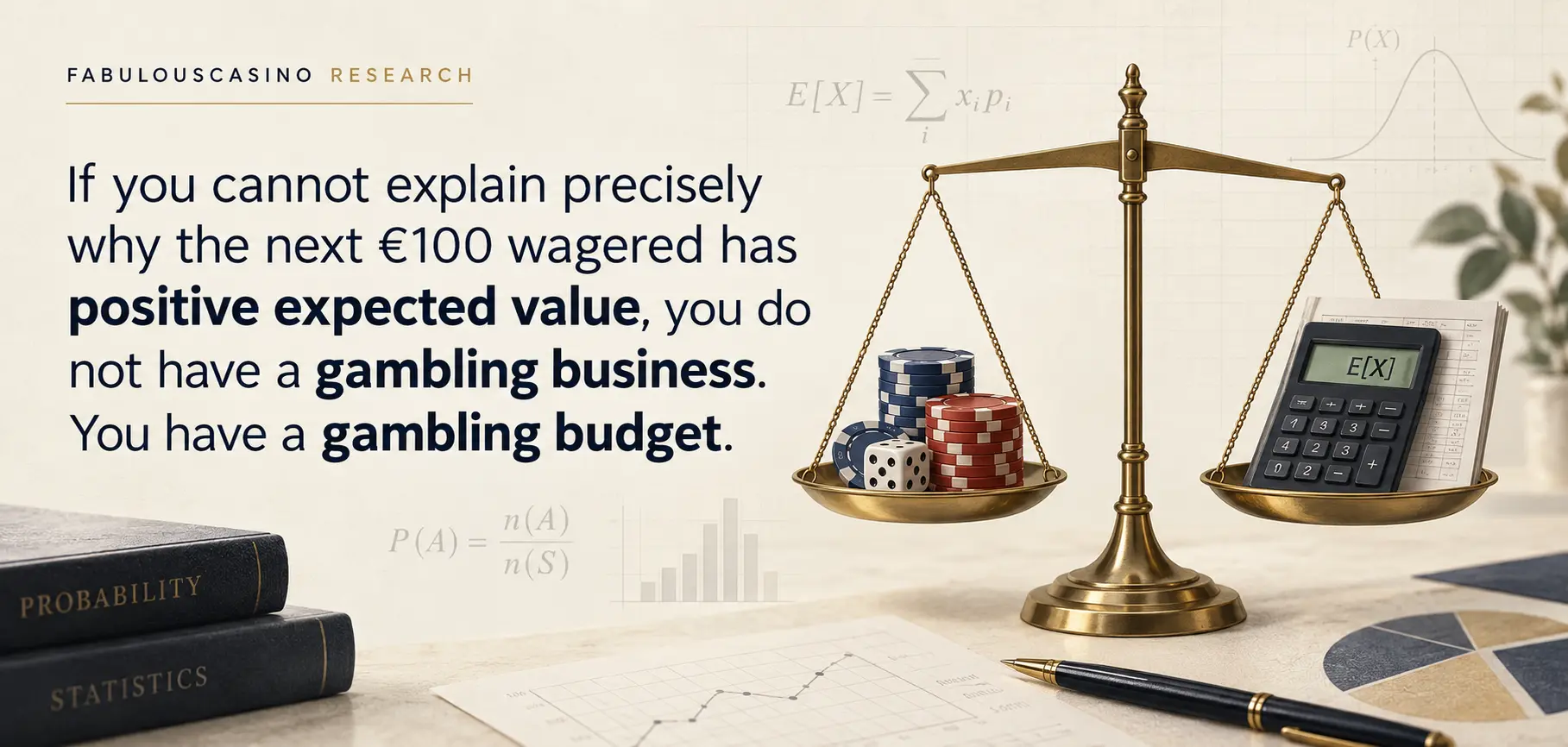
If you cannot explain precisely why the next €100 wagered has positive expected value, you do not have a gambling business. You have a gambling budget.
Frequently Asked Questions
Can you really make a living playing casino games?
A small number of specialists can earn money from poker, blackjack advantage play, promotions or other favourable situations. Ordinary play on games with a house edge is not a dependable income model.
Can you make a living playing online slots?
Not through normal slot play. A slot with an RTP below 100% has negative theoretical value before external promotions or rewards are considered. Rare specialist opportunities do not make routine slot play profitable.
Can you make a living playing roulette?
Standard roulette bets have a house edge. Betting systems change stake sizes but do not change the wheel’s probabilities or payouts.
Can you make a living playing baccarat?
Common Banker and Player bets have relatively low house edges but remain negative-expectation wagers. Baccarat pattern systems do not provide a proven recurring salary.
Can card counters make a living?
Some skilled blackjack advantage players have done so. The work requires favourable rules, adequate penetration, accurate play, bankroll, travel and continued access despite casino countermeasures.
Can poker be a full-time job?
Yes, for players who can consistently outperform their opponents by more than the rake and expenses. Income remains volatile and the required skill level changes with the competition.
Does a 96% RTP mean I will get 96% of my money back?
No. RTP is a statistical measure across game turnover and a large volume of play. It is not a promise for one deposit, player or session.
Can a 100% RTP game still lose money?
Yes. A theoretical 100% return does not eliminate variance, mistakes, fees or the possibility of a substantial short-term loss. It also does not provide positive income before expenses.
Can casino bonuses create positive expected value?
Sometimes, but only when the bonus’s real value exceeds expected gaming losses and all restrictions, fees and cashout limits are included.
Is Martingale profitable with a large bankroll?
No bankroll is infinite. Martingale leaves the negative expectation of the game unchanged and exposes the player to rapidly escalating bets, table limits and severe losses.
How much bankroll does a professional gambler need?
There is no universal amount. It depends on edge, variance, stakes, volume, risk tolerance and whether living expenses are held separately from playing capital.
Are gambling winnings taxable?
Tax rules depend on the player’s country, activity and circumstances. Players should obtain advice for their own jurisdiction and retain complete transaction records.
Are casino streamers professional gamblers?
Some may be, but a streamer can operate a profitable media business while losing money on the gambling itself. Sponsorship, affiliate and audience revenue should be separated from casino results.
How do I know whether a gambling system works?
The system must identify a measurable positive expectation after all costs and be tested over an appropriate sample. Winning sessions and withdrawal screenshots are not sufficient evidence.
Should I quit my job to gamble professionally?
Not on the basis of recent wins, confidence or a staking system. A defensible decision would require a verified long-term edge, extensive records, separate living reserves, legal and tax planning and an acceptable risk of ruin.
Final Verdict
Most people cannot make a living playing casino games because most casino wagers are designed to return less than the total amount staked over time.
Professional gambling can exist where:
- players compete against weaker players;
- a lawful advantage changes the underlying expectation;
- promotions and rebates exceed expected loss;
- results are recorded across a meaningful volume;
- bankroll and living expenses remain separate;
- the opportunity survives costs, restrictions and variance.
Those conditions describe a small, specialised group. They do not describe ordinary casino play.
Casino games can produce income for a period. Without a verifiable player edge, they cannot be expected to produce a living.
This article provides general information, not financial, legal or tax advice. Gambling outcomes are uncertain, and even positive-expectation strategies can lose money. Never use borrowed money or funds required for essential expenses.

Jake Sanford
Editor in Chief
Jake Sanford is the Editor in Chief of FabulousCasino and an experienced iGaming industry analyst with a focus on online casinos, player safety, and international gambling trends. His work combines hands-on research with practical insights to help players better understand casino platforms, bonuses, payments, and regulatory developments.