
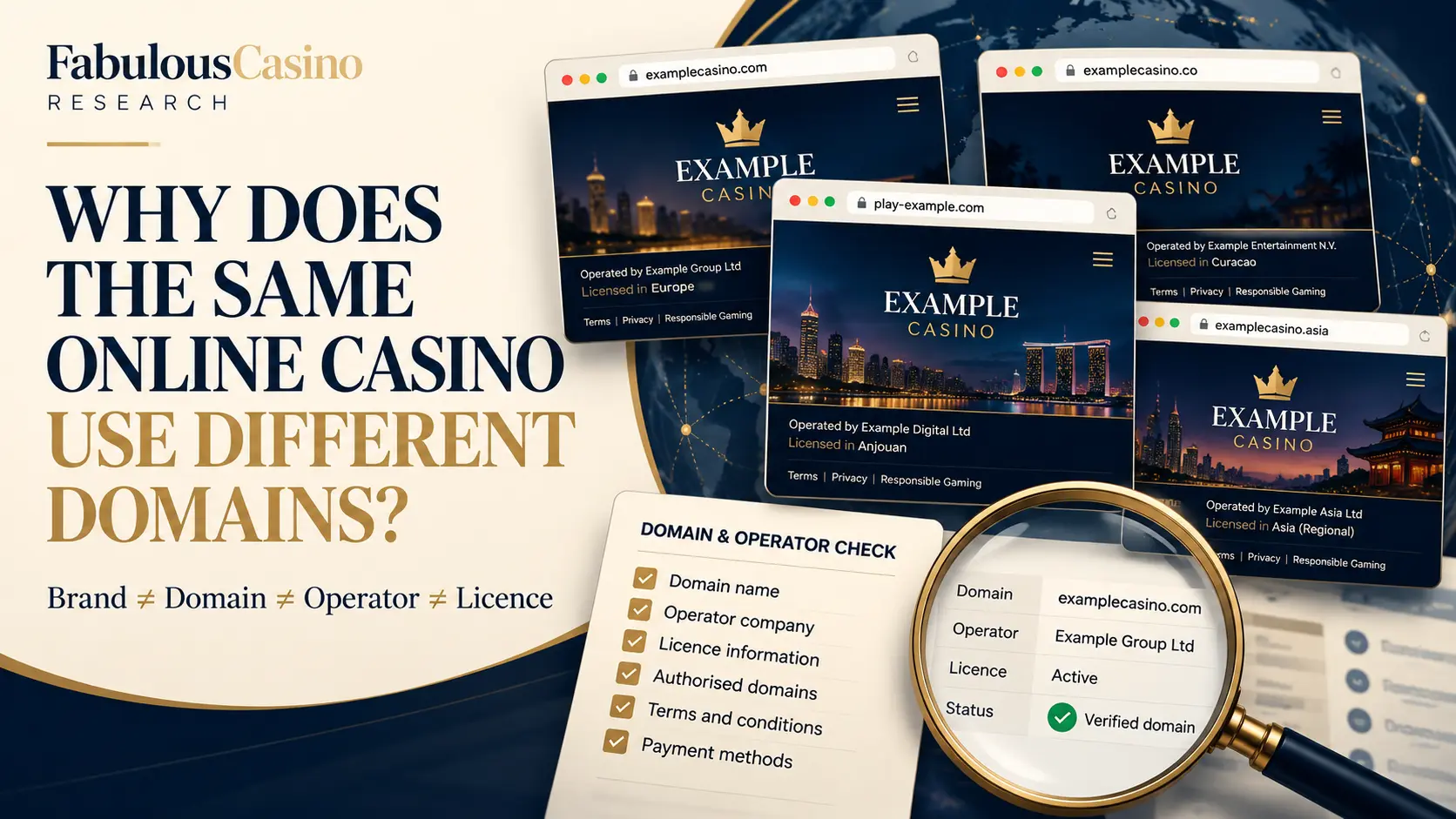
Finding the same online casino on several different web addresses can be confusing.
A player may search for one casino brand and find a .com domain, a country-specific address, another URL used for login, and perhaps a completely different domain appearing in search results or advertising.
Sometimes there is a straightforward explanation.
Sometimes there is not.
A second domain may be an official regional website, a replacement address, a technical redirect or another authorised site operated by the same gambling company.
But the same logo and casino name can also appear on an unrelated clone, an unauthorised mirror or a website whose legal operator differs from the one a player expected.
That is why FabulousCasino does not treat the brand name alone as proof of who operates a casino.
The short version: A casino brand can use several domains. What matters is whether the exact website can be connected to the operator, terms and regulatory information claimed by the casino.
Why Casino Domains Matter
When most people think about an online casino, they think about the brand.
From a research perspective, that is only the first layer.
A casino website can involve several separate elements:
Brand → Domain → Legal Operator → Licence → Platform → Payment Infrastructure
These elements often overlap, but they are not interchangeable.
A familiar brand name does not automatically prove that:
- every domain using the name has the same operator;
- every version is covered by the same licence;
- the terms are identical;
- payment processing is identical;
- or the website is even controlled by the genuine brand.
The exact URL therefore matters.
Same Casino, Different Domain: What It Can Mean
| What you see | What it may mean | What FabulousCasino checks |
|---|---|---|
| Same brand on another domain | Regional or alternative official site | Operator, terms and regulatory record |
| Automatic redirect | Domain migration or regional routing | Final destination and legal footer |
| Country-specific domain | Localised site or separate market operation | Operator, currency, terms and licence |
| Different legal footer | Different contracting or service entity | Company names and responsibilities |
| Licence badge | Regulatory claim | Official regulator record and exact domain |
| Unfamiliar mirror | Official alternative, unauthorised copy or unrelated site | Independent confirmation before relying on it |
The important word in that table is may.
A different domain is not automatically suspicious.
But it should never be assumed to be legitimate simply because the website looks familiar.

1. Regional Casino Domains
One of the simplest explanations is localisation.
An international casino may operate different websites for different languages, currencies or markets.
That can allow the operator to change:
- language;
- currency;
- payment options;
- promotional terms;
- restricted countries;
- customer support;
- responsible gambling information;
- and regulatory disclosures.
A brand may therefore look almost identical across two domains while the player-facing details differ.
This is particularly relevant when FabulousCasino compares casinos market by market.
Our Singapore casino research and Malaysia casino research do not assume that a global casino product works identically in each location.
The cashier, account currency, KYC process and even the legal information shown to the player can change with the market.
2. Domain Changes and Redirects
Casino domains can also change over time.
A company may move a website from one address to another because of:
- a rebrand;
- a corporate restructuring;
- a new primary domain;
- a platform migration;
- consolidation of several websites;
- or another operational change.
The old domain may then redirect automatically to the new one.
A redirect itself is not unusual.
What matters is the destination.
If an old casino URL redirects to a new domain, FabulousCasino follows the redirect and checks the legal information on the final website rather than assuming that historic information about the old domain remains current.
That distinction matters because casino ownership, licensing and commercial relationships can change while older reviews and search results remain online for years.
3. One Operator Can Use Many Domains
A gambling company can operate more than one casino brand.
It can also operate multiple domains connected with those brands.
Regulators themselves recognise this structure.
The UK Gambling Commission’s public register can be searched by business, trading name or domain, and remote operators are required to keep the Commission informed about relevant domains used for gambling activities.
Check the UK Gambling Commission Public Register
This gives us an important research principle:
We verify the domain against the operator rather than stopping when we find the operator’s name somewhere on the internet.
The same principle applies when researching casino groups and sister sites.
Our investigations into Who Owns Iris Casino? and Who Owns BetLabel Casino? show why the relationship between brand, operating company, licence holder, payment company and related websites can be more complicated than the casino name suggests.
4. A Licence Does Not Automatically Cover Every Similar-Looking Website
This is one of the most important distinctions.
Seeing a licence number somewhere on a casino website is not the end of the verification process.
The question is:
Does the official regulator connect this operator and this website?
Different regulators provide different ways to check that relationship.
UK Gambling Commission
The UK Gambling Commission includes domain information in its public register.
Remote gambling operators are expected to report relevant domains used for their gambling operations.
Search the UK Gambling Commission register
Malta Gaming Authority
The Malta Gaming Authority’s official Licensee Register can be searched using information including the operator and website URL.
Individual authorisation records can also identify websites associated with a licensee.
Search the MGA Licensee Register
Curaçao Gaming Authority
Under Curaçao’s current regulatory system, the Curaçao Gaming Authority uses dynamic licence seals connected with domains authorised for an operator.
That makes the exact domain particularly important.
A copied licence logo on another website is not the same thing as a regulator confirming that website.
Check the Curaçao Gaming Authority licence portal
5. The Same Brand Can Sit Inside a More Complicated Corporate Structure
The casino operator is not always the only company named on a website.
Players may encounter separate entities responsible for:
- gambling operations;
- website management;
- payment processing;
- marketing;
- software;
- intellectual property;
- or local services.
That does not automatically indicate a problem.
International online businesses commonly divide different functions between different legal entities.
But it means the question:
“Who owns this casino?”
can be less useful than several more precise questions:
- Who operates the gambling account?
- Which company appears in the Terms and Conditions?
- Which company holds the relevant gaming authorisation?
- Which company processes payments?
- Which domain is connected with the regulatory record?
- Which entity is responsible when a player has a dispute?
Our BetLabel ownership research is a good example of why these roles should be separated rather than compressed into one company name.
6. Alternative Domains Are Not Proof of Fraud
Players sometimes become suspicious as soon as a casino uses a second domain.
That conclusion is too simple.
Legitimate operators can have several websites.
A regulator may even list multiple URLs under the same licensee.
That is not unusual by itself.
The question is whether the relationship is transparent and independently verifiable.
A second domain becomes more concerning when:
- the legal footer disappears;
- the operator name changes without explanation;
- the terms link back to another website;
- regulatory information cannot be confirmed;
- contact information differs unexpectedly;
- deposits are requested through unexplained third parties;
- or the website claims an authorisation that the regulator does not associate with it.
Context matters more than the number of domains.
7. What About Mirror Domains?
The term mirror is used loosely in online gambling.
It can describe a website that replicates another casino’s interface or provides an alternative route to substantially the same product.
But the word itself proves nothing about ownership.
An official alternative domain and an unauthorised clone can look almost identical from the player’s perspective.
Both may use:
- the same casino name;
- the same logo;
- similar colours;
- copied bonus offers;
- familiar games;
- and a near-identical login page.
Visual similarity therefore cannot establish authenticity.
FabulousCasino looks for evidence outside the design itself.
8. Clone and Phishing Sites Make Domain Verification More Important
Casino brands can be copied.
A fraudulent site does not need to invent a convincing new brand if it can imitate one that players already recognise.
That makes domain verification particularly important before a player:
- creates an account;
- submits identification documents;
- enters payment information;
- transfers cryptocurrency;
- or sends money to a bank account or wallet address.
A polished interface is not evidence of regulatory status.
Neither is a familiar logo.
The same principle applies to licence seals.
A static image can be copied.
An official regulator record is substantially more useful.
9. Check the Terms, Not Just the Homepage
Casino homepages are designed to sell the product.
The legal footer and Terms and Conditions usually tell us more about who is actually providing it.
When FabulousCasino investigates a domain, we look for information including:
- legal operator name;
- company registration;
- registered address;
- licence or authorisation number;
- regulator;
- website or domain references;
- payment entities;
- dispute procedure;
- privacy-policy entity;
- and restricted markets.
We then compare those details across the website.
If the homepage names one company, the terms another and the payment page a third, we do not automatically assume misconduct.
But we do want to understand why.
10. The Payment Recipient Can Reveal Another Layer
Domains become even more interesting when they are compared with payments.
The company or person receiving a casino deposit may not share the casino brand name.
There can be legitimate reasons for this, including external payment processors or group companies.
But unexplained third-party payment instructions deserve additional scrutiny.
Our investigation into UFA’s multi-level casino network illustrates why the visible casino website may represent only one layer of a much larger technical and financial structure.
For the player, the practical questions remain straightforward:
Who receives my money? Who holds my account balance? Who owes me the withdrawal?
A brand name alone may not answer any of them.
How FabulousCasino Checks an Alternative Casino Domain
Our process is deliberately simple.
Step 1: Record the Exact URL
We start with the website the player is actually using.
Not just the brand.
Not an old review.
Not a search-result headline.
The domain itself.
Step 2: Follow Redirects
If the address redirects, we record the final destination.
That is the site whose current legal information matters most.
Step 3: Identify the Operator
We check:
- Terms and Conditions;
- footer;
- privacy policy;
- responsible gambling page;
- and payment or legal disclosures.
Step 4: Check the Regulator
Where an official licence is claimed, we look for the operator and, where possible, the exact domain in the regulator’s own records.
Step 5: Compare the Details
We compare:
- company name;
- licence;
- domain;
- trading name;
- address;
- and other legal information.
Step 6: Check the Money Layer
Where possible, we also look at the companies or payment intermediaries connected with deposits and withdrawals.
Step 7: Do Not Fill Gaps With Assumptions
If we cannot independently connect a domain to the claimed operator, we say so.
Unverified is not the same as fraudulent.
But it is also not the same as verified.
What Should Players Check?
Before treating an unfamiliar domain as the official version of a casino, check several basic details.
Exact Domain
Does the URL match the address published by the operator or regulator?
HTTPS
A secure connection is basic web hygiene, although HTTPS alone says nothing about whether a casino is legitimate.
Legal Operator
Is a company clearly identified in the Terms and Conditions?
Licence Record
Can the claimed regulator confirm the operator and, where available, the website?
Terms Consistency
Do the terms, privacy policy and footer describe the same basic corporate structure?
Payment Instructions
Are deposit instructions consistent with the casino’s published payment process?
Redirect Destination
If another casino URL redirects here, where did the player actually end up?
No single check is perfect.
Together they provide a much stronger picture.
Why FabulousCasino Records Exact Domains
Casino research ages quickly.
A brand can remain familiar while almost everything behind it changes.
Over time, a casino can change:
- domain;
- operator;
- licence;
- payment processor;
- platform;
- affiliate programme;
- terms;
- or market focus.
That is why our research articles distinguish between what we can verify now and what may only describe the brand historically.
The same principle runs through our ownership research, payment investigations and TrustLab assessments.
We are not only asking:
“Is this the casino?”
We are asking:
“What exactly is operating at this address today?”
Frequently Asked Questions
Why does an online casino have more than one domain?
A casino may use different domains for regional websites, language versions, domain migrations, separate brands, technical infrastructure or other operational reasons.
The presence of several domains is not automatically a warning sign.
Is an alternative casino domain safe?
It depends on who controls it.
Players should verify the legal operator, terms and regulatory information associated with the exact website rather than relying only on the brand name.
Does the same casino licence cover every domain?
Not automatically.
Regulatory structures differ, but some regulators explicitly record or authorise domains connected with a licensee.
The exact website should therefore be checked against the relevant regulator where possible.
Can one gambling company operate several casino websites?
Yes.
One legal operator can operate several casino brands or domains, depending on its licences and regulatory permissions.
Why does a casino redirect me to another URL?
Possible reasons include a domain migration, regional routing, localisation or another technical or operational change.
The final destination should be checked independently.
Is a mirror site the same as the original casino?
Not necessarily.
The term mirror is used loosely.
An alternative domain may be officially controlled by the casino, but another website could also imitate the genuine brand.
Can I trust a casino because the licence logo looks genuine?
A logo or licence badge should not be relied on by itself.
Where possible, follow the verification link or search the regulator’s official register.
Why can the operator name differ from the casino name?
The casino name is a consumer-facing brand.
The gambling account can be operated by a legal company with a completely different corporate name.
Additional companies may also handle payments, technology or website management.
Can a casino change operator without changing its brand?
Yes.
Brands and websites can be sold, transferred or moved between corporate structures.
That is one reason historic reviews should not automatically be treated as evidence of the current operator.
What if FabulousCasino cannot verify a domain?
We distinguish between verified information and information that remains unclear.
Failure to verify a relationship does not by itself prove that a site is fraudulent.
It means we do not treat the relationship as established until stronger evidence is available.
The Fabulous View
A casino brand is the part players remember.
The domain is the part they actually visit.
That distinction matters.
Two websites can display the same logo while sitting behind different legal, regulatory or payment structures.
And one legitimate gambling company can operate many websites without there being anything unusual about it.
The correct question is therefore not:
“Why does this casino have another domain?”
It is:
“Can this exact domain be connected to the operator and regulatory structure it claims?”
That is the question FabulousCasino tries to answer before treating two casino websites as the same operation.

Jake Sanford
Editor in Chief
Jake Sanford is the Editor in Chief of FabulousCasino and an experienced iGaming industry analyst with a focus on online casinos, player safety, and international gambling trends. His work combines hands-on research with practical insights to help players better understand casino platforms, bonuses, payments, and regulatory developments.