


Full T&C apply. 18+ New customers only. Min deposit €10. All deposit bonuses are subject to a x35 wagering requirement within 7 days after activation. The maximum stake when wagering the bonus is 5 EUR. All types of bonus are disabled for cryptocurrencies, without exception.
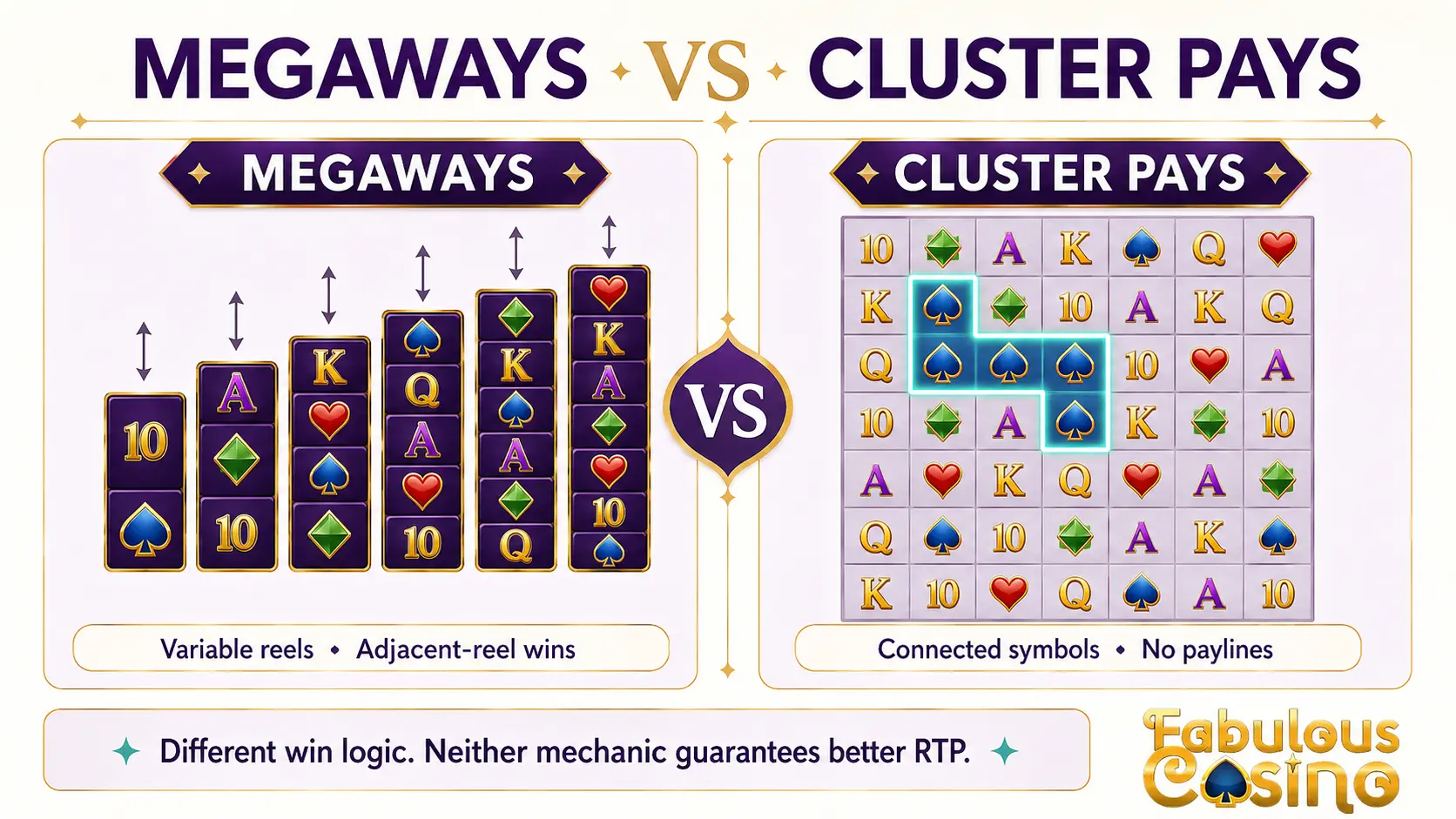
Megaways changes the number of symbols and winning ways, while Cluster Pays rewards groups of matching symbols touching on a grid.
Megaways vs Cluster Pays at a Glance
| Feature | Megaways | Cluster Pays |
|---|---|---|
| Basic layout | Usually multiple vertical reels with changing heights | Usually a fixed square or rectangular symbol grid |
| How wins form | Matching symbols appear on consecutive adjacent reels | Matching symbols connect horizontally or vertically |
| Paylines | No fixed paylines in the conventional sense | No conventional paylines |
| Number of combinations | Can change on every spin | Normally determined by the grid size and symbol distribution |
| Typical advertised maximum | Up to 117,649 ways in many classic Megaways games | No standard number of winning ways |
| Minimum winning combination | Usually matching symbols across at least three consecutive reels | Often five or six connected symbols, depending on the game |
| Direction | Usually begins from the leftmost reel | Can form anywhere on the grid |
| Cascades | Common, but not required by the basic mechanic | Common, but not required by the basic mechanic |
| Changing reel size | Core feature of traditional Megaways | Not normally part of the basic Cluster Pays mechanic |
| RTP | Set individually for each game | Set individually for each game |
| Volatility | Often high, but not determined by the mechanic alone | Can range from relatively balanced to extremely volatile |


What Is Megaways?
Megaways is a slot mechanic developed by Big Time Gaming. Rather than displaying a fixed number of symbols on every reel, a traditional Megaways game can change the height of its reels from one spin to the next.
A reel might display:
- two symbols on one spin;
- five symbols on the next;
- seven symbols during another spin.
Because each reel can show a different number of symbols, the number of available ways to win can also change.
Big Time Gaming describes Megaways as a dynamic reel-modifier system. Many classic six-reel implementations offer up to 117,649 ways to win. You can read the developer’s description of the Megaways mechanic.
How Does a Megaways Slot Create a Win?
A typical Megaways win requires matching symbols to appear on consecutive reels, normally beginning with the first reel on the left.
For example, a winning combination could contain:
- one matching symbol on reel one;
- two matching symbols on reel two;
- three matching symbols on reel three.
Those symbols can create several individual ways to win because each matching symbol on one reel can combine with matching symbols on the next.
The symbols do not normally need to appear on a specific horizontal line. Their position within each reel is less important than their presence on consecutive reels.
Example of a Megaways win
Imagine that a game displays matching crown symbols as follows:
- Reel 1: one crown
- Reel 2: two crowns
- Reel 3: three crowns
The combination creates:
1 × 2 × 3 = 6 winning ways
If reel four also contains two crowns, the combination becomes:
1 × 2 × 3 × 2 = 12 winning ways
This multiplication of symbol positions is why a single spin can contain many wins even though the game does not use hundreds of separately drawn paylines.
Why Do Many Megaways Games Advertise 117,649 Ways?
In the classic six-reel version, each reel can display up to seven symbols.
If all six reels display seven symbols, the calculation is:
7 × 7 × 7 × 7 × 7 × 7 = 117,649
This is the maximum number of symbol combinations for that particular reel configuration.
It does not mean that every spin provides 117,649 ways. If the reel heights are lower, the number is lower.
For example, reels displaying two, three, four, five, six and seven symbols would create:
2 × 3 × 4 × 5 × 6 × 7 = 5,040 ways
The number displayed by the game can therefore change substantially from spin to spin.
Not every Megaways game stops at 117,649
117,649 is strongly associated with the original six-reel format, but it is not a universal limit for every game using Megaways technology.
Some newer variants add:
- an additional reel;
- horizontal reel modifiers;
- extra symbol positions;
- special bonus configurations;
- up to one million potential ways.
Big Time Gaming has released games that increase the maximum beyond the traditional figure. Players should check the individual paytable rather than assuming that every Megaways title uses exactly the same layout.
What Is Cluster Pays?
Cluster Pays is a grid-based win mechanic in which matching symbols must form a connected group.
Instead of following paylines or moving across consecutive reels, a cluster can appear almost anywhere on the grid.
Symbols usually connect when they touch:
- horizontally;
- vertically.
Diagonal contact alone does not normally create a connection, although the individual game rules always take priority.
The number of matching symbols needed for a win varies. Some games pay for clusters of five or more symbols; others require at least six.
NetEnt’s Lost Relics, for example, awards wins for groups of at least six matching symbols connected horizontally or vertically.
How Does a Cluster Win Form?
Imagine a grid containing several matching gem symbols.
A winning cluster could form when:
- three gems sit next to each other horizontally;
- two additional gems connect vertically to that group;
- the game requires at least five connected symbols.
The symbols do not need to form a straight line. They might create an L-shape, T-shape, block or irregular connected area.
What matters is that each symbol has a valid connection to the wider group.
Separate groups are usually paid separately
If six symbols form one connected cluster and another six matching symbols form a separate cluster elsewhere on the grid, the game may treat them as two independent wins.
They do not normally combine into a twelve-symbol cluster unless the two groups are connected according to the game rules.
Do Diagonal Symbols Count in Cluster Pays?
Usually not.
Most Cluster Pays games require identical symbols to touch along a horizontal or vertical edge. Symbols touching only at the corners are generally not connected.
However, Cluster Pays is not implemented identically in every slot. Some games use:
- diagonal connections;
- special wild connections;
- expanding symbols;
- colossal symbols occupying several grid positions;
- symbols that connect separated areas;
- mechanics that merge nearby clusters.
The paytable should state exactly what counts as an adjacent symbol.
What Does “No Paylines” Actually Mean?
Both mechanics are commonly described as having no traditional paylines, but they replace paylines in different ways.
Megaways
Winning positions are calculated through combinations of symbols on consecutive reels. The player does not need to select or activate specific lines.
Cluster Pays
Winning positions are calculated by finding connected groups of matching symbols. The symbols do not need to cross the screen from left to right.
“No paylines” therefore does not mean that wins are random or undefined. Each game still has precise mathematical rules determining which symbol arrangements pay.
Are Cascades Part of Megaways and Cluster Pays?
Cascades are extremely common in both types of slot, but they are a separate mechanic.
During a cascade:
- A winning combination is identified.
- The winning symbols are removed.
- New symbols fall or appear in the empty positions.
- The game checks for another win.
- The process continues until no new win forms.
Big Time Gaming often calls this process a reaction or cascade. Other studios use terms such as:
- Avalanche;
- Tumble;
- Symbol Drop;
- Rolling Reels;
- Collapse;
- Chain Reaction.
Because clusters can remove large or irregular groups of symbols, cascading sequences are particularly natural in Cluster Pays games. Megaways slots frequently use them to create consecutive wins and increase bonus multipliers.
Nevertheless:
Megaways does not automatically mean cascades, and Cluster Pays does not automatically mean cascades.
The presence and rules of the feature must be checked for each game.
Which Mechanic Creates More Ways to Win?
The comparison cannot be reduced to one advertised number.
Megaways games can calculate a precise number of potential symbol combinations from the reel configuration. This is why they display figures such as 324, 5,040 or 117,649 ways.
Cluster Pays games normally do not express their win potential as a fixed number of ways. The possibilities depend on:
- the size of the grid;
- the number of symbols;
- the minimum cluster size;
- how symbols are distributed;
- wild behaviour;
- cascades and symbol replacements.
A large cluster grid can create an enormous number of possible winning patterns even though the game never advertises a “ways to win” figure.
The advertised number is therefore useful for explaining the structure, but it does not establish which game pays more frequently or offers better value.
Does a Higher Number of Megaways Improve Your Chances?
Not necessarily.
A spin with more visible symbol positions provides more potential combinations. However, the game’s mathematics can compensate through:
- symbol frequency;
- paytable values;
- wild frequency;
- bonus probability;
- reel-strip design;
- maximum-win restrictions.
A high number of ways does not independently determine:
- RTP;
- hit frequency;
- volatility;
- average win size;
- bonus frequency.
The same principle applies to a larger cluster grid. More positions do not automatically make the game more generous.
Which Mechanic Has the Better RTP?
Neither.
Return to player is calculated for the individual game and configuration. It is not guaranteed by the payment mechanic.
A Megaways game can have a higher or lower RTP than a Cluster Pays game. Two versions of the same slot may also be supplied with different RTP settings to different casinos.
For example, NetEnt lists:
- Aloha! Cluster Pays at 96.42% RTP;
- Lost Relics at 96.30% RTP;
- 101 Candies at 96.08% RTP.
Those figures describe specific game configurations. They do not establish a standard RTP for all Cluster Pays slots.
Always check the information screen of the version available at the casino where you are playing.
Which Is More Volatile?
Megaways slots have a reputation for high volatility because many popular titles combine the mechanic with:
- large bonus multipliers;
- cascading wins;
- expanding reels;
- free-spin upgrades;
- high maximum payouts.
Cluster Pays games can be equally volatile, particularly when large wins depend on:
- forming unusually large clusters;
- long cascading sequences;
- progressive multipliers;
- rare special symbols;
- unlocking larger grids;
- reaching a bonus feature.
Volatility is a design choice. It cannot be determined from the mechanic’s name alone.
Megaways Examples
Well-known games using the Megaways mechanic include:
- Bonanza Megaways;
- Extra Chilli Megaways;
- Who Wants to Be a Millionaire Megaways;
- White Rabbit Megaways;
- Gonzo’s Quest Megaways;
- Great Rhino Megaways;
- Buffalo Rising Megaways;
- Wheel of Fortune Megaways.
Big Time Gaming developed the original system, but the mechanic has been licensed to numerous other studios.
As a result, games carrying the Megaways name can differ substantially in:
- RTP;
- volatility;
- reel configuration;
- maximum win;
- bonus structure;
- feature-buy availability.
Cluster Pays Examples
Examples of games using Cluster Pays or closely related cluster-paying mechanics include:
- Aloha! Cluster Pays;
- Lost Relics;
- 101 Candies;
- Reactoonz;
- Jammin’ Jars;
- Sweet Bonanza;
- Moon Princess;
- Viking Runecraft;
- Fruit Party;
- Star Clusters Megaclusters.
Not every game in this category uses the trademarked term “Cluster Pays.” Studios may use their own names for mechanics that reward connected symbol groups or winning groups on a grid.
The required number of symbols and valid connection rules can differ considerably.
Can a Slot Use Both Megaways and Cluster Pays?
Yes. Slot mechanics are not mutually exclusive.
A developer can combine:
- variable reel sizes;
- Megaways-style symbol combinations;
- cluster wins;
- cascades;
- expanding grids;
- multipliers;
- colossal symbols.
Some hybrid games move beyond the most familiar version of either system. A title may use a changing number of positions while rewarding symbol groups rather than conventional adjacent-reel combinations.
This is why the game rules are more reliable than the marketing label.
Which Mechanic Is Easier to Understand?
Megaways can initially look more familiar because it still uses vertical reels and left-to-right symbol combinations. The changing reel heights and ways calculation make it more complex than a standard slot, but the basic visual structure remains recognisable.
Cluster Pays removes the left-to-right expectation. New players may need time to recognise irregular winning groups, especially on a large grid.
Once understood, Cluster Pays can be visually intuitive:
- find the group of matching symbols;
- check that they touch correctly;
- count whether the group reaches the required size.
Neither system requires the player to calculate every possible combination manually. The game highlights winning symbols and calculates the payout automatically.
Which Is Better for Mobile Play?
Both mechanics can work well on mobile devices, but the quality of the implementation matters.
A Megaways game may need to display up to seven symbols on each of six or more reels. A Cluster Pays game may need to fit a 7×7 or similarly large grid on a portrait screen.
Potential mobile issues include:
- symbols becoming too small;
- winning clusters being difficult to identify;
- paytable information requiring several menus;
- animations obscuring the result;
- important balance or bet information being compressed.
A well-designed mobile version should clearly highlight wins, keep controls readable and make the paytable accessible without relying on the player to understand the desktop layout.
Which Mechanic Is Better?
Neither mechanic is objectively better.
Megaways may appeal more to players who prefer:
- a recognisable reel-based layout;
- a changing number of ways on each spin;
- left-to-right winning combinations;
- free-spin features with increasing multipliers.
Cluster Pays may appeal more to players who prefer:
- large symbol grids;
- wins forming anywhere on the screen;
- chain reactions and symbol removal;
- visually growing clusters;
- grid-based bonus progression.
The more important comparison is between the individual games:
- What is the verified RTP?
- How volatile is it?
- What is the maximum payout?
- How frequently does the bonus occur?
- Are feature buys available?
- How transparent is the paytable?
- Is the game supplied in more than one RTP version?
Common Megaways and Cluster Pays Myths
“117,649 ways means 117,649 chances to win”
Not exactly. It describes the number of possible symbol-position combinations in the maximum reel configuration. It does not mean the game performs 117,649 independent bets or guarantees a high hit rate.
“Cluster Pays wins can connect diagonally”
Usually not. Most games require horizontal or vertical contact unless the rules specifically allow diagonal connections.
“More symbols mean better RTP”
No. The game’s mathematical model adjusts symbol frequency and payout values. Grid or reel size alone does not determine RTP.
“All Megaways slots are the same”
No. Megaways provides a structural mechanic. Developers add different reels, bonuses, multipliers, RTP settings and volatility profiles.
“Cluster Pays always includes cascades”
No. Cascades are frequently combined with cluster wins, but they remain a separate feature.
“Megaways is always more volatile”
No. Many famous Megaways games are highly volatile, but volatility is set at game level. Cluster-paying slots can be just as volatile or more volatile.
The FabulousCasino View
Megaways and Cluster Pays solve the same design problem in different ways: they create more varied winning patterns than a conventional fixed-payline slot.
Megaways varies the number of visible symbols and calculates wins across adjacent reels. Cluster Pays abandons reel-to-reel combinations and looks for connected groups on a grid.
Neither label tells us whether a slot is fair, generous or suitable for a particular player.
When FabulousCasino examines a game, we look beyond the mechanic and check:
- the RTP version supplied by the casino;
- volatility;
- hit frequency where disclosed;
- maximum-win probability where disclosed;
- feature-buy cost;
- bonus contribution rules;
- maximum bet restrictions;
- whether the paytable clearly explains the win logic.
More ways, more reels or a larger grid can make a game feel more active. They do not automatically improve its mathematical value.
Frequently Asked Questions
What is the main difference between Megaways and Cluster Pays?
Megaways creates wins through matching symbols on consecutive reels and changes the number of symbols displayed on those reels. Cluster Pays awards wins for connected groups of matching symbols anywhere on a grid.
Does Megaways use paylines?
Megaways does not normally use fixed paylines. It calculates winning ways from matching symbols appearing across adjacent reels.
Does Cluster Pays use paylines?
No. Wins depend on forming a sufficiently large connected group of identical symbols.
How many symbols are needed for a cluster win?
The number depends on the game. Five or six matching symbols are common minimums, but the paytable may specify another requirement.
Do Cluster Pays symbols connect diagonally?
Usually not. Most implementations count horizontal and vertical connections. Check the game rules for exceptions.
Does every Megaways spin have 117,649 ways?
No. The number of ways normally changes with the reel heights. 117,649 is the traditional maximum when six reels each display seven symbols.
Can Megaways have more than 117,649 ways?
Yes. Some variants use additional positions or modified reel structures to create up to one million or more potential ways.
Are Cluster Pays games more likely to win?
Not necessarily. The mechanic does not determine hit frequency or RTP. Those values depend on the individual game’s mathematical design.
Which mechanic has the higher RTP?
Neither mechanic has a standard RTP. The return is set for each game and may also vary between configurations of the same title.
Can both mechanics include cascading wins?
Yes. Cascades are frequently used in both Megaways and Cluster Pays slots, but they are not automatically included.
Final Verdict
Megaways and Cluster Pays are different methods of replacing conventional paylines.
Megaways changes reel heights and rewards matching symbols across consecutive reels. The number of available ways can vary on every spin.
Cluster Pays uses a grid and rewards sufficiently large groups of matching symbols connected horizontally or vertically.
Megaways generally preserves the familiar appearance of a reel slot while making the reel structure dynamic. Cluster Pays changes the way players visually search for wins by allowing them to form in irregular groups anywhere on the grid.
Neither system guarantees a higher RTP, more frequent wins or better value. The mechanic describes how wins are formed—not how generous the underlying mathematics will be.
FabulousCasino recommends checking the individual game’s RTP, volatility, paytable and maximum-win rules instead of choosing a slot solely because it carries the Megaways or Cluster Pays label.









Jake Sanford
Editor in Chief
Jake Sanford is the Editor in Chief of FabulousCasino and an experienced iGaming industry analyst with a focus on online casinos, player safety, and international gambling trends. His work combines hands-on research with practical insights to help players better understand casino platforms, bonuses, payments, and regulatory developments.