

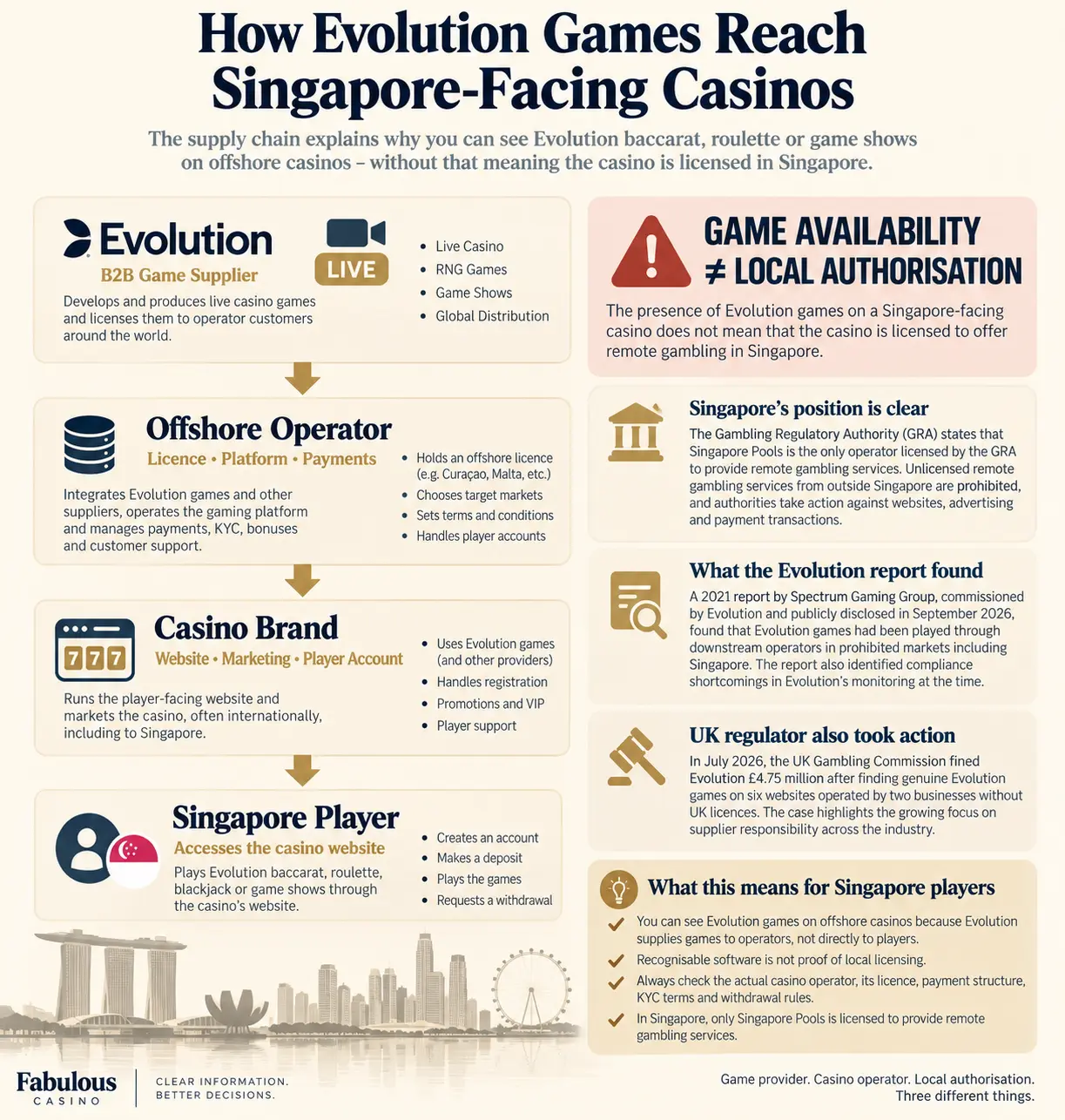
The presence of Evolution games tells you who produced or supplied the casino content. It does not, by itself, tell you whether the casino website offering those games is licensed to provide remote gambling in Singapore.
That distinction has become particularly important following the public disclosure in September 2026 of a previously confidential compliance report commissioned by Evolution itself.
The report found that Evolution games had been accessible through downstream operators in prohibited markets, including Singapore.
Understanding why requires looking at how the online live casino supply chain actually works.

Evolution Is a Game Supplier, Not the Casino You Are Playing At
Evolution operates primarily as a business-to-business (B2B) gaming supplier.
The company develops, produces and licenses live casino and other online casino products to gaming operators. Evolution’s own corporate reporting describes a model in which Evolution provides gaming content and infrastructure while its operator customers provide those products to end users.
At the end of 2025, Evolution reported approximately 870 customers and around 2,000 live tables.
A simplified relationship looks like this:
Evolution → Casino Operator → Casino Website → Player
This distinction matters.
When a player opens an Evolution baccarat table through an online casino, the player has generally not opened an account with Evolution. The casino operator controls the player-facing relationship, including:
- registration;
- deposits;
- withdrawals;
- bonuses;
- KYC and account verification;
- account restrictions;
- customer support; and
- the markets in which the casino is promoted.
Evolution supplies the underlying game.
Therefore, seeing Evolution inside a casino lobby should not be interpreted as evidence that the casino is authorised in every country from which its website can be reached.
Why Can Singapore Players Encounter Evolution Games?
Online casinos frequently integrate games from multiple external suppliers.
A single offshore casino can contain thousands of games supplied by companies located in different jurisdictions. Its live casino section might contain Evolution alongside other international live gaming providers.
The operator then distributes that casino product internationally.
This creates several separate layers:
Game supplier → Operator / platform → Casino brand → Target market → Player
Licensing and regulatory permissions do not automatically travel down that chain.
A supplier being licensed somewhere does not automatically make every operator using its games licensed everywhere.
Likewise, an offshore casino holding a licence in one jurisdiction does not mean that licence authorises remote gambling in Singapore.
This is the fundamental reason Evolution games can appear on websites that are accessible to Singapore players.
Is Evolution Licensed as an Online Casino Operator in Singapore?
Evolution should not be confused with a Singapore-licensed remote casino operator.
Singapore’s Gambling Regulatory Authority (GRA) states that it is unlawful to provide unlicensed remote gambling services from outside Singapore to people situated in Singapore.
The regulator is particularly clear about the local licensing position:
Singapore Pools is the only operator licensed by the GRA to provide remote gambling services.
This means that the appearance of Evolution baccarat, roulette or blackjack on another website does not make that website a Singapore-licensed remote gambling operator.
The same principle applies to other major casino software suppliers.
A casino can use software produced by internationally established companies while the legal and licensing status of the player-facing operator remains an entirely separate question.
What the Newly Released Evolution Compliance Report Found
This distinction became considerably more significant in September 2026.
A confidential report prepared by Spectrum Gaming Group in 2021 was publicly disclosed during litigation involving Evolution and intelligence firm Black Cube.
Importantly, Evolution had commissioned the Spectrum investigation itself after allegations were made concerning where its games were being accessed.
According to reporting on the disclosed report, Spectrum was able to corroborate that Evolution games had been played through operators in prohibited jurisdictions including:
- Singapore;
- Hong Kong;
- Saudi Arabia; and
- the United Arab Emirates.
Spectrum did not substantiate some of the more serious allegations involving US-sanctioned jurisdictions such as Iran and Syria.
However, the report identified weaknesses in Evolution’s compliance controls at the time, including insufficient proactive monitoring of whether customer-facing operators were complying with contractual restrictions concerning where Evolution games could be offered.
The report also found that Evolution received revenue associated with operators providing games in markets including Singapore and Hong Kong.
That is importantly different from claiming that Evolution itself operated a Singapore-facing online casino.
The issue concerns the distribution of Evolution content through downstream B2B customers.
Game Availability Does Not Equal Local Authorisation
For players, this produces one of the most important rules when evaluating an online casino:
Recognisable casino software is not proof of local licensing.
Seeing Evolution in the lobby can tell you something useful. It identifies the company responsible for producing a particular game and shows that the casino has access to Evolution content.
But it does not answer:
- Who operates this casino?
- Where is that company incorporated?
- Which regulator licenses the operator?
- Does that licence apply to Singapore?
- Who receives the player’s deposit?
- Who performs the KYC checks?
- Who is responsible when a withdrawal is disputed?
Those questions concern the casino operator and its legal and payment structure — not simply the company whose logo appears above the roulette table.
This supplier/operator distinction is also important when understanding the difference between a casino operator and a platform or technology provider.
The UK Case Shows Why the Supply Chain Matters
Singapore is not the only jurisdiction where this distinction has attracted regulatory attention.
In July 2026, the UK Gambling Commission announced a £4.75 million regulatory settlement involving Evolution Malta Holding Limited.
The Commission found genuine Evolution games on six websites operated by two businesses that did not hold UK Gambling Commission licences but were accessible to consumers in Great Britain.
Evolution confirmed that the games were genuine and subsequently permanently geo-blocked them for British consumers on the affected websites, as well as on other sites where its games had been identified.
The UK regulator concluded that Evolution’s controls had not been sufficiently effective to ensure that its games were available in Great Britain only through appropriately licensed operators.
The case illustrates a broader regulatory issue: suppliers increasingly need to understand who receives their games and where those games are ultimately being accessed.
This does not determine the regulatory position in Singapore. UK and Singapore gambling laws are separate.
But it demonstrates why regulators increasingly look beyond the casino homepage and examine the complete B2B supply chain behind an online gambling product.
Why Major Casino Providers Appear Across Offshore Markets
The underlying commercial reason is scale.
Evolution reported hundreds of operator customers globally. Those operators may themselves operate multiple casino brands, domains and regional products.
The resulting distribution network can therefore be enormous.
Consider a simplified hypothetical example:
Evolution
↓
Operator A
↓
Casino Brand X
↓
Singapore-facing website or marketing
↓
Player
The presence of Evolution at the top of that chain says nothing definitive about the regulatory status at the bottom of it.
This distinction becomes even more complicated when platforms, game aggregators, white-label providers, payment companies and affiliate marketing operations sit between those layers.
That is why Fabulous Casino evaluates operators separately from game providers.
Does an Evolution Logo Make an Offshore Casino Safer?
Not in the way players sometimes assume.
A respected software supplier and a casino operator perform different functions.
Evolution does not normally decide whether your casino withdrawal is approved. It does not set the casino’s general bonus terms, conduct the operator’s customer support or necessarily control how the casino handles an account dispute.
Those responsibilities generally sit with the player-facing operator.
For that reason, Fabulous Casino does not treat the presence of Evolution — or any other major provider — as a substitute for examining the casino itself.
A casino assessment should instead consider factors such as:
- identifiable operator ownership;
- applicable gambling licence;
- independent licence verification;
- withdrawal rules;
- KYC procedures;
- payment counterparties;
- dispute procedures;
- operating history; and
- material regulatory or enforcement history.
Software quality and operator trust are different questions.
What Should Singapore Players Check Instead?
If you encounter Evolution games on a Singapore-facing casino, start with the casino operator, not the game provider.
1. Identify the actual operator
Look beyond the casino brand name. The relevant operating company is normally disclosed in the website’s terms and conditions, footer or licensing information.
2. Verify the claimed licence
Do not stop at a licence logo.
Identify the regulator, licence holder and — where possible — verify the licence independently. An offshore gambling licence should be described accurately as an offshore licence, rather than a Singapore licence.
3. Check who handles the money
The company receiving a casino deposit can sometimes reveal more about the operating structure than the games displayed in its lobby.
This is particularly relevant where local-looking payment methods are offered. A familiar payment rail does not itself establish that the gambling operator is locally licensed.
Our guide to online casino payment methods explains some of the wider payment structures players may encounter.
4. Read the withdrawal and KYC terms
Check withdrawal limits, identity requirements, source-of-funds provisions, maximum cashout clauses and restrictions affecting the payment method used for the original deposit.
These conditions are controlled by the casino relationship — not by the fact that an Evolution game was played.
For Singapore-specific verification issues, see our guide to casino KYC in Singapore.
5. Understand the Singapore position
Singapore takes a restrictive approach to remote gambling.
The GRA states that Singapore Pools is the only operator it licenses to provide remote gambling services. Singapore authorities can also take measures against unlawful remote gambling websites, advertising and associated payment transactions.
That regulatory reality does not change because a website carries games from a major international supplier.
Evolution Is Not the Only Provider Where This Distinction Matters
The broader lesson extends beyond Evolution.
Singapore-facing offshore casinos may advertise games from internationally recognised providers because software supply and casino operation are separate layers of the industry.
The correct question therefore isn’t:
“Does this casino have games from a reputable provider?”
It is:
“Who is operating the casino that is offering those games to me?”
Those two questions can produce very different answers.
The Bottom Line
Evolution games appear on Singapore-facing casino websites because Evolution operates as a global B2B casino game supplier, distributing its products through casino operators rather than generally providing the player-facing casino relationship itself.
The September 2026 disclosure of Evolution’s own Spectrum Gaming Group report provides unusually clear evidence of why that distinction matters. The investigation found that Evolution games had been accessed through downstream operators in prohibited jurisdictions including Singapore and identified shortcomings in the company’s monitoring at the time.
Singapore’s regulatory position is separate and clear: the Gambling Regulatory Authority states that Singapore Pools is the only operator licensed by the GRA to provide remote gambling services.
So an Evolution table inside an offshore casino lobby establishes neither a Singapore gambling licence nor local authorisation for the casino carrying it.
Game provider. Casino operator. Local authorisation. Three different things.
For Singapore players assessing an offshore casino, the more useful questions concern the operator behind the website, its actual licence, its payment structure and the rules governing withdrawals and account verification.
Sources & Further Reading

Aidan Lee Chong
Head of Asia
Aidan Lee Chong leads the Asia-Pacific division at FabulousCasino and has been actively involved in the iGaming industry for many years. Originally from Kuching, Malaysia, he built his reputation through the development of multiple gaming and affiliate platforms tailored to Asian markets. His background combines operational industry experience with deep insight into regional player trends and online casino growth across SEA/APAC.