

Crypto casinos have become one of the most talked-about parts of online gambling. They promise faster payments, global access, fewer banking restrictions and a more flexible way to deposit and withdraw. Traditional fiat casinos, on the other hand, usually offer stronger regulation, clearer consumer protection and more familiar payment methods such as cards, bank transfers, e-wallets and open banking.
At FabulousCasino, we think the real comparison is not “crypto vs real money”. Crypto casinos are also real-money casinos. The better question is: how do crypto casinos compare with fiat casinos when it comes to speed, safety, regulation, transparency and player trust?
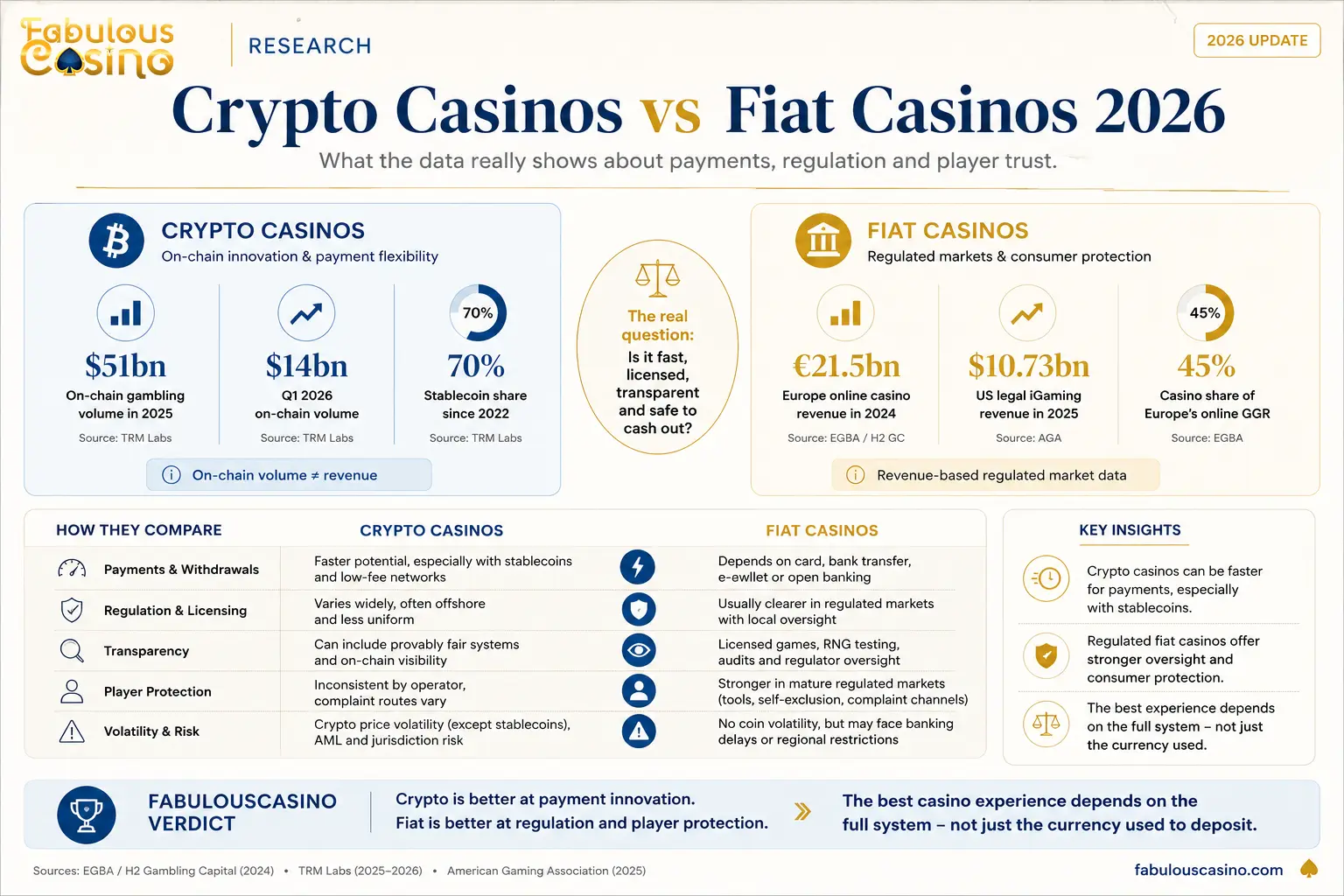
The data shows a more nuanced picture than most casino marketing suggests. Regulated online casino revenue remains massive in Europe and the United States, while on-chain crypto gambling volume is growing quickly. But these numbers are not the same metric. Traditional market reports usually measure gambling revenue, while crypto reports often measure on-chain volume. That distinction matters.
Key Takeaways
Europe’s online casino market generated an estimated €21.5 billion in revenue in 2024, making casino the largest online gambling product in Europe with 45% of online gross gaming revenue. Sports and events betting followed at €13.7 billion and 29%.
In the United States, legal internet gaming revenue across the seven states with lawful online casinos exceeded $10 billion in 2025, reaching $10.73 billion after 27.6% year-on-year growth, according to the American Gaming Association. (American Gaming Association)
Crypto gambling is growing quickly on-chain. TRM Labs reported $51 billion in on-chain crypto gambling volume in 2025, with a record $15 billion in Q4 2025 and $14 billion in Q1 2026. This is volume, not casino revenue. (Trm Labs)
Stablecoins now matter more than Bitcoin in many crypto gambling flows. TRM Labs says stablecoins accounted for about 70% of all on-chain gambling volume since 2022, equal to $117 billion of $169 billion in total on-chain gambling volume. (Trm Labs)
Regulators treat crypto gambling carefully. The UK Gambling Commission states that crypto-assets create additional risks compared with fiat currency, including price fluctuations and challenges around customer identification. (Gambling Commission)
Crypto Casino vs Fiat Casino: The Basic Difference
A fiat casino is an online casino where players deposit and withdraw using government-backed currencies such as euros, pounds, dollars or Canadian dollars. These payments usually move through cards, bank transfers, e-wallets, open banking, instant banking or local payment processors.
A crypto casino allows players to deposit and withdraw using digital assets such as Bitcoin, Ethereum, Litecoin, USDT or USDC. Some crypto casinos hold balances directly in crypto. Others convert deposits into a fiat-like internal balance or use crypto only as a payment layer.
The important point: both are real-money gambling products. The difference is not “crypto vs real money”. The difference is crypto payment rails vs fiat payment rails.
From our experience, this distinction matters because many players assume crypto automatically means faster payouts, more privacy and fewer restrictions. In reality, the casino’s internal approval process, KYC policy, licence, withdrawal limits and support quality still decide whether the experience is good.
Market Size: Revenue vs On-Chain Volume
The first mistake in crypto casino research is comparing the wrong numbers.
Regulated online gambling reports usually measure GGR, GGY or gaming revenue. This means the revenue left after player winnings are paid out. It is a revenue metric.
Crypto gambling reports often measure on-chain volume. This means the total value of transactions or wagers recorded on-chain. It is a volume metric, not necessarily the money kept by the operator.
That makes the headline comparison tricky. Europe’s online casino market generated an estimated €21.5 billion in revenue in 2024, while TRM Labs reported $51 billion in on-chain crypto gambling volume in 2025. Both numbers are important, but they are not directly equivalent.
FabulousCasino Research Note
Volume is not revenue.
When a crypto gambling report says “$51 billion in on-chain volume”, that does not mean crypto casinos earned $51 billion. It means that amount moved through on-chain gambling activity.
When a regulated market report says “€21.5 billion in online casino revenue”, that is closer to the money operators retained after paying player winnings.
This is why FabulousCasino treats crypto casino statistics carefully. Big on-chain volume shows activity and adoption, but it should not be presented as the same thing as regulated casino revenue.
Crypto Casinos vs Fiat Casinos: Market Snapshot
| Category | Crypto Casinos | Fiat Casinos |
|---|---|---|
| Main metric usually reported | On-chain volume | GGR, GGY or gaming revenue |
| Payment rails | BTC, ETH, USDT, USDC, LTC and other crypto-assets | Cards, bank transfer, e-wallets, instant banking, open banking |
| Speed advantage | Potentially fast, especially with stablecoins and low-fee chains | Depends on payment method and casino approval |
| Regulation | Often offshore or mixed | Usually clearer in regulated markets |
| Player protection | Varies heavily by operator | Stronger in mature regulated markets |
| Transparency | Can include provably fair systems | Usually relies on licensed games, RNG testing and regulator oversight |
| Main risk | Weak regulation, AML concerns, volatility, offshore access | Slow payouts, strict KYC, payment friction, local restrictions |
Why Stablecoins Matter More Than Bitcoin
When people talk about crypto casinos, they often talk about Bitcoin. But the actual growth story is increasingly about stablecoins.
Stablecoins such as USDT and USDC are designed to track the value of fiat currencies, usually the US dollar. That makes them more practical for casino balances than volatile assets such as Bitcoin or Ethereum. A player depositing $500 worth of BTC may see the value of that balance move because of market price changes. With a dollar-backed stablecoin, the balance is easier to understand.
TRM Labs reports that stablecoins made up about 70% of all on-chain gambling volume since 2022, with USDT and USDC accounting for most of that volume. On TRON, stablecoins represented an even larger share, with USDT dominating gambling volume on that network. (Trm Labs)
From a player perspective, this matters because the crypto casino conversation is no longer only about Bitcoin casinos. The more practical comparison is often stablecoin casino vs fiat casino.
Stablecoins reduce price volatility, support faster transfers and can work well for cross-border payments. But they do not remove the need to evaluate the casino itself. A fast USDT transfer is only useful if the casino approves withdrawals quickly, explains fees clearly and does not create unnecessary friction.
Are Crypto Casinos Faster?
Crypto casinos can be faster, but not automatically.
Blockchain transfers can settle quickly depending on the network, token and fee environment. Stablecoins on low-cost chains can be especially efficient. But a casino payout has more than one step.
A withdrawal still depends on:
- internal casino approval
- KYC or enhanced due diligence checks
- wallet review
- withdrawal limits
- network selection
- compliance monitoring
- support quality when something goes wrong
That is why “crypto withdrawals” and “fast withdrawals” are not the same thing.
From our experience, the best crypto payout experience happens when three things work together: the casino approves withdrawals quickly, the payment rail is efficient, and the operator communicates clearly. If one of those pieces fails, crypto does not magically fix the cashout experience.
Fiat Casinos Still Have the Stronger Regulatory Safety Net
Fiat casinos are not always better products, but in mature regulated markets they often offer clearer player protection.
In regulated markets, players may have access to licensing oversight, approved game providers, certified random number generation, complaint procedures, safer gambling tools, deposit limits, self-exclusion systems and rules around customer funds.
Crypto casinos can also be legitimate, but the quality range is wider. Some crypto casinos operate with recognisable licences and serious compliance systems. Others operate from offshore jurisdictions with weaker consumer protection and limited complaint routes.
The UK Gambling Commission’s guidance highlights why regulators are cautious. It states that crypto-assets create additional risks compared with fiat currency, including fluctuations against fiat value and customer identification challenges. (Gambling Commission)
The Commission also says it has seen applicants struggle to evidence source of funds when crypto-assets are involved, because anonymity and weaknesses in acquisition processes can make it difficult to provide satisfactory evidence. (Gambling Commission)
For players, the practical lesson is simple: a casino accepting crypto is not automatically safer, more modern or more trustworthy. It still needs a credible licence, fair terms, transparent ownership, reliable games and a proven payout process.
The AML and Compliance Problem
Crypto payments create real compliance questions for gambling operators.
The UK Gambling Commission reminds operators that crypto-assets are considered high risk and that licensees are expected to scrutinise transactions appropriately throughout customer and business relationships. (Gambling Commission)
In its April 2025 emerging risks update, the Commission again described cryptoassets as a high-risk payment method and said operators should treat customer funds linked to cryptoasset trading as a high-risk indicator requiring sufficient due diligence. (Gambling Commission)
This does not mean every crypto casino player is suspicious. It means the payment method creates additional risk for operators, regulators and players.
UNODC has also warned about the connection between casinos, cryptocurrency and underground banking in East and Southeast Asia. In January 2024, UNODC said casinos, junkets and cryptocurrency had become a critical part of underground banking and money laundering infrastructure in the region. (UNODC)
That context is important for a serious comparison. Crypto can improve payment speed and financial access. But it can also make enforcement, source-of-funds checks and cross-border supervision harder, especially when gambling operators are weakly regulated.
Privacy: Pseudonymous Does Not Mean Anonymous
Crypto casinos are often marketed around privacy. That appeal is real, but it is also easy to misunderstand.
Blockchain transactions are not the same as anonymous cash. Many public blockchain transactions are visible, traceable and analysable. A wallet address may not show a legal name on the blockchain, but once it connects to an exchange, KYC process, payment provider or other identifiable service, the trail can become much easier to follow.
Fiat casinos usually require more direct identity verification. That can feel slower and less private, but it also supports licensing, player protection, AML controls and dispute resolution.
The honest FabulousCasino view is this: crypto may offer more payment privacy at the front end, but it does not remove regulatory and compliance risk. Players should not assume that crypto gambling is fully anonymous or consequence-free.
Provably Fair vs Regulated Game Testing
Crypto casinos often promote “provably fair” games. This means players can verify that a game result was not changed after the bet was placed, usually through cryptographic seeds and hashes.
That can be a real transparency advantage, especially for crypto-native games such as dice, crash games and simple instant-win products.
Fiat casinos usually rely on a different trust model. They use licensed game providers, independent RNG testing, certified payout percentages, regulator-approved games and audits. The player does not verify every spin directly, but the ecosystem is more formal.
Neither model is perfect.
Provably fair technology is useful, but it does not solve every casino trust issue. A provably fair game can still exist inside a casino with poor withdrawal rules, weak support or unclear licensing. Regulated testing is useful, but it also requires the player to trust the provider, auditor and regulator.
The best online casino experience combines fair games with transparent payments, strong licensing and responsible player protection.
Withdrawal Speed: Crypto Advantage, Casino Reality
Crypto’s strongest practical advantage is payment flexibility.
A stablecoin withdrawal can potentially move faster than a traditional bank transfer. It may also work across borders where cards or banks are less reliable. For crypto-native players, this is a major benefit.
But the real cashout experience still depends on the casino.
A crypto casino can be slow if it holds withdrawals in pending status, performs manual review, asks for documents late, imposes low limits or provides vague support responses. A fiat casino can be fast if it uses instant banking, e-wallets or efficient internal approval systems.
That is why FabulousCasino does not judge payout speed only by payment method. We look at the full withdrawal journey:
- request submitted
- pending time
- approval speed
- verification friction
- payment method
- arrival time
- support communication
- limits and restrictions
Crypto can improve the payment rail. It does not automatically improve the casino operation behind it.
Crypto Casinos vs Fiat Casinos: Player Pros and Cons
Crypto Casino Advantages
Crypto casinos can offer fast payment potential, especially with stablecoins. They can also support players who prefer digital assets, want global payment flexibility or cannot easily use traditional banking options.
They may also offer crypto-native features such as provably fair games, instant-win formats, crash games and blockchain-based transaction transparency.
Crypto Casino Disadvantages
The biggest disadvantages are regulatory uncertainty, weaker complaint routes, volatility for non-stablecoin assets and inconsistent consumer protection. Some crypto casinos operate offshore, and the player may have limited recourse if withdrawals are delayed or terms are applied unfairly.
Crypto payments can also create compliance triggers. A casino may ask for source-of-funds information, wallet history or additional verification, especially when larger amounts are involved.
Fiat Casino Advantages
Fiat casinos in regulated markets usually offer more legal clarity and stronger player protection. Players may benefit from local licensing, regulated payment processors, safer gambling tools, formal complaint channels and recognised game providers.
For mainstream players, fiat casinos are also easier to understand. Deposits and withdrawals happen in familiar currencies, with no crypto wallet setup or token volatility.
Fiat Casino Disadvantages
Fiat casinos can be slower, more restricted and more dependent on banks or local payment rules. Card withdrawals may be limited, bank transfers can take longer, and strict KYC processes may delay cashouts.
Some regulated markets also restrict bonuses, payment methods, game features or betting behaviour, which may frustrate players looking for more flexibility.
The FabulousCasino Crypto Trust Framework
When we evaluate crypto casinos, we do not stop at the question “Does it accept Bitcoin?”
The better questions are:
- Who operates the casino?
- Which licence does it hold?
- Are the games from trusted providers?
- Are any games provably fair?
- Which coins and stablecoins are accepted?
- Are withdrawal limits clearly explained?
- Does the casino process withdrawals quickly?
- Is KYC handled transparently?
- Are bonus terms fair for crypto deposits?
- Can support explain payment and wallet issues clearly?
- Are responsible gambling tools visible and usable?
A serious crypto casino should not hide behind the word “decentralized” if the actual product is still a centralized gambling platform. If the casino holds the balance, sets the rules, controls withdrawals and manages disputes, then trust still matters.
Which Is Better for Players?
There is no universal winner.
Crypto casinos can be better for players who value payment speed, stablecoin flexibility, crypto-native games and global access. Fiat casinos can be better for players who value regulation, legal clarity, mainstream banking and stronger consumer protection.
The best choice depends on the player’s priorities.
| Player priority | Better fit |
|---|---|
| Fast payment potential | Crypto casino, especially stablecoins |
| Legal clarity | Regulated fiat casino |
| Strong complaint route | Regulated fiat casino |
| Crypto-native gameplay | Crypto casino |
| No token volatility | Fiat casino or stablecoin casino |
| Maximum consumer protection | Regulated fiat casino |
| Global payment flexibility | Crypto casino |
| Simple mainstream banking | Fiat casino |
FabulousCasino Verdict
Crypto casinos are not automatically better than fiat casinos. They are different.
Crypto is strongest as a payment innovation layer. It can make deposits and withdrawals faster, more flexible and more global, especially when stablecoins are used. It can also introduce provably fair games and transparent blockchain-based mechanics.
Fiat casinos are strongest as a regulated consumer product. In mature markets, they usually provide clearer oversight, stronger player protection, more familiar payment methods and better complaint structures.
The key point is this: the currency does not make a casino trustworthy. The full system does.
A good crypto casino still needs fair terms, reliable withdrawals, transparent limits, credible licensing and responsive support. A good fiat casino still needs fast payouts, clear rules and a smooth mobile experience.
From our experience, the best casino experience in 2026 is not defined by crypto or fiat alone. It is defined by whether the casino is fast, fair, licensed, transparent and safe to cash out from.
FAQ
Are crypto casinos real-money casinos?
Yes. Crypto casinos are real-money casinos because players deposit and withdraw assets with real monetary value. The better distinction is crypto casinos vs fiat casinos, not crypto casinos vs real-money casinos.
Are crypto casinos faster than fiat casinos?
They can be faster, especially when stablecoins and efficient blockchain networks are used. But the casino’s internal approval process, KYC checks, withdrawal limits and support quality still decide how fast the payout feels in practice.
Are crypto casinos safer than fiat casinos?
Not automatically. Some crypto casinos are serious and transparent, but many operate offshore with weaker consumer protection. Regulated fiat casinos usually offer stronger oversight and clearer complaint routes.
Why are stablecoins important for crypto casinos?
Stablecoins such as USDT and USDC reduce price volatility and make balances easier to understand. TRM Labs reports that stablecoins accounted for about 70% of all on-chain gambling volume since 2022. (Trm Labs)
Is Bitcoin still important for crypto casinos?
Yes, but Bitcoin is no longer the whole story. Many crypto casino payments now involve stablecoins because they are faster, less volatile and easier to use as a gambling balance.
Do crypto casinos require KYC?
Some do and some do not, depending on the operator, licence, jurisdiction and transaction patterns. However, serious operators may request KYC or source-of-funds checks, especially for larger withdrawals or risk-triggering activity.
What is the biggest risk with crypto casinos?
The biggest risk is not the coin itself. It is weak regulation, unclear ownership, poor complaint routes, slow withdrawals, vague terms and limited player protection.
What is the biggest advantage of fiat casinos?
The biggest advantage is usually regulatory clarity. In mature regulated markets, fiat casinos are more likely to offer recognised licensing, formal complaint systems, safer gambling tools and approved payment processes.
Sources Used
European Gaming and Betting Association / H2 Gambling Capital: European Gambling Market – Key Figures 2025 Edition.
TRM Labs: Gambling is One of Crypto’s Fastest-growing Sectors, Reaching USD 14 Billion in Q1 Despite Market Correction. (Trm Labs)
American Gaming Association: State of the States 2026. (American Gaming Association)
UK Gambling Commission: Blockchain technology and crypto-assets. (Gambling Commission)
UK Gambling Commission: Emerging money laundering and terrorist financing risks. (Gambling Commission)
UNODC: Casinos and cryptocurrency as drivers of money laundering, underground banking and cyberfraud in East and Southeast Asia. (UNODC)
Responsible gambling note: Online casino games involve risk and are intended only for players of legal gambling age in jurisdictions where online gambling is permitted. Never gamble with money you cannot afford to lose. Use deposit limits, time-outs and self-exclusion tools if gambling stops feeling controlled or recreational.

Enrico Braunschweig
Founder
Enrico Braunschweig is the Founder of FabulousCasino and a long-time entrepreneur in the digital marketing and iGaming industry. With nearly two decades of experience in affiliate marketing, online casino acquisition, and SEO-driven publishing, he focuses on building trusted gaming brands with a strong emphasis on transparency, product quality, and long-term player value.